World Press Photo of the Year 2026 Shows the Impact of Immigration Enforcement
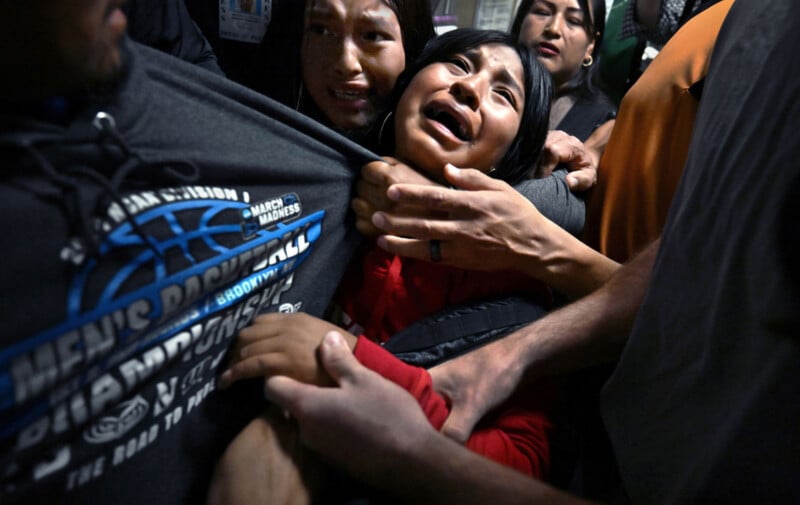
World Press Photo announced the winners of its annual competition earlier this month, highlighting powerful and poignant photojournalism from around the world. Today, World Press Photo unveiled its Photo of the Year for 2026.
World Press Photo of the Year 2026
Photographer Carol Guzy’s impactful shot, seen above, “Separated by ICE” for Miami Herald, is this year’s World Press Photo of the Year. Guzy, who has been diligently documenting ICE arrests, court proceedings, and the vast human impact of the U.S. federal government’s crackdown on immigration, acknowledges the extremely important duty that photographers have and the impact that their work can make.
“This award highlights the critical importance of the story worldwide. We bear witness to the suffering of countless families, but also to their grace and resilience that transcends adversity that has been quite humbling. The courage to open up their lives to our cameras, allowed us to tell their stories. And certainly this award belongs to them, not me,” Guzy explains.
“This image shows the inconsolable grief of children losing their father in a place built for justice. It is a stark and necessary record of family separation following the US reform policies,” says Joumana El Zein Khoury, executive director of World Press Photo. “In a democracy, the camera’s presence in that hallway serves as a witness to a policy that has turned courthouses into sites of shattered lives — it is a powerful example of why independent photojournalism matters.”
Guzy took the awarded photo after an immigration court hearing at the Jacob K. Javits Federal Building in New York City on August 26, 2025. This is one of only a few U.S. federal buildings that photographers were allowed to access. Guzy and other photographers showed up day after day to document and record what was happening.
This particular image, one of many Guzy has shot, shows Luis, an Ecuadorian migrant who his family says has no criminal record and served as the family’s sole provider, being pulled away while his wife, Cocha, and their three children, aged seven, 13, and 15, were left reeling and facing significant uncertainty.
For her win, Guzy has earned an additional 10,000 euro cash prize, and a choice between a Fujifilm GFX100 II and two Fujinon GF lenses or a Fujifilm GFX100RF plus a Fujinon GF lens.
Finalists
Alongside Guzy’s win for World Press Photo of the Year 2026, the competition also named two finalists, photographers Saber Nuraldin and Victor J. Blue.
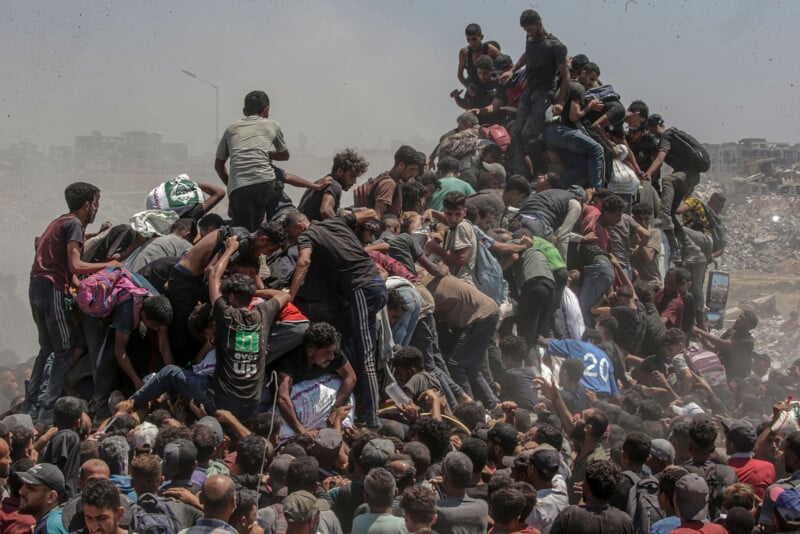
Saber Nuraldin’s honored photo, “Aid Emergency in Gaza,” shows Palestinians climbing onto an aid truck as it entered the Gaza Strip on July 27, 2025.
“In 2025, famine took hold amid what an independent United Nations Human Rights Commission inquiry has concluded is a genocide in Gaza, which Israel disputes. Israeli authorities imposed a complete aid blockade in March, a tactic described by humanitarian organizations as the weaponization of starvation. The UN reports that between late May and early October, at least 2,435 Palestinians seeking food were killed at or near aid distribution sites. Despite a ceasefire agreement in October, more than 75% of the population still face hunger and malnutrition,” World Press Photo reports.
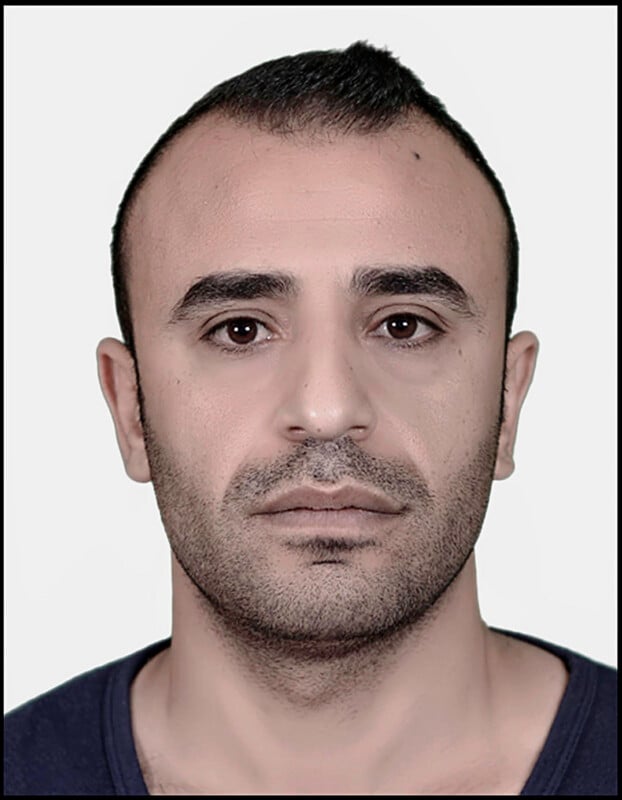
Nuraldin is a Palestinian photographer and has been working there since 1997.
Victor J. Blue’s photo, “The Trials of the Achi Women,” for The New York Times Magazine, shows Doña Paulina Ixpatá Alvarado, who was held captive and assaulted for 25 days in 1983. Blue took this photo outside a Guatemalan court in May 2025, when three former civil defense patrollers were sentenced to 40 years in prison for rape and additional crimes against humanity.
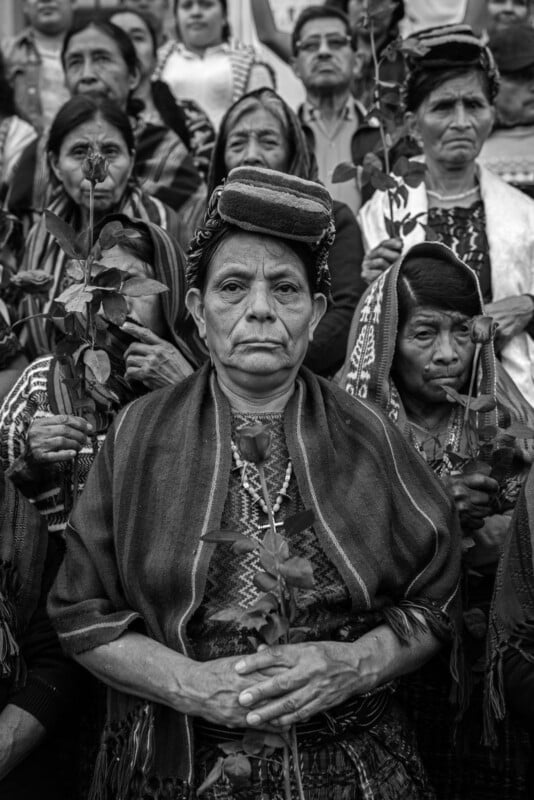
Alvarado and other Indigenous Maya Achi women in Rabinal, Guatemala, lived for decades in the same communities with the men who had assaulted and imprisoned them during the Guatemalan civil war. During the war, thousands of Maya Achi people were brutally killed, assaulted, and subjected to extreme violence, often sexual.
In 2011, 36 surviving women launched a legal campaign against their abusers. The 14-year legal battle ended last year.
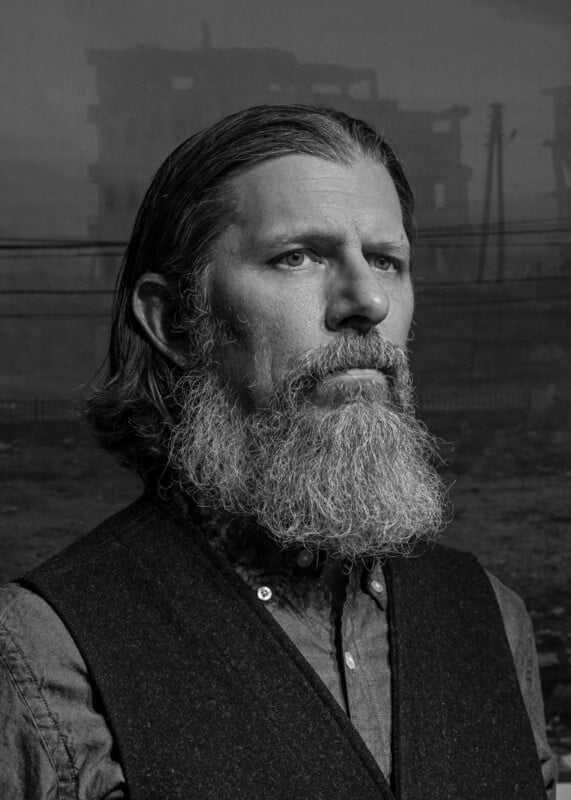
As World Press Photo comments, Victor J. Blue’s photo shows powerful resilience and emphasizes dignity and authority, rather than victimhood. It shows a moment of resounding strength and success, where so often victims are depicted as powerless.
Both Naraldin and Blue also win Fujifilm GFX100 II kits or a GFX100RF and a GF lens.
71 Years of Celebrating and Showcasing Photojournalism
The annual World Press Photo contest has elevated photojournalism and highlighted its immense power for 71 years. This year’s winners were selected from 57,376 entries submitted by 3,747 photographers from 141 different countries.
“Photojournalism has never been easy work. It has never been lucrative, or safe, or guaranteed an audience. And yet photographers go. To the courthouses and the conflict zones, to the quiet corners of the world where history is being made without witnesses. They go because they believe that seeing matters. That evidence matters,” says World Press Photo 2026 global jury chair Kira Pollack.
Image creditsWorld Press Photo. Photos by Carol Guzy, Saber Nuraldin, and Victor J. Blue