Award-Winning Photographers Describe Emotional Toll of Documenting ICE Arrests

Award-winning photographers documenting immigration arrests in New York City have witnessed far-flung strife and conflict, but nothing quite like this.
This story is being brought to you as an ad-free preview. Go fully ad-free with a PetaPixel Membership today.
Update 11/17: Since posting this story, Carol Guzy’s powerful work on ICE arrests won “Best in Show” for Domestic (U.S.) General News Picture Story in the Atlanta Photojournalism Seminar.
Four photojournalists will share their insights on November 11 at Bronx Documentary Center via “Panel Talk: New York’s ICE Raids” (ICE stands for U.S. Immigration and Customs Enforcement):
- Victor J. Blue, whose recent work regarding Guatemala and Afghanistan has been published by The New York Times
- David “Dee” Delgado, a 2023 Pulitzer Prize finalist for photos of The Bronx fire covered by The New York Times Metro Desk
- Carol Guzy, winner of four Pulitzer Prizes who covered events in Haiti, Iraq, Colombia, Kosovo, Ukraine, and more
- Madison Swart, a freelancer whose work has appeared in leading news outlets

“Some stories are greater than us,” says 4-time Pulitzer Prize winner Carol Guzy. “This is one of them.”
Documenting ICE enforcement is occurring coast to coast. On November 8, The New York Times published a lengthy report on ICE arrests in San Diego, with visuals by Mark Abramson.

“Many of those who show up to the so-call check-in sessions have been detained by masked agents,” said The Times’ article from San Diego.
The Boston Globe published a front-page story November 8 (“Father details struggle with ICE”) with photos by award-winning Erin Clark.

Mass Deportation
President Donald Trump’s administration says it has deported more than half a million people.
“This is just the beginning. President Trump and Secretary Noem have jumpstarted an agency that was hamstrung and barred from doing its job for the last four years,” said Tricia McLaughlin, assistant secretary of the Department of Homeland Security, in late October.
In New York City, an epicenter of enforcement action is 26 Federal Plaza in lower Manhattan, home of a federal immigration court. This location has been in the news because federal agents pushed and shoved journalists outside the courtroom on September 30, sending the chief videographer of the Turkish news agency Anadolu to the hospital.
The Department of Homeland Security said agents had a right to defend themselves; they were “swarmed by member of the press, which obstructed operations,” a DHS official said.
For months, photographers have documented detentions outside the courtroom at 26 Federal Plaza.

“I am blown away by the commitment of the photojournalists who have gone day after day,” says Victor J. Blue. “They show up again and again, navigate this difficult and disturbing dynamic, knowing full well the historical import of what they are are photographing.”

Key Insights From Photographers
The photographers on a panel at the Bronx Documentary Center (November 11) are prepared to explain their roles, provide context, and describe the difficulty of their task. A commonly used word is “history.”
“As a photojournalist,” says David “Dee” Delgado, “my role transcends simply taking pictures; it is fundamentally about serving as a neutral observer and meticulous recorder of history.”

“I see myself as a witness to documenting history,” says photographer Madison Swart. “Photography has a way of making people visible, especially those the system is trying to erase.”
Globetrotting photojournalist Blue says photographers rarely witness “the disappearance machine in operation.” He cites — as an exception — David Burnett’s 1973 photo of a student surrounded by armed guards as the student was led into the National Stadium in Chile.
“Our visual record contains few examples, not from Guatemala, not from Syria, not from El Salvador, not from Russia,” says Blue.
Therefore, he says, documenting ICE arrests at the New York immigration court is an “historic opportunity.”
‘This Kind of Pain Is Different’
Photographing ICE arrests is the hardest work she’s ever done, says Swart.
“You are witnessing fear, grief, and separation up close,” she says. “It is the first time I have really documented trauma to this degree, seeing it unfold right in front of me. I have covered violent arrests before, but this kind of pain is different because it is a ripple effect of multiple lives being torn apart in real time.”
It is important for photographers to address mental health and “figure out how we can bear witness without losing ourselves in the process,” says Swart.
Guzy is especially sensitive to children’s loss; her father died when she was six years old.
“The most heart-wrenching to document are family separations,” she says. “There are dramatic scenes in the hallways but sometimes it’s the quiet moments that reach most deeply into the collective conscience of a nation.”
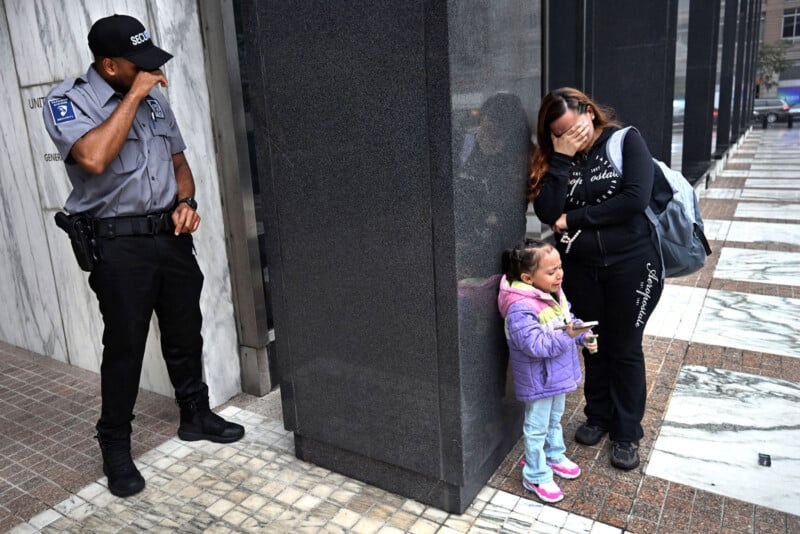
Empathy, Guzy says, is a blessing and a curse.
“[Empathy] allows us to create images that resonate with viewers on a deeply personal level, but our own hearts break harder,” says Guzy. “Now more than ever the media is a crucial link to cover effects of policies on real people at this pivotal time in America. It can be soul crushing at times to bear witness to any emotionally charged story, but vital.”
Delgado concurs: “Empathy is a blessing because it facilitates profound human connection and understanding, yet it becomes a curse when the absorption of others’ distress leads to emotional exhaustion or personal distress. This is a crux many of us carry.”
Affiliate Disclosure PetaPixel articles may include affiliate links; we may earn a commission if you buy through one.