OM System Announced an Infrared OM-1 Mark II, but Only in Japan
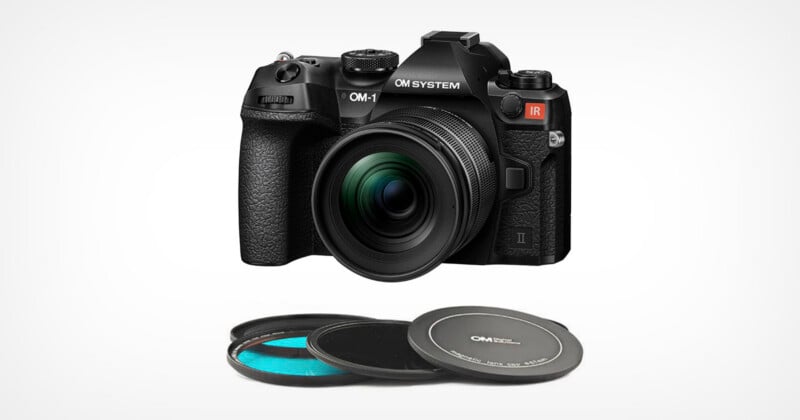
OM Digital Solutions (OMDS) officially announced the OM System OM-1 Mark II IR in Japan, a new infrared version of the OM-1 II released in early 2024. The new camera is designed primarily for industrial and scientific applications.
It’s not especially unusual for camera manufacturers to release versions of certain camera models for highly specialized applications. For example, last year Fujifilm began offering an infrared version of its flagship GFX100 II medium-format camera. However, users had to sign an agreement to buy one that outlined how they would use the camera. OM Digital Solutions is doing something similar with its new infrared camera, requiring customers to sign a purchase confirmation form.
Presumably, part of this is to ensure that customers fully understand the camera they are buying, how to use it, and what it is designed for. Infrared cameras are not suitable for general-purpose photography. As OMDS says in a footnote, it “does not guarantee image quality performance equivalent to our general products in normal photography.”
This is also not OM System’s first foray into infrared photography, though it is the first time the company has released an OM System-branded model for it. Back in the Olympus days, the company released the OM-D E-M1 Mark III IR and the OM-D E-M1X_IR. Like with the E-M1X IR, the new OM-1 II IR ships with the 12-45mm f/4 Pro lens.

On OMDS’ Japanese website, the company describes the OM-1 II IR as a “cost-effective camera system for non-destructive testing and research using near-infrared light.”
Although the OM-1 II IR is not explicitly designed for general-purpose photography and may not match the performance of a standard OM-1 II in these situations, OMDS is still making it easy to switch between visible-light and infrared photography. The OM-1 II IR works with detachable magnetic filters, allowing specific ranges of light to pass through the lens to reach the filter. The company notes this makes it straightforward to capture comparative shots of something in visible and infrared light.
As for what the company expects customers to do with the OM-1 II IR, OM Digital Solutions outlines several potential use cases. In industrial manufacturing, an infrared camera can be useful for visual inspection and quality assurance, especially when inspecting wafers, acrylic, glass, and mirrored parts. Infrared photography can also be used to assess food health and safety, per OMDS.
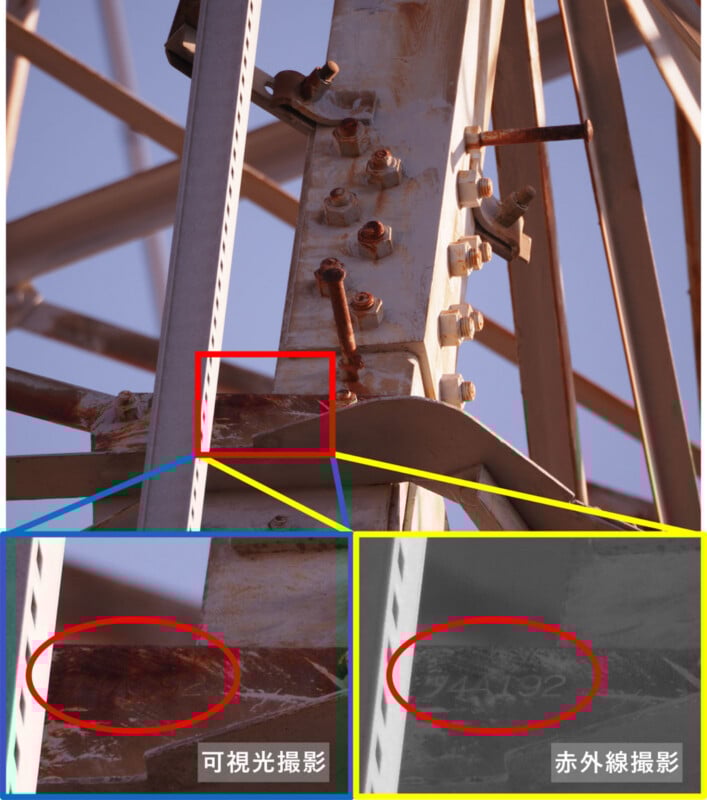
As other companies have said when discussing their infrared cameras, a camera like the OM-1 II IR can also be useful for forensic investigations, including verifying the authenticity of an item or examining evidence. Infrared and near-infrared observations are also useful for cultural heritage and research, including the detection of ink on old artifacts and the analysis of brushstrokes in paintings. The OM-1 II IR’s 80-megapixel image stacking mode may prove particularly useful in these instances.
Aside from the red “IR” badge on the front of the camera and the removal of the IR-cut filter in front of the OM-1 II IR’s 20-megapixel stacked image sensor, it is essentially identical to the standard OM-1 II in terms of specifications and features.
It will very likely cost more than the standard OM-1 II, though, given that it is a specialized product. OM Digital Solutions did not announce a specific price, but noted that the OM-1 II IR is generally a more affordable solution than conventional infrared cameras.
For photographers aiming to do artistic infrared photography, rather than perform industrial inspections or food safety checks, special infrared conversions through a company like Kolari Vision are often a better option. Kolari already sells an OM-1 II with full spectrum conversion for $2,799, an $800 premium over the OM-1 II’s current street price, although only a $400 premium over its list price. Kolari also offers full-spectrum, infrared, and astrophotography conversions for cameras photographers already have, starting at $299.
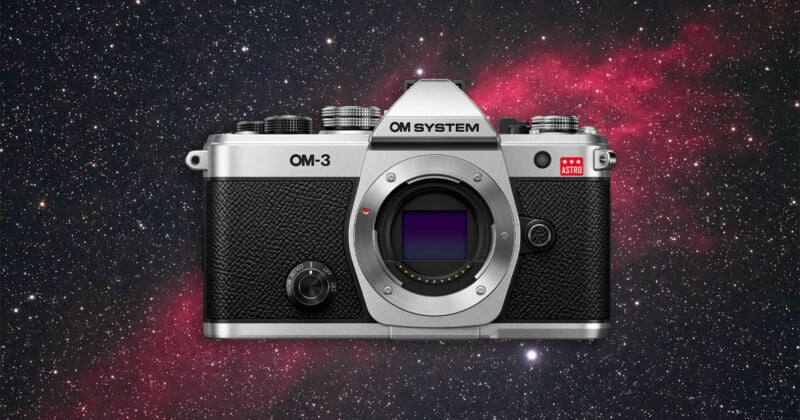
Speaking of astrophotography, it has been a busy start to the year for OM Digital Solutions and niche OM System cameras. Just two months ago, OM System unveiled the OM-3 Astro, a dedicated version of the OM-3 built for astrophotographers. And no, photographers don’t need to sign any special forms to buy the OM-3 Astro; it is available to all.
Image credits: OM System