Zeiss’ Nine New Vintage-Inspired Aatma T1.5 Lenses Look Exceptional

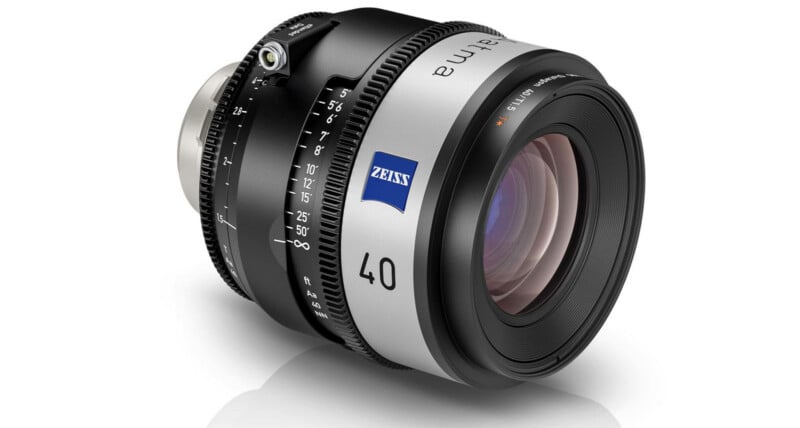
Zeiss has announced the Aatma T1.5 full-frame cinema lens series, featuring nine lenses. Focal lengths ranging from 18mm to 135mm, and each lens features a fast T1.5 aperture. Zeiss’ new professional cine lenses promise to combine modern technology with 20th century-inspired rendering.
Specifically, Zeiss says its new Aatma cine primes deliver rich bokeh, a subtle soap-bubble effect, and soft textures. Zeiss says its Aatma lenses, thanks to their lower contrast and subtle softness, render skin particularly beautifully. As for the bokeh, not only is there a subtle soap-bubble effect that gives the Aatma lenses their vintage look, but there is also a cat’s-eye effect toward the edges, which is often quite pleasing.
“Aatmas take inspiration from vintage Zeiss Contax lenses, but we made the character and characteristics that we liked more intense. Vintage Contax lenses were not specifically designed for the look that happens to be liked by Cinematographers today. Therefore, on this Aatma project, we had the opportunity to create a new optical design, learning from the vintage lenses, but fine-tuning the look to be more unique and more intense,” says Zeiss Optical Designer Xiang Lu.

Jeanfre Fachon, Senior Product Manager Cinema at Zeiss, says that the new Aatma lenses were built based on feedback from professional cinematographers.
“The consensus was to have slightly lower contrast and smoother skin tones,” Fachon explains. “The bokeh has a touch of swirliness — not too much for out of focus areas in front of your subject — but you can still see it. Bokeh behind your subject is busier and highlights like soap bubbles, as you may remember with the Contax Zeiss 50mm f/1.4.”

The company also promises smooth, pleasing focus falloff. Focus pulls are a very common tool for cinematographers, and Zeiss promises that these look “very elegant” with the Aatma lenses.
“Objects come into and go out of focus in a smooth and unique rather than a surprising or abrupt way,” Zeiss explains.

The name “Aatma” comes from a Sanskrit word meaning “innermost essence,” “self,” or “soul.” Coincidentally, not even a month ago, Thypoch announced a new lens, the Ksana 21mm f/3.5, inspired by 1970s cinema glass. That lens’s name is also derived from Sanskrit, where “Kṣaṇa” means something like “instant” or “now.”
As for Zeiss’ choice of Aatma, the company boasts that each lens is designed to “resonate with the cinematographer’s creative vision” and evoke a sense of nostalgia while delivering the technical excellence and precision demanded in modern filmmaking.
“The Aatma lenses, of which I had four focal lengths for ‘Welcoming Grace’, are rendering skin tones beautifully with more softness. And I loved the way the focus falls off. This gives them a more distinctive character than I’m used to from other modern Zeiss lenses while remaining truly reliable with their known ergonomics,” says cinematographer Pascale Martin, AFC.
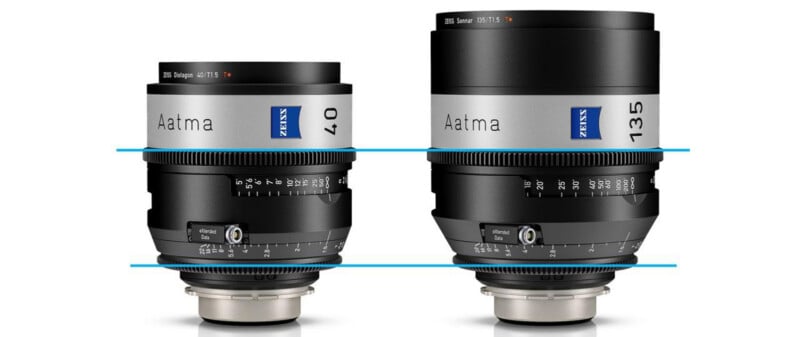
To support modern cinema workflows, the Zeiss Aatma series features consistent focus and iris ring positions across the entire lineup. Seven of the lenses have unified 95mm front diameters (25, 35, 40, 50, 65, 85, 100), while the 18mm and 135mm primes have larger 114mm front diameters.
The seven smaller lenses are all fairly lightweight, ranging from 2.7 to 3.7 pounds (1.22 to 1.70 kilograms). They are all between 4.7 and 4.8 inches (119 and 121 millimeters) long. The 18mm and 135mm lenses are, as expected, bulkier. They each weigh five pounds (nearly 2.3 kilograms) and are 5.7 and 6.4 inches (146 and 163 millimeters) long.
Pricing and Availability
The new Zeiss Aatma cinema primes are very much priced for the professional market. The seven smaller primes, ranging from 25mm to 100mm, are $20,950 each, while the Zeiss Aatma 18mm T1.5 and 135mm T1.5 cine lenses are $25,500 each. The lenses come standard in an Arri PL mount.
Image credits: Zeiss Aatma