The Rolling Stones’ Historic IMAX Concert Returns to Theaters
This week marks the release of Rolling Stones: At The Max in theaters, a remastered version of the first-ever feature-length IMAX concert movie.
Shot across three venues in 1990 — Wembley Stadium in London, East Berlin in Germany, and Turin in Italy — the film pushed the boundaries of what was possible on IMAX cameras.
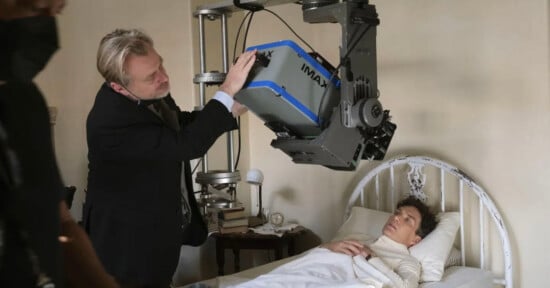
The crew used eight IMAX film cameras but could only capture three minutes of footage before the magazines needed switching, so the first long load film magazines were developed to make it easier for the crew to capture an entire song.
But even with the extended magazines, in post-production the editors required some of the 3/4″ videocassette format that was feeding images to the jumbotron inside the concert. The fidelity of that footage had to be improved so it could be mixed in with the IMAX 70mm without anyone noticing. There are six minutes of the 3/4″ footage in the final cut.
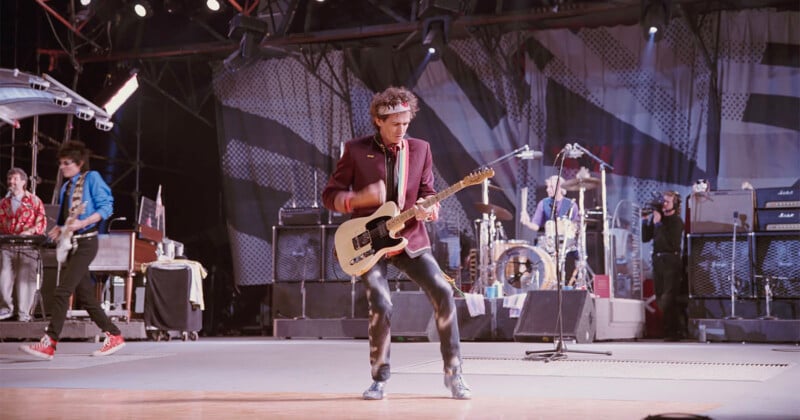
Unfortunately the new version of Rolling Stones: At The Max is not getting a print release and so the aspect ratio is 1.90:1, not the famous IMAX 1.43:1. On the flip side, that means the film can be released in more theaters.
The footage from the film looks incredible, even when watching on YouTube. IGN has an exclusive clip of the Stones performing ‘Honky Tonk Women’, which is well worth a watch.

IMAX cameras are famous for being loud. Forbes spoke to IMAX cinematographer James Neihouse, who shot the Rolling Stones concerts.
“The music overpowered any camera noise that was there,” Neihouse tells Forbes. “There was just no way, at the dB level coming out of those speakers, that you could manage to hear a camera running.”
Despite the format’s comeback in recent years, largely driven by director Christopher Nolan, Rolling Stones: At The Max had mixed reviews when it was released.
“As it started to play, the first thing that happened was I heard shocks and gasps of anxious intakes of air,” Neihouse tells Forbes. “And actually, Ronnie Wood howled out and ran out of the screening. He couldn’t take what they were seeing in terms of the close-up!”
The film had limited success in 1991 because IMAX didn’t allow a standard 35mm print release; therefore theatrical showings were in short supply.