8 Micro Four Thirds Myths, Exposed by Four Full-Frame Converts
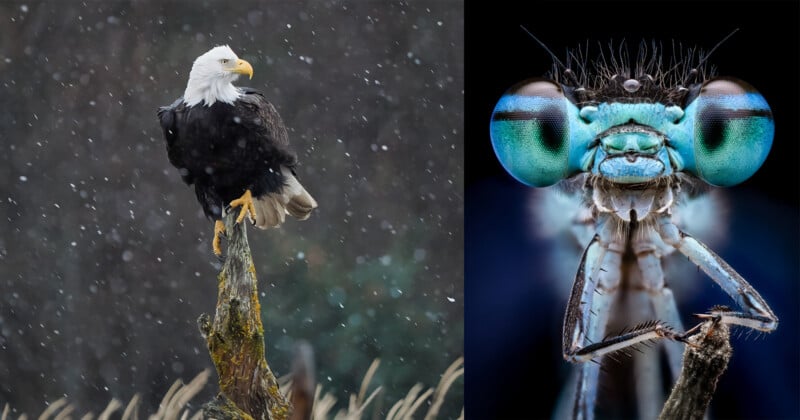
Photography often feels like a battle against physics, where image quality supposedly demands heavy glass and aching backs. However, four accomplished OM SYSTEM Ambassadors challenge assumptions that Micro Four Thirds cameras cannot compete with full-frame alternatives. Macro specialist Ben Salb, wildlife veteran Eric Rock, bird and nature photography duo Lisa and Tom Cuchara, and landscape artist Matt Suess each abandoned full-frame systems for a smaller alternative. They reveal how shedding weight unlocked creativity they never knew they were missing.
Full disclosureThis article was brought to you by OM SYSTEM
The OM SYSTEM Holiday Specials are live now! Save up to $400 on practically every camera and lens that OM SYSTEM makes, including the OM-1 Mark II, the OM-3, the M.Zuiko Digital ED 12-40mm F2.8 PRO II, and the M.Zuiko Digital ED 90mm F3.5 Macro IS PRO. Check out OM SYSTEMS Holiday Specials and take your photography to the next level.
At a Glance
Ben Salb experienced the skepticism many photographers feel toward smaller sensors. A self-described “pixel peeper,” he came from a 45-megapixel Nikon Z7 system. He was convinced that resolution was the only metric that mattered.
“I was completely stuck on this idea that megapixels equaled quality,” Salb admits. “Then I noticed something. Many of the macro photographers I admired seemed to be using Micro Four Thirds cameras.”
Driven by that contradiction, Salb designed a test he expected to fail. He purchased a used OM-D E-M1 Mark II with the M.Zuiko Digital ED 60mm F2.8 Macro OM lens. He intended to prove its limitations against his full-frame setup.
“I fully expected to prove to myself that the Micro Four Thirds sensor wasn’t good enough,” Salb acknowledges. “Instead, I sold all my full-frame macro gear within a month.”
The panic he anticipated never arrived.

“I expected a moment of dread when I opened that first 20-megapixel file, certain I had lost critical data,” Salb explains. “But the detail and the sharpness were there.”
For Salb, the fear of missing out on resolution was replaced by results on his screen. He is one of four OM SYSTEM Ambassadors who challenge eight persistent myths about Micro Four Thirds. They prove that the “smaller” system often delivers the biggest results.
1. The Resolution Myth
For photographers conditioned to believe more is always better, dropping from 45 megapixels to 20 sounds like a downgrade. In the unforgiving world of macro photography, however, the battle is rarely against resolution.
“It is against physics,” Salb counters. “At extreme magnifications, depth of field collapses to fractions of a millimeter. Massive sensors become counterproductive if only a sliver of the subject falls sharp.”
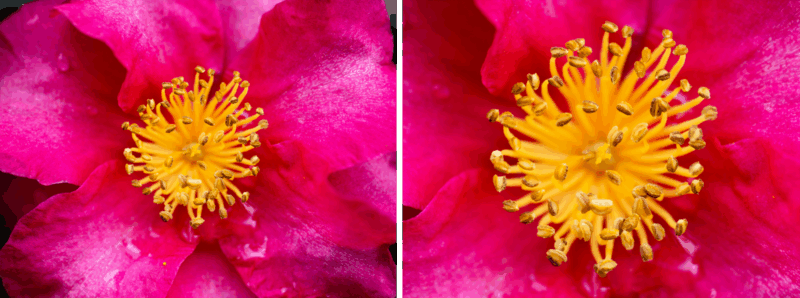
“If megapixels were the only metric for detail, every macro photographer would be hauling a medium format system into the field,” Salb continues. “But they’re not, because there’s so much more to image quality than sensor size. Lens magnification, optical sharpness, and capabilities like focus bracketing let you capture details that megapixel count alone could never achieve.”
For Salb, the Micro Four Thirds sensor acts less like a constraint and more like a physics loophole.
“Its crop factor provides deeper depth of field at equivalent apertures, while computational speed automates techniques that used to require additional hardware.”
At extreme magnifications, photographers historically needed bulky rail systems to capture multiple focus planes. The M.Zuiko Digital ED 90mm F3.5 Macro IS PRO changed Salb’s workflow. It delivers native 2x magnification (35mm equivalent of 4x) with full autofocus that enables his OM-1’s focus bracketing to fire hundreds of frames in just a few seconds.

“Wolf spiders sit in the grass and constantly make micro-movements,” Salb notes. “Using focus bracketing, I photograph just the face, from the fangs to the back of the head. It is maybe two millimeters total. The camera slices that into 200 frames, moving microns at a time. It captures the sharpest part of each slice and builds something no single exposure could ever produce. If you tried to get similar results on a full-frame setup without focus bracketing, you would likely need a rail system and a static, deceased subject.
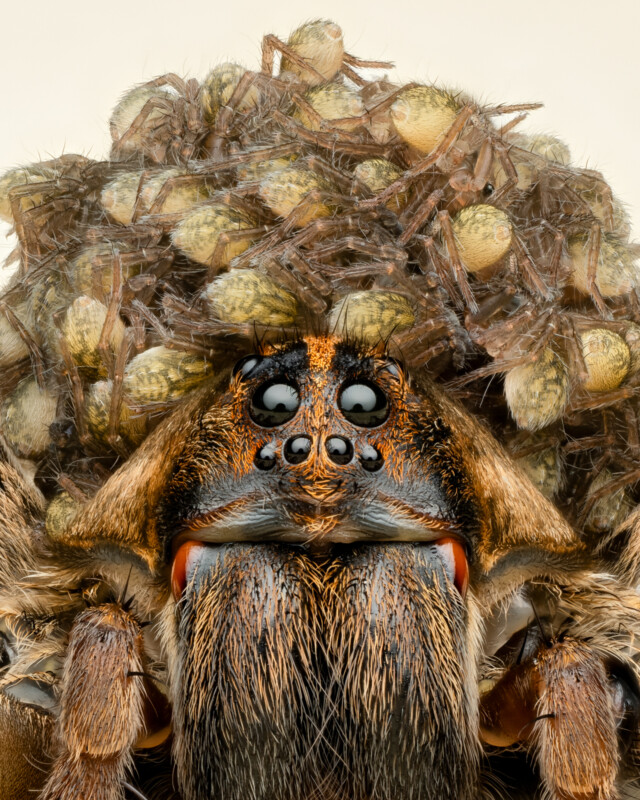
Salb emphasizes that this isn’t exclusive to flagship bodies. He achieves similarly intricate detail with the OM-5 Mark II and the M.Zuiko Digital ED 60mm F2.8 Macro OM lens.
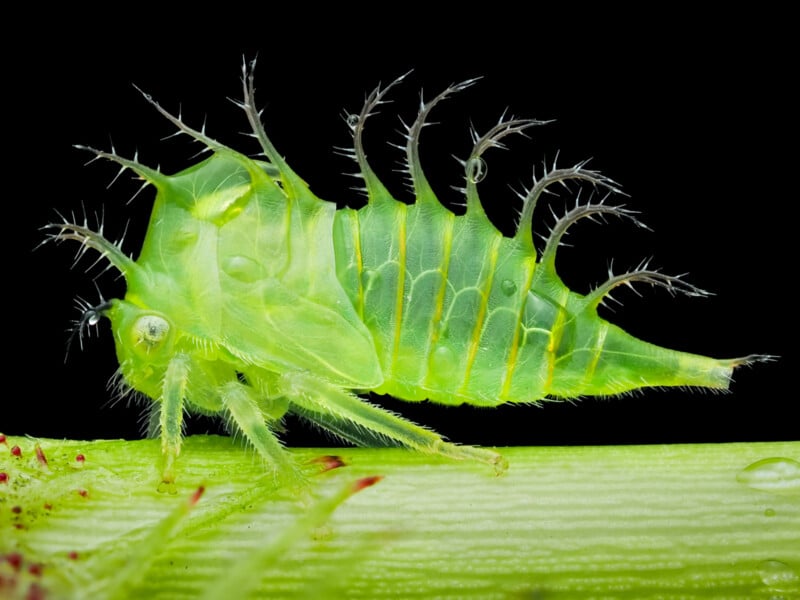
Salb clarifies that the versatility extends across the lens lineup.
“Just this weekend, I was in my yard using the M.Zuiko Digital ED 50-200mm F2.8 IS PRO with the M.Zuiko Digital 2x Teleconverter MC-20. I was photographing mushroom textures at macro distances. Then I noticed a Cooper’s hawk. I quickly captured a photo of it without changing lenses or reaching full extension on either shot.”

Right: Cooper’s Hawk • OM-1 Mark II • M.Zuiko Digital ED 50-200mm F2.8 IS PRO • MC-20 • 342mm • 1/160sec • f/5.6 • ISO 200 • Single Shot
“The 50-200mm isn’t a macro lens, but the system makes it capable of that kind of work,” he observes. “It is an extremely versatile, extremely portable system.”
2. The Lens Quality Myth
A persistent bias suggests that physically smaller lenses must rely on compromised optical formulas. Without the massive glass elements of full-frame equivalents, some photographers expect corner softness, chromatic aberration, and resolving power that crumbles under scrutiny. Macro work should expose these weaknesses immediately.
Salb expected exactly that. He found the opposite.
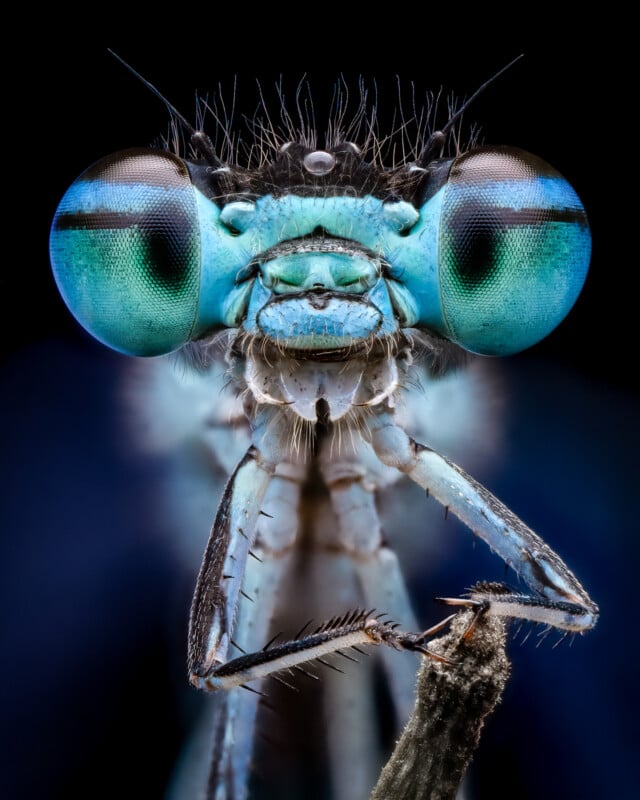
“The M.Zuiko Digital ED 90mm F3.5 Macro IS PRO isn’t just ‘good for a small sensor,'” he insists. “It is one of the sharpest optics I have ever used on any system. When it came out, it was the only 2x (4x 35mm equivalent) magnification lens with autofocus. That autofocus means it is capable of creating incredibly detailed focus stacking and focus bracketing shots. I’m capturing textures and fine details at 2x magnification (4x 35mm equivalent) that I don’t recall seeing with my full frame kit.”

Salb explains that the optical design takes full advantage of the Micro Four Thirds sensor.
“Because MFT lenses are designed so that light hitting the edges of the image circle reaches the sensor as close to perpendicular as possible, they avoid the edge compromises you often encounter with full-frame glass,” he says. “For macro photographers like me who stop down to maximize depth of field, aperture performance becomes critical.”
“I don’t know what the 90mm Macro lens looks like on an MTF chart, and honestly I don’t really care with the real-world results I’m getting,” Salb states. “The level of detail it reproduces, even when I’m pushing up to f/8, f/11, or even higher, is incredible. The diffraction is hardly noticeable. It produces gorgeous, sharp images no matter how close you get.”
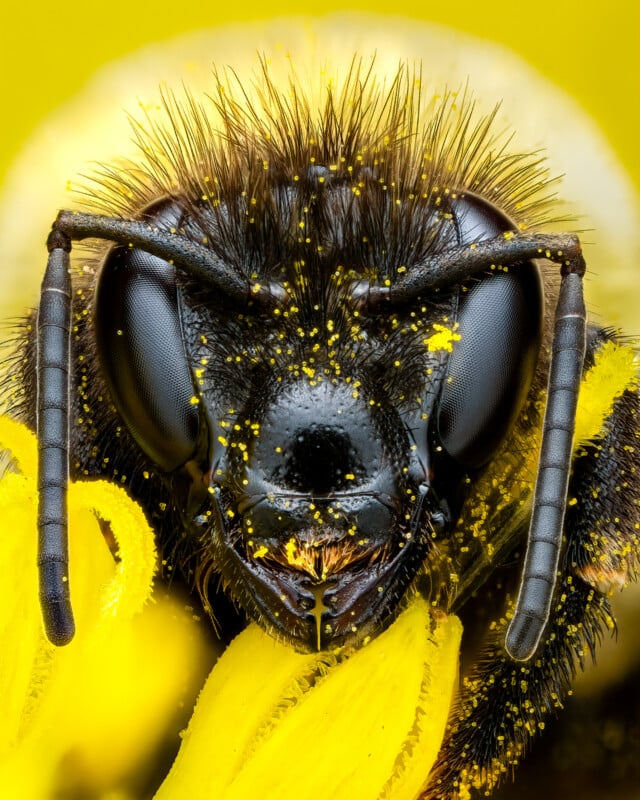
The system also delivers a magnification advantage that changes what is achievable without accessories.
“With Micro Four Thirds, you get the 2x crop factor. A 90mm lens is actually 180mm at 35mm equivalent, so the 90mm’s 2x magnification effectively becomes 4x,” Salb details. “You are getting incredibly close without any attachments. No extension tubes, no close-up filters, no teleconverters. It’s closeness without compromise.
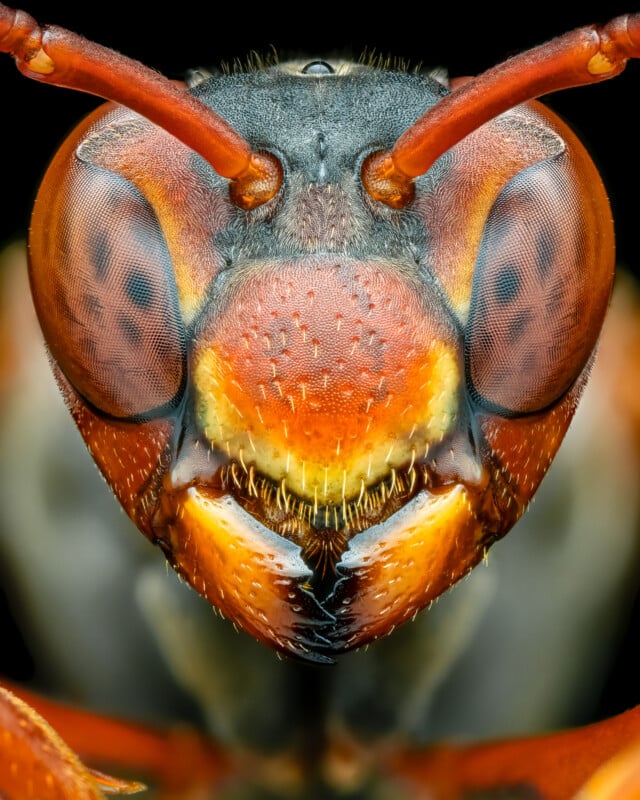
The lens reshaped what the macro community considers possible.
“Because it is a Micro Four Thirds lens, it gets dismissed by some full-frame photographers,” Salb notes. “But it changed macro photography for the better. When it came out, the quality of images being produced in the community jumped noticeably just from that one lens.”
3. The Professional Conditions Myth
The word “professional” once implied bulk. Serious wildlife photographers carried serious weight. 500mm f/4 lenses, battery grips, and carbon fiber tripods became incredibly heavy when combined. Eric Rock, whose 30-year career has taken him across the globe, spent decades in that world.
“I used to haul a 500mm f/4 and a full-frame body around Africa for a month,” Rock recalls. “I would come home physically exhausted. I wanted to hide the gear in a closet because I dreaded carrying it again. I looked at that shelf of heavy glass and asked myself why I was holding onto it if I wasn’t shooting it.”

The realization reshaped his definition of professional capability.
“If the gear hurts my back or requires a dedicated Sherpa to help me carry it, why would I take it with me?” he questions. “The best camera is the one you actually have in your hand when the moment happens. It is not the one sitting in the hotel room because it was too heavy to carry on a short excursion.”
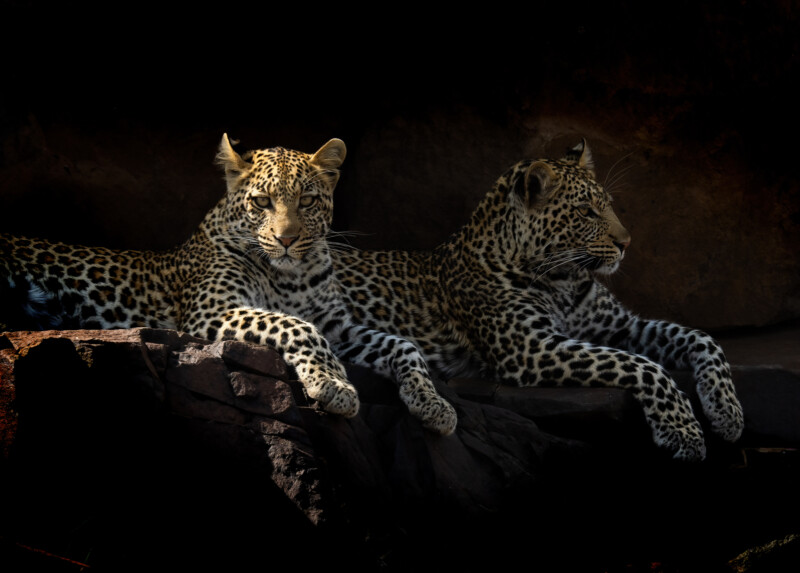
Rock discovered something counterintuitive. Lighter gear produces more images not because it performs better technically, but because it gets used.
“The most important part of photography is accessibility,” he emphasizes. “If you have to dig your gear out of a backpack because you are worried about the rain or the weight, you have already missed the moment.”

Rock emphasizes that accessibility extends beyond convenience. During the Kumbh Mela in India, a Hindu pilgrimage where holy men gather at the Ganges River, Rock discovered that gear size fundamentally altered his relationship with subjects.

Right: Olympus OM-D E-M1 Mark II • M.Zuiko Digital ED 40-150mm F2.8 PRO OM • 142mm (284mm equivalent) • 1/200sec • f/4 • ISO 200
“If I pull out a massive DSLR with a battery grip, the dynamic changes immediately,” Rock explains. “That hefty, full-frame gear made me become an observer rather than a participant. On the other hand, the compact size of a small Micro Four Thirds camera allowed me to slip into small huts and sit with Sadhu holy men without the camera creating a barrier. It removed the intimidation factor and allowed for a purity of experience that translated directly into the images.”

Middle: Olympus OM-D E-M1 Mark II • M.Zuiko Digital ED 40-150mm F2.8 PRO OM • 150mm (300mm equivalent) • 1/60sec • f/2.8 • ISO 400
Right: Olympus OM-D E-M1 Mark II • M.Zuiko Digital ED 40-150mm F2.8 PRO OM • 150mm (300mm equivalent) • 1/1000sec • f/2.8 • ISO 800
Between photographing the Kumbh Mela and documenting tribes in India’s western desert, Rock realized that professional capability isn’t defined by the imposing presence of equipment. The best professional gear disappears into the work.

“I left that trip telling everybody that it was a life-changing experience for me,” he recalls. “Being that involved in a cultural moment and having the ability to photograph it without the gear getting in the way is what a Micro Four Thirds system enables.”
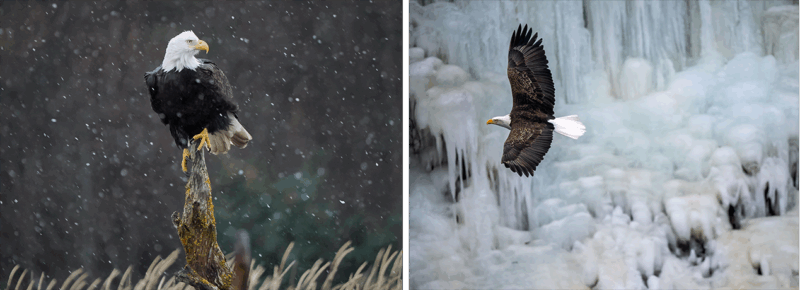
Right: OM-1 Mark II • M.Zuiko 150-400mm F4.5 TC 1.25x IS PRO • 400mm (800mm equivalent) • 1/2000sec • f/4.5 • ISO 2500
The OM-1 Mark II‘s IP53 weather sealing extends that accessibility into conditions that would sideline other equipment. Rock no longer treats weather as a reason to stop.
“With the OM SYSTEM weather sealing, I don’t pack up when conditions get tough,” he adds. “I keep shooting because I trust the equipment to survive what I’m standing in. That’s not a gear safety feature for me. It’s a creative one. The best light often happens when the weather is at its worst.”
Weather no longer stops Rock from shooting. Low light, however, raises a different question. Can a smaller sensor keep up when light becomes scarce?
4. The Low Light Myth
The criticism has merit. Smaller pixels gather less light than larger ones, and Micro Four Thirds sensors will produce more noise at equivalent ISO settings. Rock acknowledges this physics rather than dismissing it. However, he points out that recent sensor developments have narrowed the gap considerably. “The stacked BSI sensor in the OM-1, OM-1 Mark II, and OM-3 delivers high-ISO performance that would have been impossible in earlier Micro Four Thirds bodies,” Rock observes. But he argues the conversation ignores the other critical variable in the exposure equation: time.

“People get hung up on sensor size, but they forget the equation for which ISO you need to use also includes stabilization,” Rock describes. “Because the OM SYSTEM in-body image stabilization is so effective, I can handhold at shutter speeds that were simply impossible with my old full-frame gear. This allows me to drag the shutter speed much longer to let light in while keeping my ISO manageable. I am not limited by the light. I am liberated by the stability.”
The OM SYSTEM’s 5-axis in-body image stabilization delivers up to eight stops of compensation. This transforms what handheld shooting can accomplish. During a recent trip to Caddo Lake in Texas, Rock tested this from an unstable platform in fading light.

“I was shooting landscapes from a boat during blue hour,” he recalls. “Even with the subtle movement of the water, I was capturing sharp two-second exposures handheld. That simply isn’t possible with a heavier, non-stabilized full-frame system without setting up a tripod. By the time you do that, the light is gone.”
Rock is sure to stress, however, that stabilization cannot freeze subject motion.
“When shutter speeds must stay high to capture moving wildlife at dawn or dusk, my ISO climbs,” Rock explains.
The experienced photographer, who began his career in the film era, sets his ceiling around ISO 6400 and trusts modern processing to handle the rest.
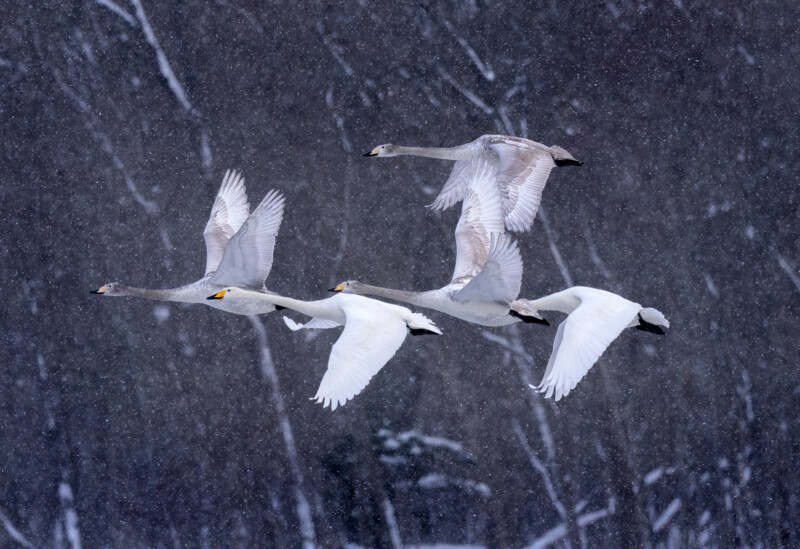
“I came from the film days where ISO over 100 was considered too risky to print on a magazine cover,” he notes. “Today, between the sensor quality and modern noise reduction software, I don’t hesitate to push the ISO when I need to. I am not missing shots at dusk because I am afraid of grain. I would rather have a grainy photo that I can easily fix than no photo at all.”
“The smaller sensor might produce more noise,” Rock concludes. “However, the stabilization system ensures that noise rarely matters.”
5. The Speed & Print Myth
In bird photography, the difference between a master shot and a missed opportunity is measured in milliseconds. A hawk lifts off before the brain registers movement. A heron strikes faster than reflexes can respond. Lisa and Tom Cuchara, a Connecticut-based duo who transitioned from Canon systems, discovered that human reaction time was the actual bottleneck.

“In the past, birds moving as quickly as they do was a major problem for photographers like us,” Tom explains. “By the time I reacted, they were gone. Now, with the agility of a Micro Four Thirds system, I capture photos of things my brain can’t even process in real time. My OM-1 Mark II captures the moments that exist between human reflexes.”
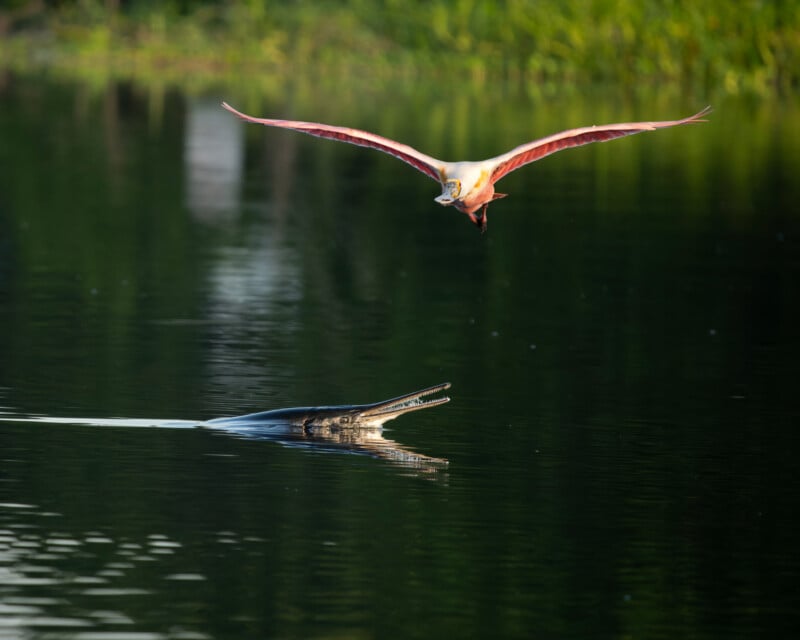
For Lisa, the solution lies in Pro Capture. This computational feature begins buffering images when the shutter is half-pressed. When the photographer fully commits, the camera records the preceding frames and effectively travels back in time to capture the action.

“I was photographing short-eared owls when a hawk landed on a post really close to us,” Lisa recalls. “I sat there for 10 minutes because I knew eventually the hawk was going to take off. Everyone else had heavy gear on tripods. I had my Pro Capture mode set and waited for the moment to start buffering frames from the immediate past into memory. When the hawk took off, nobody else got the shot. I got the whole lift-off sequence.”
The efficiency created confusion among people who followed Lisa and Tom’s work. After switching systems, friends and followers assumed the team was shooting more frequently given the increase of portfolio-worthy images they were capturing.
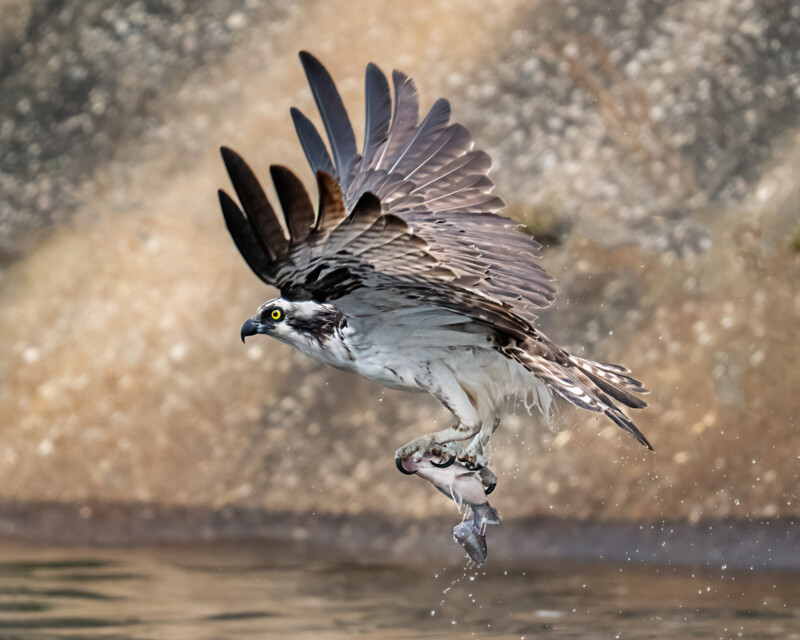
“We hadn’t been out more,” Lisa observes. “If anything, we were getting out a little less. But because Pro Capture and the lightweight system made it easier for us to go further, it gave the illusion that we were producing more.”

Lisa admits she shared the common concern about print quality before switching.
“The files hold up to easily print big and put into a gallery,” she says.

For subjects that stay still long enough, Tom pushes the resolution even further. He uses Handheld High Res Mode for stationary birds to resolve detail that silences the megapixel debate. Lisa adds that the mode also reduces noise dramatically because the multi-frame stacking averages out random grain, allowing them to photograph a Great Horned Owl at ISO 20,000 with almost no visible noise.
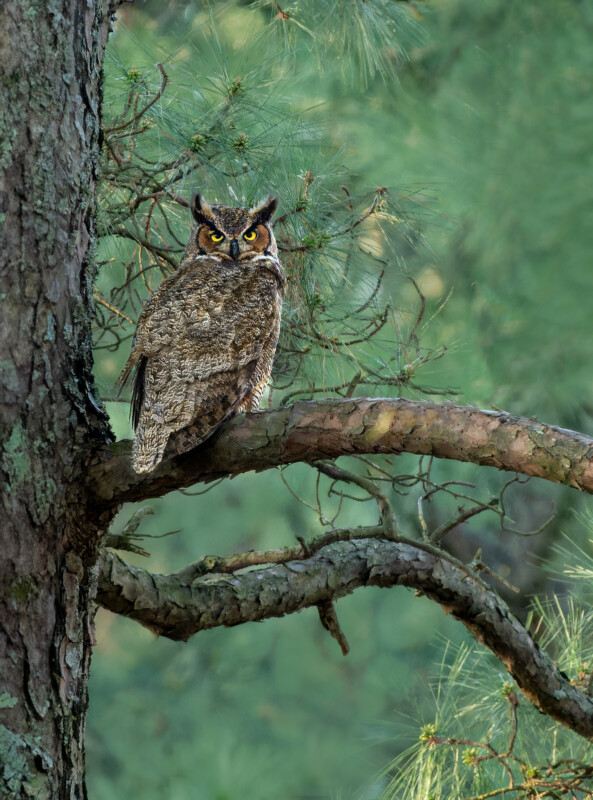
“The resulting file resolves every barb in the feathers and every detail in the iris,” Tom emphasizes. “To me, it dispels the myth that you can’t get fine detail from a smaller sensor.”
6. The Bokeh Myth
The shallow depth of field that full-frame shooters prize becomes a liability in nature photography. At f/2.8 on a large sensor, the plane of focus is often too thin to render an entire subject sharp, especially for macro subjects. Photographers face a constant trade-off: open wide and blur the flower or insect, or stop down and get a cluttered distracting background or carry fake backgrounds around, the latter then requiring either an assistant to hold the background or being on a tripod and using a remote.

Lisa Cuchara spent years fighting this physics.

Right: Black crowned night heron • OM-1 • M.Zuiko 150-400mm F4.5 TC 1.25x IS PRO • 1/2000sec • f/5.6 • ISO 64
“Shooting at f/2.8 my depth of field was so shallow that I would get the eyes sharp but nose and face or a frog would blur, or the antennae and feet of the insect would blur” she notes. “Stopping down to f/8 or f/11 meant cluttered backgrounds. With Micro Four Thirds, and especially with in-camera focus stacking, I finally have enough depth of field at wider apertures like f2.8 and f4 to render the entire frog or insect sharp without sacrificing image quality.”
The solution came through combining Micro Four Thirds depth of field characteristics with computational photography. Using lenses like the M.Zuiko Digital ED 150-400mm F4.5 TC 1.25x IS PRO, the Cucharas achieve what larger formats struggle to replicate. Telephoto compression obliterates backgrounds while the Micro Four Thirds sensor’s deeper depth of field at equivalent apertures keeps the entire subject in focus.

The control extends beyond birds. While conventional wisdom suggests insects move too much for computational photography, Lisa has learned to work with behavior.
“People have said to me, ‘you can’t focus stack insects because they move,'” she adds. “Clearly, they have never photographed with a Micro Four Thirds system. You can easily do an in-camera 15-image focus stack handheld. It just works.”
7. The Landscape Tripod Myth
For decades, the landscape photographer’s uniform has been unchangeable: heavy backpack, sturdy tripod, and stationary observation. Matt Suess, an OM SYSTEM ambassador who spent 17 years of his 35-year career shooting full-frame Canon and Sony systems, knows that ritual intimately. He also knows what it cost him creatively.
“I spent almost two decades as a full-frame snob,” Suess admits. “I was on a Sony A7R and couldn’t imagine why anyone would shoot Micro Four Thirds. However, around that time, my creativity had fallen into a rut. I was only calculating commercial viability before pressing the shutter, not shooting what inspired me.”

Suess describes his shot-in-the-dark plan to break his creative block.
“I had traded emails with OM SYSTEM before, and one day they reached out to me and offered to send me a kit to try out,” he recalls. “I tested the system in the field. The creative possibilities I found in Micro Four Thirds changed my opinion almost immediately.”

“I was at a classic Yellowstone bear jam, with hundreds of photographers jockeying for position to see bears hidden behind some trees,” Suess describes. “I watched photographers with Canon 600mm f/4 lenses anchored to heavy tripods. I walked around with my M.Zuiko Digital ED 300mm F4 IS PRO, which gives me the same 600mm equivalent field of view at less than half the weight. The difference between me and the other photographers was that I could handhold my camera to stay completely mobile.”

While others committed to single perspectives, Suess worked the scene.
“The bears weren’t posing. They were moving,” he notes. “While the other photographers were wrestling with adjusting their ball heads and leveling legs, I was getting different compositions and different backgrounds. That was the moment I realized I wanted to switch to Micro Four Thirds. I haven’t had an ounce of regret since.”

The primary argument against abandoning the tripod is that camera shake robs images of fine detail. The answer lies in Handheld High Res Mode, which captures 50-megapixel raw files from approximately 12 instantaneous exposures.

But Suess wanted to test the limits. The stabilization built into his OM SYSTEM cameras and lenses pushed him into territory he never imagined possible.
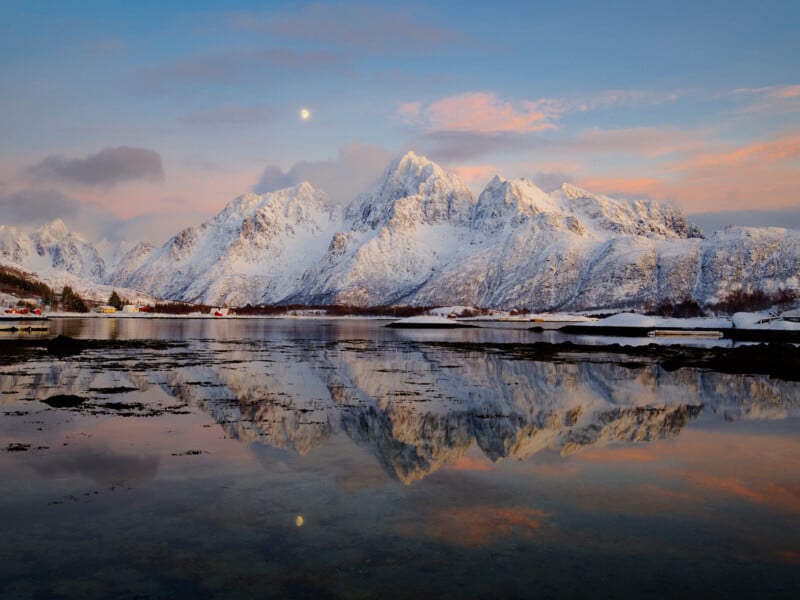
“I was in the Tetons one night last fall and held my camera up in the air just to see if I could capture a 10-second exposure of the Milky Way, completely handheld,” he recalls. “You’re told you can’t do that. But I looked at my LCD and there it was. A tack sharp ten-second handheld photo of the Milky Way. No way could I have done that on my old full-frame systems.”

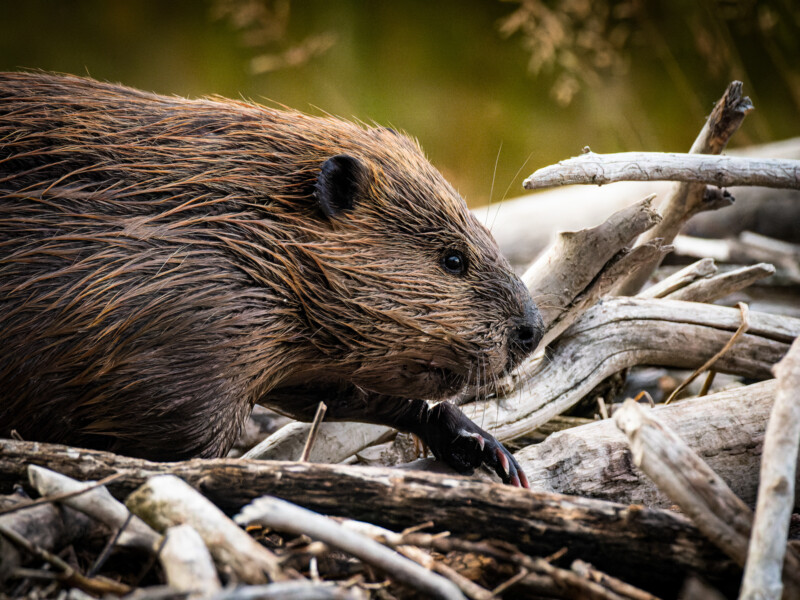
Modern internal processing extends what the camera captures. On another morning in the Tetons before sunrise, Suess photographed a beaver in near-darkness.
“I looked at my settings before I took the photo and noticed I had to increase the ISO to 20,000,” he recalls. “I thought it was going to be garbage, but I ran it through noise reduction. The final image looked like it was shot at 400 ISO. It just goes to show that the quality of RAW files matters. It might not look great on your LCD screen, but the creative possibilities with high-quality RAW files are endless.”
Suess ties together the importance of his Micro Four Thirds camera and his advanced editing skills.
“I have two 40×60-inch prints hanging in my home right now,” Suess observes. “One is from a standard 20-megapixel file. One is from Handheld High Res Mode at 50 megapixels. Both look flawless. The idea that you can’t print large from Micro Four Thirds is a myth that is debunked the moment you see the physical artwork.”
8. The Computational Gimmick Myth
Landscape purists often dismiss computational photography as a crutch for amateurs who never learned proper technique. Glass filters represent tradition, craftsmanship, and a tactile connection to the image. Digital simulation, the argument goes, is cheating.
Suess held similar views until a workshop student demonstrated the future of long-exposure photography.
“I was teaching a Milky Way workshop and explaining the tedious traditional method of capturing a star trails photo,” he describes. “Set up your intervalometer, take a one-minute exposure every minute or two for an hour, then stack 60 frames in software later. One of my students wasn’t following my instructions at all. I asked him why, and he said, ‘I have an Olympus camera with Live Composite. Watch my screen.’ I watched the star trails building on his LCD in real time. No stacking. No computer work. That was the moment I realized that I wasn’t using all of the tools available to me.”

Live Composite builds long exposures progressively and displays results as they develop. Live ND simulates neutral density filtration without physical glass. Live GND handles graduated exposures computationally. In volatile weather, these features offer advantages physical glass cannot match.

“Stormy weather yields fabulous photos. I love photographing in rain and snow and wind,” Suess explains. “But shooting landscapes in a storm usually means frantically wiping rain off a glass GND filter every few seconds. With Live GND, that physical glass is gone. I can keep my lens hood on while the camera handles the graduated exposure computationally. My gear stays weather-sealed, and I stay focused on the image instead of maintenance.”

Even focusing has been transformed. Starry Sky AF locks onto stars automatically in approximately 10 seconds, replacing the trial-and-error manual adjustments that once defined night photography.
“It removed the technical anxiety from astrophotography and let me focus entirely on composition,” Suess adds. “You don’t have to worry about blurry stars anymore.”
“These features are not gimmicks. They are workflow shifts disguised as menu options,” Suess concludes.

These OM SYSTEM Ambassadors agree: the sensor size debate misses the point entirely.
Ben Salb captures macro detail that physics would deny to larger formats. Eric Rock keeps shooting when others pack up, trusting weather sealing and stabilization over spec sheet comparisons. Lisa and Tom Cuchara freeze moments that exist between human reflexes, then print them at gallery scale. Matt Suess works compositions that tripod-bound photographers cannot reach, previewing long exposures in real time while purists guess through dark glass.
“The real fear of missing out was never about megapixels,” Rock observes. “It was about the images never captured because gear was too heavy, too slow, or packed away. We look at cameras in terms of sensor size, but that misses the point. When you add it all up, the smaller sensor isn’t a compromise. It’s the foundation for a system that lets you shoot more and carry less.”
For Suess, the transformation went deeper than workflow.
“Photography was fun again,” he admits. “I stopped calculating whether a scene was worth photographing and just started creating again.”
“The photographers who dismiss Micro Four Thirds based on sensor size alone are missing what actually matters,” Salb concludes. “I am not fighting the equipment. I am just creating what inspires me. That is why we all got into photography in the first place.”
See more from Ben Salb on his website and Instagram.
See more from Eric Rock on his website and Instagram.
See more from Lisa & Tom Cuchara on their website.
See more from Matt Suess can be found on his website, Facebook, YouTube, and Instagram.
Full disclosureThis article was brought to you by OM SYSTEM
The OM SYSTEM Holiday Specials are live now! Save up to $400 on practically every camera and lens that OM SYSTEM makes, including the OM-1 Mark II, the OM-3, the M.Zuiko Digital ED 12-40mm F2.8 PRO II, and the M.Zuiko Digital ED 90mm F3.5 Macro IS PRO. Check out OM SYSTEMS Holiday Specials and take your photography to the next level.
Affiliate Disclosure PetaPixel articles may include affiliate links; we may earn a commission if you buy through one.