Students Picked a Dramatic Nebula as the Gemini North Telescope’s 25th Birthday Photo Subject

Students in Hawaiʻi have played a central role in celebrating the 25th anniversary of the International Gemini Observatory, selecting the target for a new Gemini North telescope image and giving the final result a name that reflects the islands’ deep cultural and scientific heritage.
Earlier this summer, four Hawaiʻi Island high school students participating in the first Project Hōkūlani internship were invited to choose an astronomical object for a special 25th anniversary image to celebrate the completion of the International Gemini Observatory. After weeks of research, discussion, and hands-on learning, the team selected NGC 6820, a dramatic emission nebula accompanied by the young open star cluster NGC 6823. Located about 6,000 light-years away in the constellation Vulpecula, the nebula sits in the region known in Hawaiʻi as Mānaiakalani, traditionally associated with exploration and navigation.

The students also chose a name for the final image: Ua ʻŌhiʻa Lani, meaning “Heavenly ʻŌhiʻa Rains.” Their choice draws from the moʻolelo or traditional Hawaiian tale of ʻŌhiʻa and Lehua, a story that speaks to themes of love, loss, transformation, and the enduring connection between earth and sky. For the students, the parallels between the tale and the life cycle of stars, creation, destruction, and renewal, made the name a natural fit for the glowing clouds and young stellar populations seen in the image.

“This image is crimson and red like lava because of the abundance of hydrogen gas present in the nebula. One of Pele’s most well-known stories is that of ʻŌhiʻa and Lehua. Their story is about regrowth after tragedy and the act of new beginnings, which we felt was evocative of the cycle of stellar life, death, and rebirth,” Gemini intern Hope Arthur explains.

Building a Legacy
Using the powerful capabilities of the Gemini North telescope on Maunakea, astronomers captured vivid details of the nebula’s structure: deep red hydrogen gas shaped by powerful ultraviolet radiation, towering dark pillars of dust where new stars form, and clusters of hot blue stars lighting up the region. The combination showcases the dynamic processes that shape star-forming regions across the galaxy.
Throughout the internship, the students were introduced to observational astronomy, imaging techniques, and aspects of telescope operations. Their experience also emphasized the cultural significance of Maunakea, incorporating visits to key sites and discussions about the relationships between scientific research and the stewardship of the mountain. The program’s aim, according to organizers at NSF’s NOIRLab (U.S. National Science Foundation National Optical-Infrared Astronomy Research Laboratory), is to provide real-world STEM experiences while ensuring students see themselves represented in the scientific community that works on Maunakea.
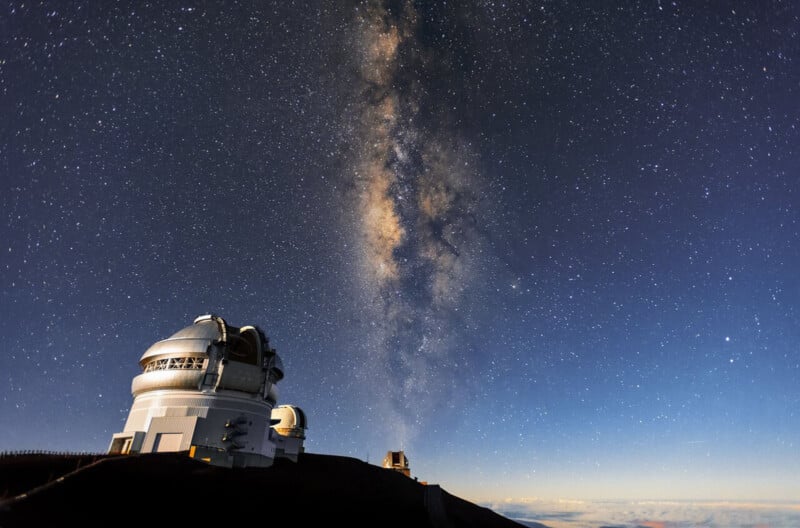
“It was so important to me that our interns gained a solid understanding of not just the astronomical science that takes place on Maunakea, but also the cultural and environmental significance of the mauna. The depth of their learning is evident in the name they created, and I’m so impressed and proud of them,” says Leinani Lozi, Hawaiʻi Education and Engagement Manager at Gemini North and internship mentor.
The Gemini North anniversary image, which can be viewed in exceptional detail here, is part of the ongoing NOIRLab Legacy Imaging Program, which highlights visually striking cosmic targets and the scientific capabilities behind them. A companion image from Gemini South in Chile will be released later this year as the observatory continues its 25th-anniversary celebrations.
With Ua ʻŌhiʻa Lani, the contribution of Hawaiʻi’s youth becomes part of the observatory’s legacy, linking the next generation of local scientists with the stories, skies, and stellar landscapes that inspire discovery.
Image credits: International Gemini Observatory/NOIRLab/NSF/AURA. NGC 6820 Image Processing: J. Miller & M. Rodriguez (International Gemini Observatory/NSF NOIRLab), T.A. Rector (University of Alaska Anchorage/NSF NOIRLab), M. Zamani (NSF NOIRLab)