NASA Photo of Martian ‘Leopard’ Rock is Strongest Hint of Life Yet

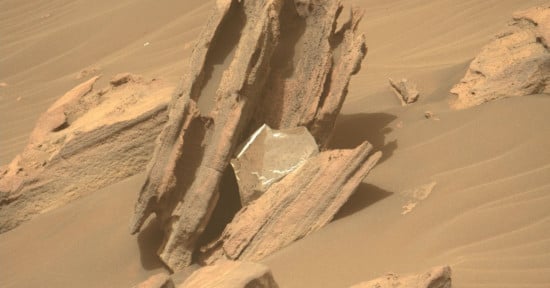
NASA’s Perseverance rover has taken high-resolution images of unusual rocks on Mars that could represent the strongest evidence yet of possible ancient life.
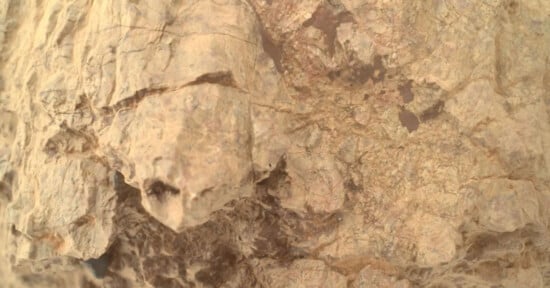
The rover identified mudstones in a former riverbed within Jezero Crater. These rocks, estimated to be 3.5 billion years old, display distinctive markings scientists have nicknamed “leopard spots” and “poppy seeds.”
Researchers believe the markings may contain minerals formed through chemical reactions involving organic matter. On Earth, such processes are often linked to microbes. However, the features could also have been created by geological activity.
At a press briefing, NASA describe the findings as potentially the clearest indication of life yet observed on Mars.
“We’ve not had something like this before, so I think that’s the big deal,” says Prof Sanjeev Gupta, a planetary scientist at Imperial College London and co-author of a study published in Nature.
“We have found features in the rocks that if you saw them on Earth could be explained by biology — by microbial process. So we’re not saying that we found life, but we’re saying that it really gives us something to chase.”
Dr Nicola Fox, NASA’s Associate Administrator for the Science Mission Directorate, adds: “It’s like seeing a leftover fossil. Maybe it was a leftover meal, maybe that meal’s been excreted and that’s what we’re seeing here.”

The rocks were found in the Bright Angel Formation, a canyon formed by an ancient river flowing into Jezero’s long-vanished lake. Perseverance analyzed them using its onboard instruments and sent the results back to Earth.
“We think what we’ve found is evidence for a set of chemical reactions that took place in the mud that was deposited at the bottom of a lake – and those chemical reactions seem to have taken place between the mud itself and organic matter – and those two ingredients reacted to form new minerals,” says Joel Hurowitz of Stony Brook University, lead author of the paper and a mission scientist.
On Earth, microbes often drive such reactions. “That is one of the possible explanations for how these features came to be in these rocks,” Dr Hurowitz continues. “This feels like the most compelling potential biosignature detection that we’ve had to date.”
Ultimately, determining the origin of these minerals may require laboratory analysis on Earth. Perseverance has been collecting samples, including from the Bright Angel Formation, and sealing them in canisters for possible return.
NASA and the European Space Agency have proposed a sample return mission, but U.S. budget cuts are putting the project at risk. China, meanwhile, is developing its own mission that could launch in 2028.
For scientists, retrieving the samples remains critical. “We need to see these samples back on Earth,” says Prof Gupta. “I think for true confidence, most scientists would want to see and examine these rocks on Earth – this is one of our high priority samples to return.”
Recently, the Perseverance rover captured a rare sunny day on Mars.
Image credits: NASA/JPL-Caltech/MSSS