Scientists Capture World-First Footage of Dolphins Using Seashells to Catch Fish
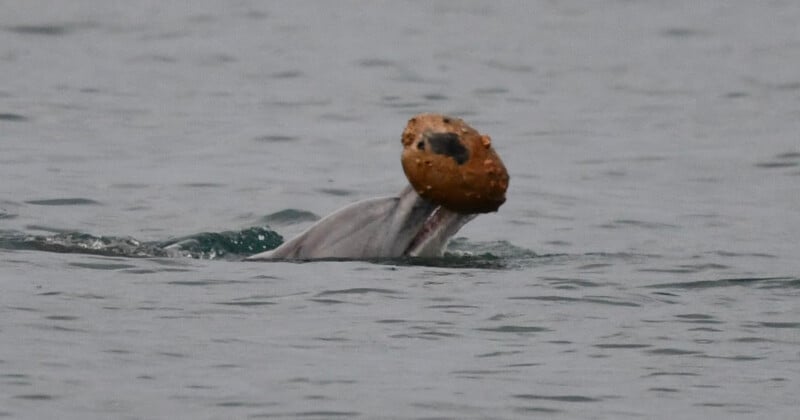
Researchers have captured the first-ever footage of dolphins using seashells to catch fish, with evidence suggesting that calves may learn the technique from their mothers.
The extraordinary footage was captured by scientists from the University of the Sunshine Coast in Australia. In a new study published in the journal Marine Mammal Science, researchers reported two separate sightings of bottlenose dolphins using shells to catch fish. The behavior, known as “shelling,” was recorded in the Great Sandy Marine Park in Queensland, Australia, between July and October 2025
‘I Started Screaming’
Researchers observed the dolphins herding fish into large empty shells, then carrying the shells above the water and tipping the fish into their mouths.
“We were on a research boat off Hervey Bay when we spotted a dolphin raising something large out of the water. I started screaming because I know what shelling looks like,” Dr Alexis Levengood, the study’s lead author, says in a statement. “It’s a hunting behaviour where dolphins chase fish into large empty shells, bring the shell to the surface and then shake it to drain the fish into their mouths.”
“We were able to record footage and take photographs of dolphins shelling in the Great Sandy Marine Park, which is the first published record of it on the east coast of Australia.”
‘Smart, Clever, and Innovative
During one sighting, a young dolphin was also seen imitating its mother by using a shell in the same way. The scientists’ findings suggest that dolphins may learn this ingenious technique by watching and copying their mothers.
“We saw the mother surface with a shell, the fish inside escaped and the dolphin dropped the shell to chase the fish. Then, minutes afterwards, the dolphin calf picked up the shell and held it the same way as its mother,” Dr Levengood explains. “Our footage provides the first potential evidence of maternal social transmission – a process by which offspring learn behaviour by observing the actions of its mother. It challenges the belief that dolphins learn this tool use from their peers.”
She adds: “These findings highlight how smart, clever and innovative dolphins are.”
Scientists say shelling had previously only been reported in Western Australia, about 3,700 miles away. But after speaking with local tour guides, the researchers discovered older photos showing dolphins in the area using shells as far back as 2019. This suggests the behavior has been taking place there for years without being formally documented. Dr. Levengood says more research is needed to better understand how dolphins learn the technique and how it may relate to their environment, intelligence, social behavior, and evolution.
“There’s still a lot we don’t know and many questions we will hopefully ask and answer with time,” Dr Levengood says. “But better understanding shelling, and other tool use in non-human animals, will continue to teach us more about ourselves and how and why we evolved the way we did.”
Affiliate Disclosure PetaPixel articles may include affiliate links; we may earn a commission if you buy through one.