
VSCO Terms of Use Explained: Why It Says It Isn’t Stealing Your Photos
Many photographers will remember the massive controversy Adobe found itself embroiled in nearly two years ago when photographers noticed just how invasive and overreaching the company’s updated Terms of Use were. The company quickly reacted. VSCO is now finding itself in a similar position, as users are taking notice of some concerning language in the platform’s Terms of Use.
Photographer Simon Migaj was reading VSCO’s Terms of Use over the weekend, and observed that users grant VSCO the right to use the “name, image, voice, or likeness of any individual in your Content, in whole or in part, and in any form, media, or technology, whether now known or developed in the future.”
Further, the license also includes “the right” for VSCO to “use certain Content for Creator Promotion and to develop, train, and improve AI or machine learning models as further described in our Creator Content Standards.”
It is worth noting here that VSCO has already published new Terms of Use that will be going into effect on June 22, 2026, but these are not materially different in the relevant “License You Grant to Us” section. In fact, the language Migaj noticed isn’t new at all.
Terms of Use Look Scary
For those who actually read Terms of Use for software will know all too well that the agreements always look onerous. For example, consider the very beginning of the “License You Grant to Us” section in VSCO’s Terms of Use, either current or upcoming.
“By using our Services, you grant us a royalty-free, sublicensable, non-exclusive, perpetual, irrevocable, worldwide license to use, reproduce, distribute, publicly perform, publicly display, and make derivative works of your Creator Content and AI Content (collectively, “Content”)… ”
This is common language. That doesn’t necessarily make it any less scary, but it does allow VSCO to actually do anything with the content its users upload to the platform. Even displaying an image in an app requires a license, especially when it may be shown as a thumbnail, sent to servers, displayed in connected apps, etc.
As Adobe explained following its Terms of Use fallout in June 2024, software companies require a license to user content to provide essential services and software functions. It also needs to be sublicensable so that companies can utilize technologies and services developed by third parties, even if it’s backend software architecture.
The issue is that companies, by and large, neglect to include plain-language explanations of their Terms of Use, especially the sections that sound bad. What photographer would immediately feel comfortable handing over an irrevocable, lifetime royalty-free license to their content without understanding what that actually means? No photographer, that’s who.
“On the “royalty-free, sublicensable, perpetual” language: this is functionally required for any platform that displays user-uploaded content,” VSCO’s CEO Eric Wittman tells PetaPixel. “Without it, we couldn’t legally render your photos on different devices, let you share your profile publicly, or build the discovery features photographers rely on. This language protects our ability to operate, not to exploit.”
The Right to Likeness
However, the larger concern is that VSCO’s Terms of Use go beyond just the standard licensing question. While the company, and any company, should explain Terms of Use in a way that makes sense to the average user who surely isn’t a lawyer or technology expert, there is more concerning language in VSCO’s Terms of Use than the general license language above.
VSCO’s Terms of Use grant the company the right to use, reproduce, distribute, and make derivative works of more than just an uploaded photo. The company also claims the right to the “name, image, voice, or likeness of any individual included in your Content, in whole or in part, and in any form, media, or technology, whether now known or developed in the future.”
“This language provides a fairly standard license related to the right of publicity. Your ‘right of publicity’ provides you control over how your name, face, or voice is used,” Sara Lee, VSCO General Counsel tells PetaPixel.
“We ask for permission to use these aspects of creators’ content so we can display and feature content and improve our platform, including in search, feeds, featured content, and in future new ways to provide a rich experience on VSCO. To be clear, this doesn’t mean VSCO owns your work or publicity rights or can do anything we want with them. The content posted by you as a creator still belongs to you.
“We always respect creators’ privacy settings and also give attribution (typically by referencing creator usernames) where applicable.”
As photographers have painfully learned firsthand, it is nearly impossible to predict what a company might do with images it has the license to use, especially when considering technology that doesn’t yet exist. VSCO is covering its bases here, keeping things extremely open-ended in a way that rightly concerns some photographers. That doesn’t necessarily mean anything nefarious is happening, of course, but it’s important for people to keep an eye on how companies say they may use their content and data.
VSCO and AI Training
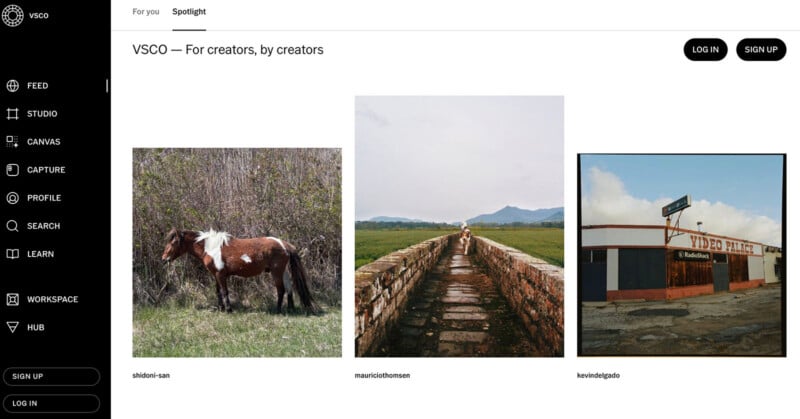
VSCO has historically been transparent about its relationship with AI, including a new campaign dedicated to empowering real, human creativity.
The company’s relationship to AI and transparency has not changed. The language in VSCO’s Terms of Use that outlines how the company can use user content to “develop, train, and improve AI or machine learning models… ” has a fairly significant caveat worth considering.

“VSCO does not use content from paying subscribers for AI training, nor is their content licensed to third parties. Full stop,” Wittman tells PetaPixel. It is worth noting here that, as VSCO has said before, the company does train AI using content uploaded by non-paying VSCO subscribers.
“For non-paying members whose content is publicly posted, we may use that content to develop and improve AI-powered features on the platform. This is consistent with how most creative platforms operate, and it’s the reason the license language exists. We want to be honest about that rather than obscure about it.”
Wittman says that while much of the language in VSCO’s Terms of Use is purposefully broad, it is designed to cover the company’s bases for rather standard functionality.
“The legal framing is broad by necessity, but what it actually covers is operating the platform, enabling discovery, personalizing experiences, and improving AI features,” Wittman explains. “It does not mean VSCO owns your photos or can sell them.”
Wittman offers a practical example. When a photographer looks at a photo on VSCO, the app displays a set of visually similar images as recommendations. This recommendation engine is powered by machine learning, which requires licensed images to develop, including those uploaded to VSCO by free members.
Wittman knows not every photographer is okay with any level of AI training done with their content.
“We respect that perspective,” Wittman says. “What we can commit to is transparency about what we’re actually doing, rather than hiding behind vague policy language.”
If VSCO users don’t want their content used for AI training, they must either be a paying member or, if they are a free user, not upload content publicly. Those are their only options as of now.
Trust Is An Important Part of the Equation
Legalese rarely reads well. It almost always sounds terrifying, like the user is signing their life away to a company to use an app or website. It’s certainly true that people are signing away significant rights whenever they use a platform. A photography platform cannot exist without licensing rights to display people’s images.
With the specific exception of marketing materials, which VSCO explains here, the company is not displaying photos that users have uploaded in any unusual way. VSCO is not selling users’ photos to the highest bidder or preventing photographers from going about their business as usual with any images uploaded to VSCO.
However, companies should still consider ways they can directly engage with the community, including explaining Terms of Use in plain language that outlines exactly what they mean. Photographers care deeply about their work, as they should, so they must know what a company commits to doing, or more importantly, not doing, with their photos. This is an area where VSCO’s current and upcoming Terms of Use come up short.
The company has done plenty of things right in recent years and worked hard to deliver useful tools and services to photographers, but that doesn’t mean there isn’t room for improvement.
At the risk of sounding glib, photographers who do not wish to transfer any rights or license to their photos cannot use social media or most photo editing apps. VSCO’s Terms of Use are not unique, not by a long shot. Those who read the Terms of Use on platforms like Instagram or Reddit will find considerable overlap, for example. The same is true nearly universally.
That said, it remains important to understand what companies may do with photos, especially as nearly every company pursues some form of AI development. It’s also essential that people know what companies do with their data. It’s also important for people to decide to what extent they trust a company. That is a significant component when dealing with any company.
Photographers should read Terms of Use, research companies, and determine what they are willing to give up to use the platforms and services they like. It’s a perfectly reasonable response to dislike a company’s approach to licensing or data and stop using their products and services. There is nothing wrong with that.
However, it’s important too for photographers to realize what any line in the sand they draw may mean for how they can actually share their work online.
Affiliate Disclosure PetaPixel articles may include affiliate links; we may earn a commission if you buy through one.