
Remote Camera Captures Ultra-Rare Jaguar Roaming in Arizona Mountains
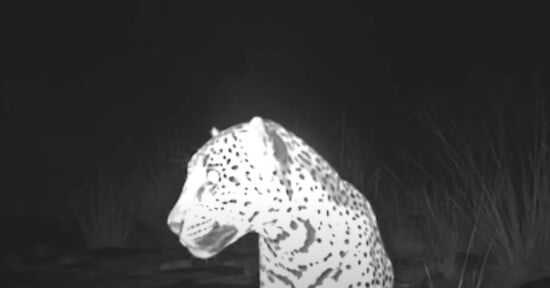
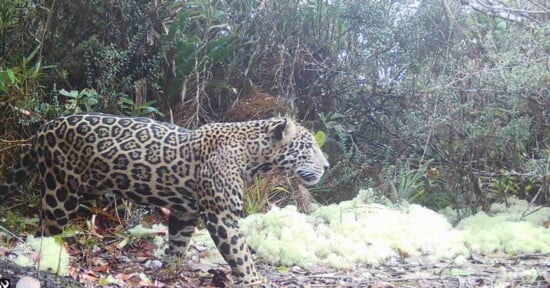
A remote camera placed near a watering hole captured a rare wild jaguar roaming an Arizona mountain range.
The sighting on the remote camera is only the fifth jaguar seen in southern Arizona in 15 years and gives conservationists hope for the species’ future.
Volunteers and scientists with the University of Arizona’s Wild Cat Research and Conservation Center captured the footage in March and April. Remote camera footage shows a large adult male jaguar nicknamed Jaguar Number Five, or “Cinco,” moving through the Sky Island mountain ranges south of Tucson. The researchers had attached a camera to the base of a small tree near a watering hole.
Arizona’s newest jaguar, first spotted in photos in November 2025, after wandering across the border from Mexico and later captured on video in March, is only the fifth the group has documented in the last 15 years. Since then, Cinco has been detected more than 17 times. These observations are helping University of Arizona scientists better understand the movement patterns of this rare and endangered species in the region.
According to a report by the National Geographic, 63-year-old volunteer Chris Schnaufer took a rugged off-trail hike across a hillside to reach a remote watering hole where he set up the camera. Along the way, he navigated rocky drop-offs and barrel cactuses before reaching a stream bed. He then worked his way around steep waterfalls, carefully placing each step to avoid an agave plant nicknamed a “shin dagger.”
“Everything in Arizona has thorns,” Schnaufer tells the National Geographic. “If you’re not careful where you step, they’ll actually stick you in the leg. They usually draw blood,”
He eventually followed a bear trail, deliberately making noise to avoid surprising any wildlife, until he reached the camera site. Schnaufer was delighted to later discover that his camera had captured Cinco drinking at the watering hole in March, shortly after sunset.
Once widespread, the jaguar historically reached as far north as the Grand Canyon. Over time, however, hunting and the loss of suitable habitat drove sharp declines in jaguar numbers, both in Arizona and across their broader range extending through Central and South America to Argentina. Today, jaguars are listed as endangered in both the United States and Mexico.
More recently, jaguars have quietly crossed back over the U.S.–Mexico border. Wildlife officials say their future depends on cross-border conservation efforts.
Affiliate Disclosure PetaPixel articles may include affiliate links; we may earn a commission if you buy through one.