A Tiny Camera In a Cereal Box-Sized Space Telescope Is Searching for Habitable Planets
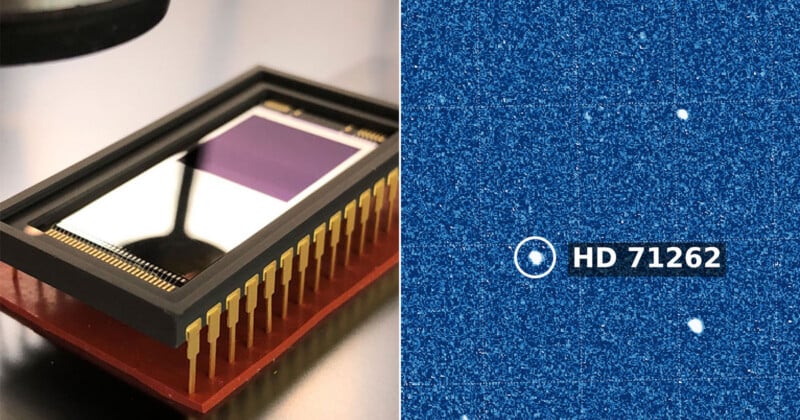
NASA’s Jet Propulsion Laboratory (JPL) built an ultraviolet camera for NASA’s teeny-tiny SPARCS space telescope, which is about the size of a cereal box. The camera is searching the Milky Way Galaxy for habitable planets.
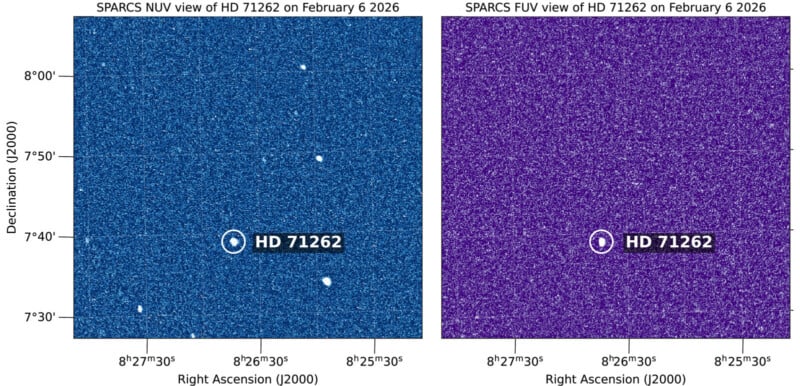
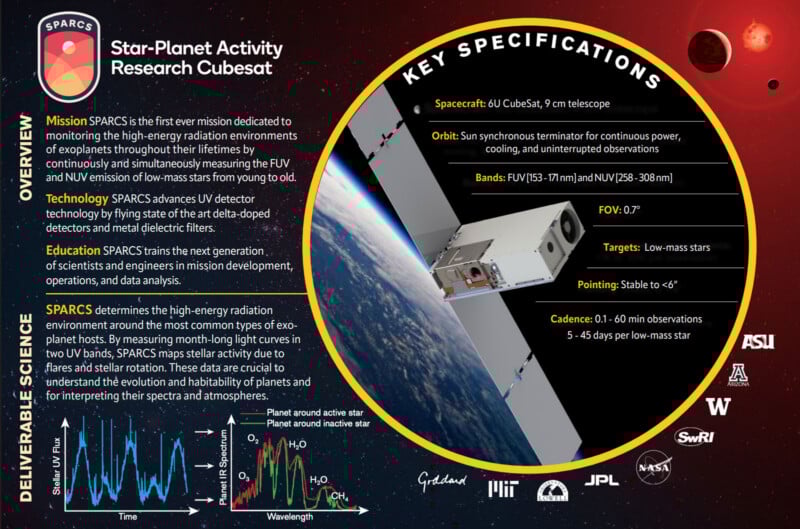
SPARCS, short for Star-Planet Activity Research CubeSat, launched into space aboard a SpaceX rocket on January 11, carrying aboard JPL’s SparCAM, a custom-built, highly sensitive UV camera system. The camera passed its first tests in space, demonstrating that it is up for the challenge of scouring the cosmos for exoplanets.
SPARCS is looking for flares and sunspot activity on low-mass stars, or stars with approximately 30 to 70 percent of the Sun’s mass. These stars are “among the most common in the Milky Way and host the majority of the galaxy’s roughly 50 billion habitable-zone terrestrial planets,” JPL explains in a press release. A habitable-zone terrestrial planet is a rocky world that is close enough to its host star to have temperatures that could have liquid water and potentially support life.
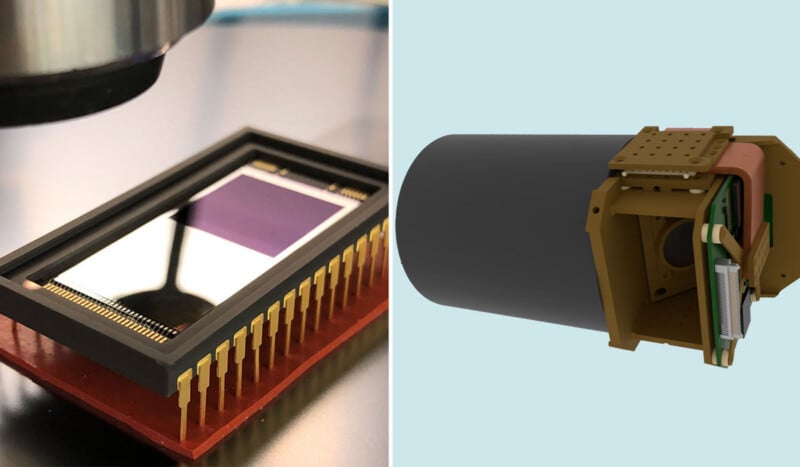
SPARCam combines customized image sensor technology with highly specialized filters to detect far-ultraviolet and near-ultraviolet light from low-mass stars. SPARCam simultaneously performs both far- and near-ultraviolet observations.
“We took silicon-based detectors — the same technology as in your smartphone camera — and we created a high-sensitivity UV imager. Then we integrated filters into the detector to reject the unwanted light. That is a huge leap forward to doing big science in small packages, and SPARCS serves to demonstrate their long-term performance in space.” explains Shouleh Nikzad, the lead developer of SPARCam and the chief technologist at JPL in California.
The filters are the most exciting aspect of SPARCam’s design. JPL’s engineers used a new technique to directly deposit the filters onto the specially made UV-sensitive “delta-doped” detectors. Integrating the filters directly into the sensor meant the team did not need to develop a separate filter element, which not only kept the size small but also improved sensitivity.
As NASA says, SPARCam is among the most sensitive imaging systems of its kind to ever go to space.
The SPARCS mission is planned to last about a year, during which time the telescope will target about 20 low-mass stars for five- to 45-day observations.
Although SPARCam is already doing important work aboard SPARCS, it is also a proof of concept of sorts for future NASA missions, including the flagship Habitable Worlds Observatory mission, a large infrared/optical/ultraviolet space telescope that is currently in planning. The Habitable Worlds Observatory, if it is ultimately built, will search for life in the Universe using camera technology that is at least in part being pioneered by JPL now.
Image credits: NASA/JPL-Caltech/ASU