Hubble and Euclid Team Up for Sharpest Ever Photos of Cat’s Eye Nebula
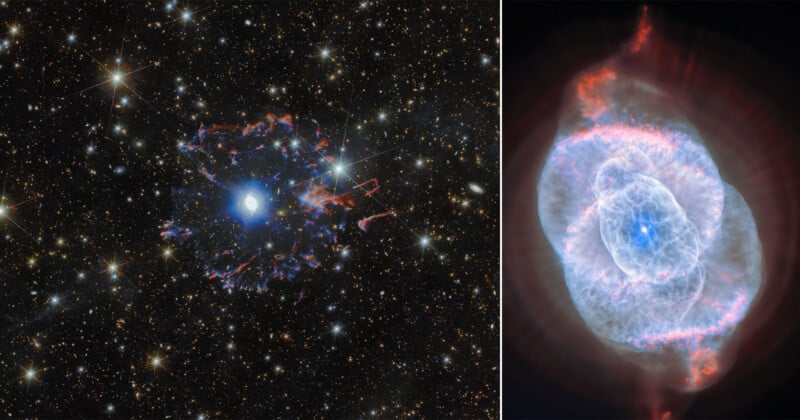
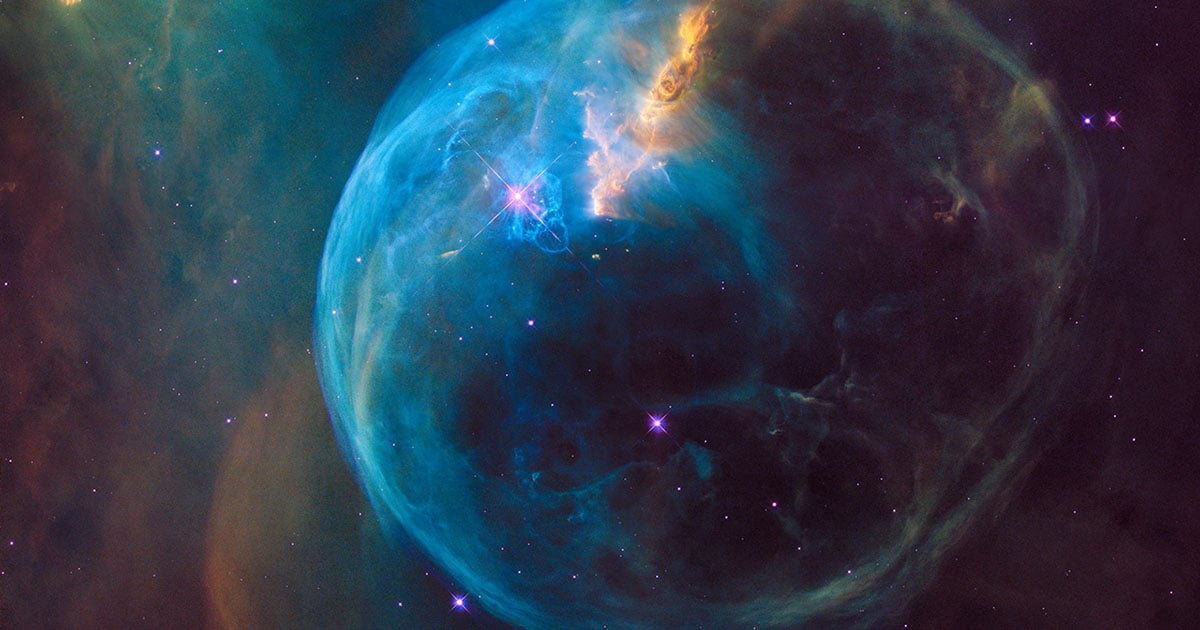
The European Space Agency’s (ESA) remarkable and relatively new Euclid space telescope teamed up with NASA and ESA’s venerable Hubble Space Telescope (Hubble) to capture beautiful photos of the Cat’s Eye Nebula, also known as NGC 6543.
The Cat’s Eye Nebula, one of the most visually stunning remnants of a dying star in the observable Universe, is located about 4,400 light-years from Earth in the constellation Draco. Planetary nebulae like this are so named because of their round shape, which earlier astronomers thought resembled planets but are actually the expanding gas that stars shed in their final stages.
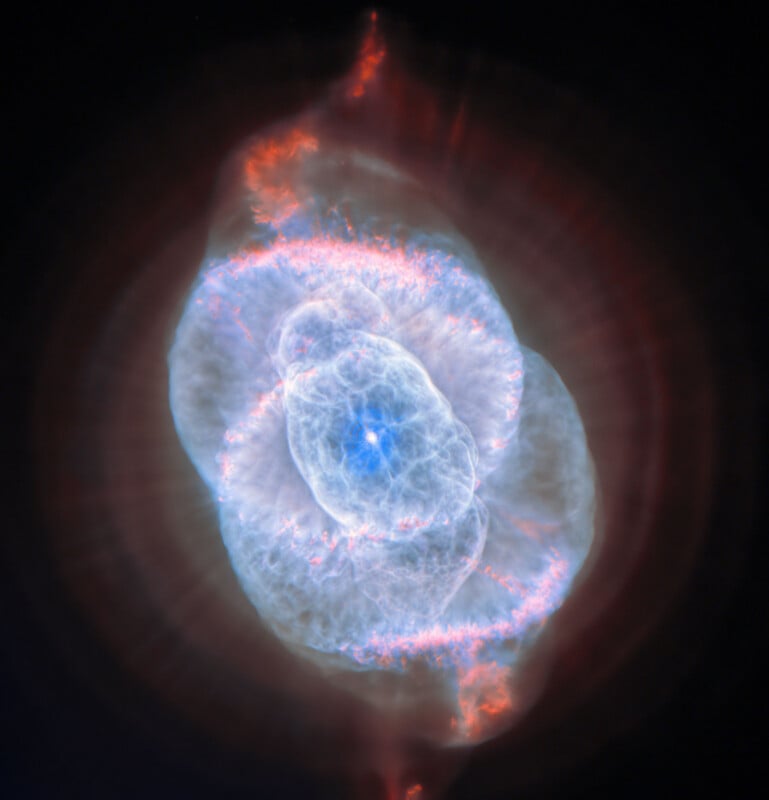
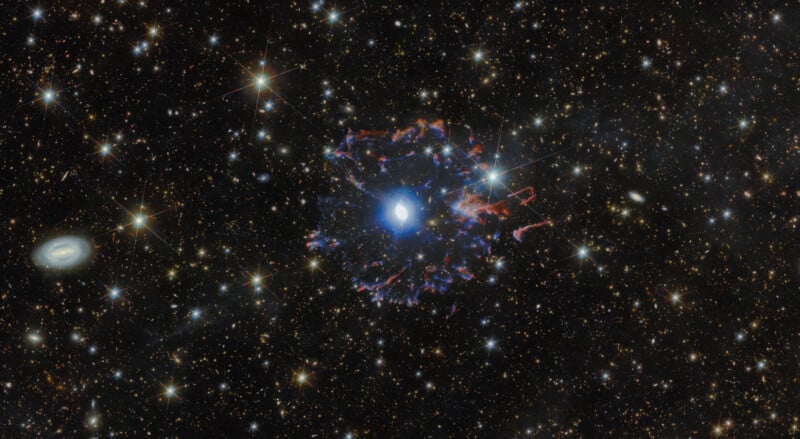
The Cat’s Eye Nebula was first discovered back in 1864 and has dazzled many astronomers, scientists, and astrophotographers. Euclid and Hubble’s collaborative imaging efforts show the nebula in an all-new way. Euclid’s exceptional resolution helps, of course, but scientists also used cutting-edge image processing techniques to combine Hubble’s Advanced Camera for Surveys (ACS) images and data, some from more than 20 years ago, with Euclid’s wide, near-infrared, and visible-light views of the Cat’s Eye Nebula. The resulting close-up and cosmic environmental photos are not just gorgeous; they are the sharpest-ever photos of this beautiful nebula.
“Combining the focused view of Hubble with Euclid’s deep field observations not only highlights the nebula’s exquisite structure but also places it within the broader context of the universe that both space telescopes explore,” NASA and the ESA explain. “Together, these missions provide a rich and complementary view of NGC 6543 — revealing the delicate interplay between stellar end-of-life processes and the vast cosmic tapestry beyond.”
Although Hubble is getting up there in years, it continues to contribute to important scientific work. Euclid, on the other hand, is nearly brand-new. Just over a year ago, the 600-megapixel telescope broke new ground by photographing an “Einstein Ring” encircling a nearby galaxy. The space telescope is using its 36 CCD image sensors, each 4,000 x 4,000 pixels, to scour the Universe for dark matter and dark energy and help scientists build a 3D map of the distribution of galaxies and dark matter.
Euclid observed more of the Universe in a single day than Hubble has done in 25 years, but as the new photos of the Cat’s Eye Nebula show, space science — and astrophotography — is at its best when multiple space telescopes team up.
Image credits: ESA/Hubble & NASA, ESA Euclid/Euclid Consortium/NASA/Q1-2025, J.-C. Cuillandre & E. Bertin (CEA Paris-Saclay), Z. Tsvetanov