Canon 14mm f/1.4L VCM Review: Major Trade-Offs for Compactness
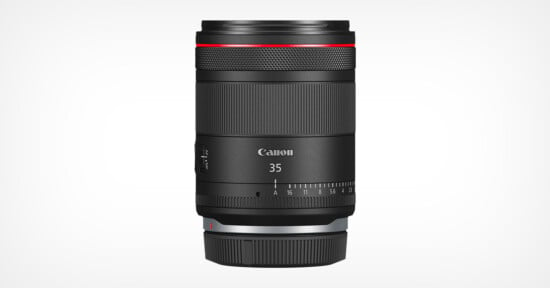
Canon has created, in a very short time, a complete line of L-series prime lenses that cater to the hybrid photo and video shooter. It is quite an achievement to build a whole line of professional prime lenses that are all similar in size, weight, and form factor, while still maintaining the quality expected of an L-series optic. The latest addition to the family is the 14mm f/1.4L VMC, a first for Canon in its RF-mount. I took this $2,600 lens for a spin, appreciating its compact nature, but with serious trepidation that Canon may have pushed the envelope a little too far this time.
Canon 14mm f/1.4L VCM: How It Feels
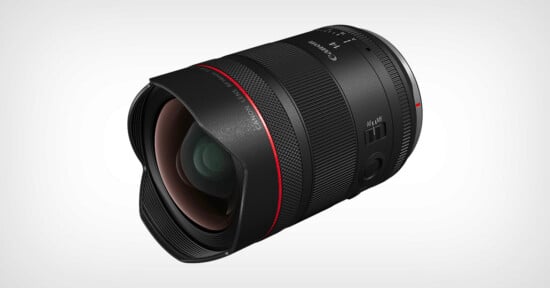
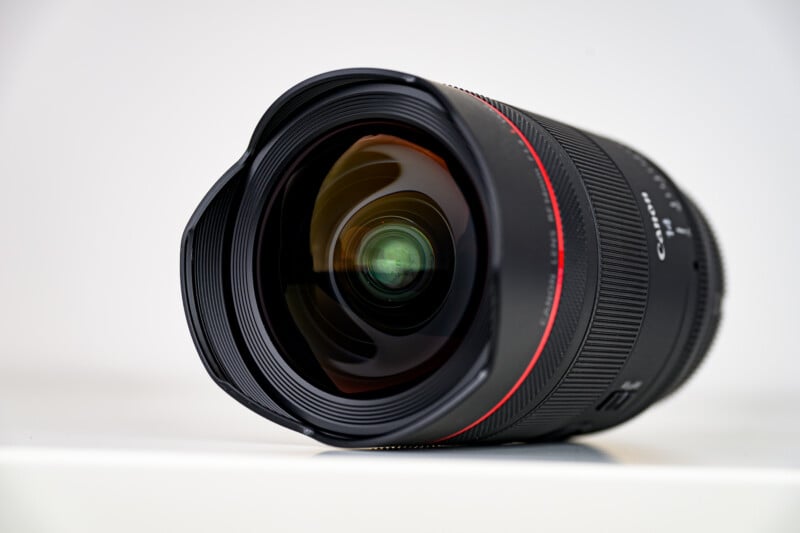
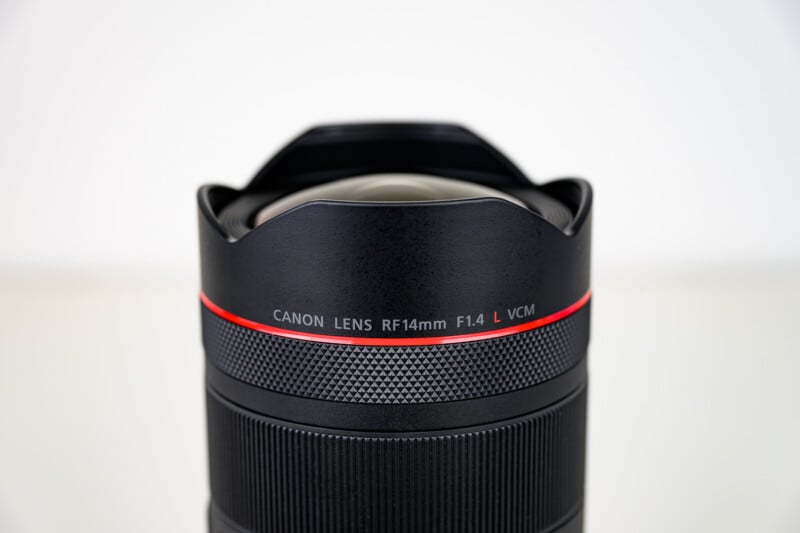
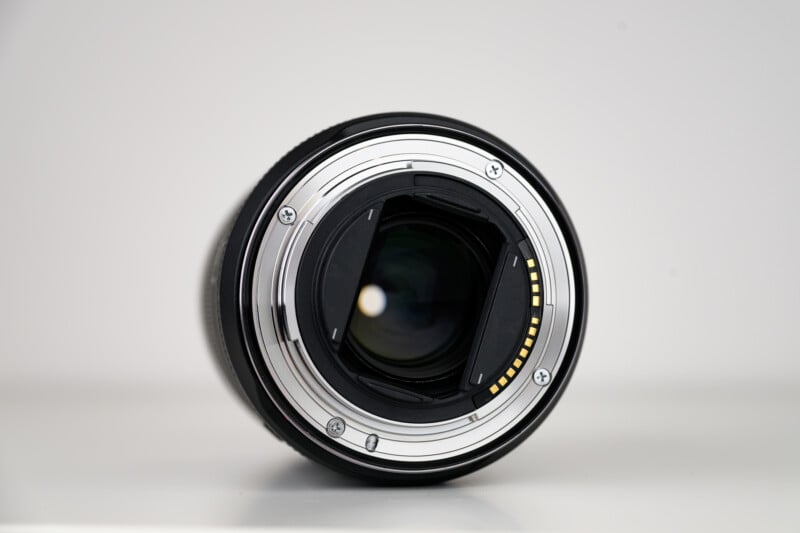
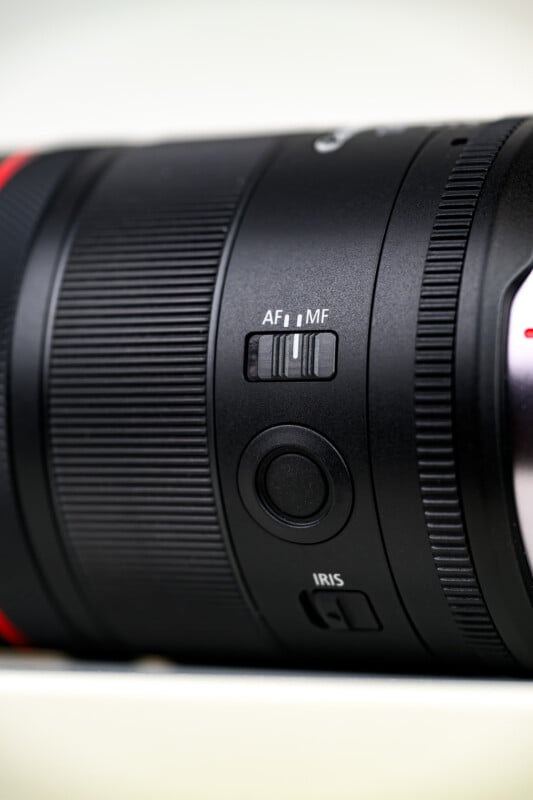
The new 14mm seems way too small to be a full-frame 14mm f/1.4 lens. Weighing in at only 20 ounces (578 grams), the 14mm has a similar diameter to the other VCM lenses in the lineup. There is an incorporated hood attached to the front and a drop-in filter slot at the rear of the lens mount. Canon provide a customizable ring on the front of the lens, which has click stops, and is ideal for use as an exposure control ring. Right behind that ring is a large and well-damped manual focus ring that turns so smoothly to facilitate perfect focus pulls.
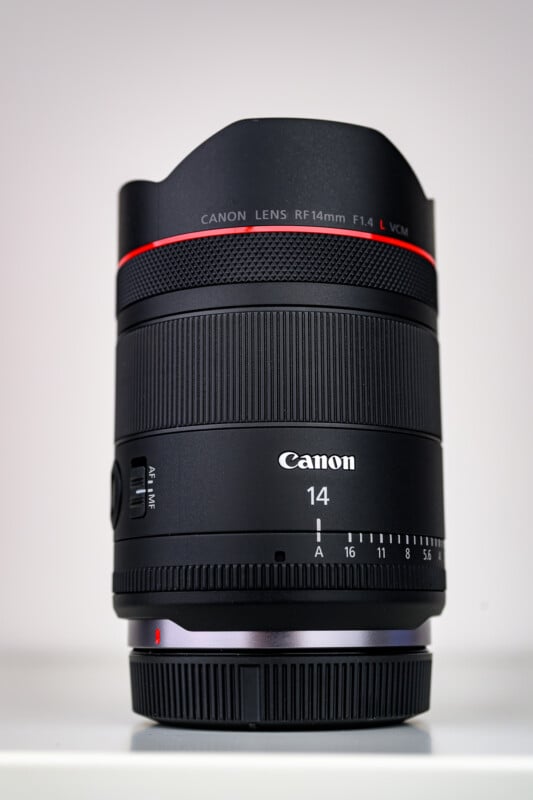
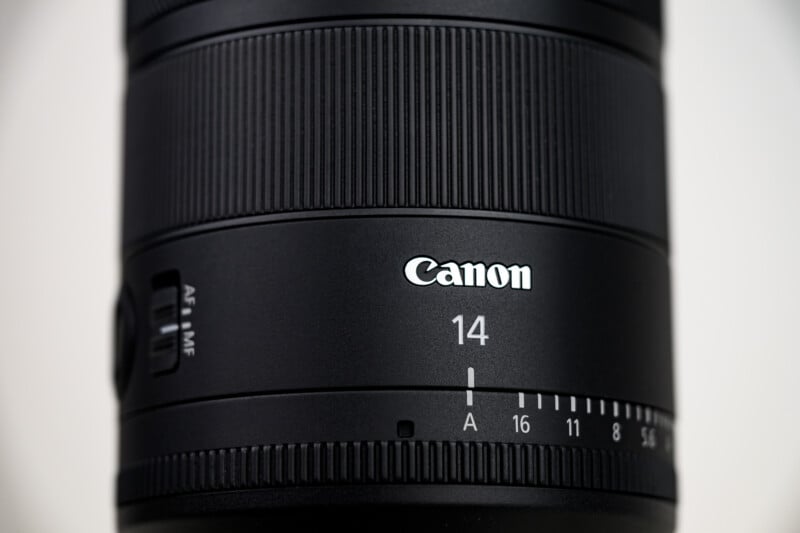
Canon has provided a customizable button on the lens and a switch to lock the aperture ring into auto mode. However, we do see the return of the strange design choice to only allow the aperture ring to function in video mode on most camera bodies. This means on many of the slightly older Canon bodies, such as the R5 that I used for testing, the aperture ring does not function at all when taking photographs. It also only has a smooth-turning function to it without the option to turn on click stops for the various aperture settings.
Of course, it’s easy to work around this and change aperture on the body, but I still find it odd to have an aperture ring that only partially works in most cases.
Canon 14mm f/1.4 L VCM: How It Shoots
It’s hard not to have the sun or a similar bright light source in the frame when using such a wide-angle lens. In that case, the flare characteristics had better be good. At wider apertures, the Canon 14mm exhibits good contrast with only a smidge of ghosting in the frame. However, at tighter apertures, the ghosting is very apparent with bright and colorful streaks right across the frame.
At least the sun stars out of this lens are classic Canon, with long and well-defined stars that come across as very dramatic.



I also tested bokeh because the f/1.4 aperture has some potential to give shallow depth of field, even with the ultra-wide nature of the 14mm lens. If you get close enough, the background can fade into softness.
The specular highlights are very clean with minimal cat’s eye effect at f/1.4. There are no onion rings or issues with the highlights when stopped down, either, and the 11-bladed aperture keeps everything looking round. Obviously, this is not a lens for achieving a softer background in most use cases, but for the occasional photo where the focus transitions, the 14mm performs admirably. Any longitudinal chromatic aberrations or LoCA that would normally show on an f/1.4 lens were also suppressed very well, with almost no color fringing to worry about.


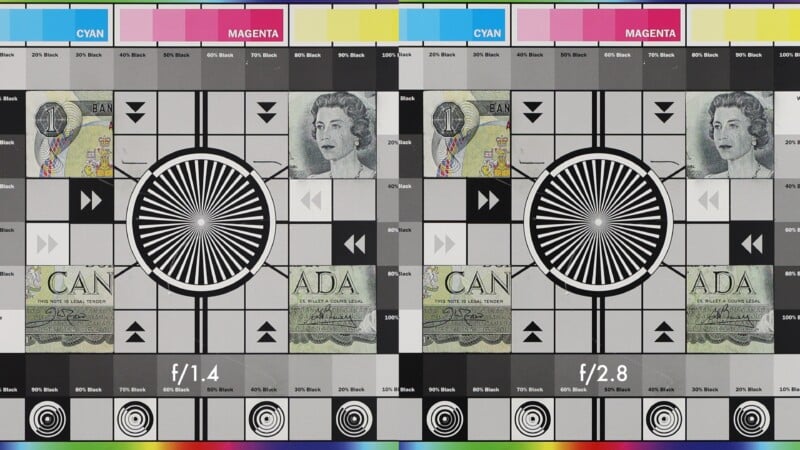
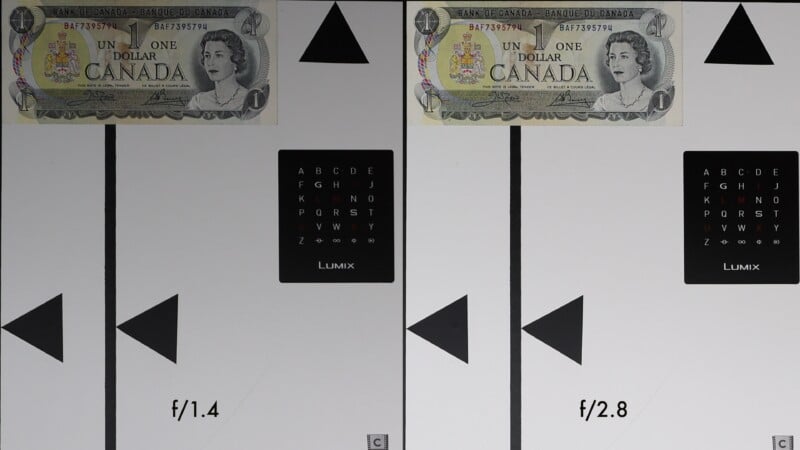
I expected excellent sharpness out of this lens and was not disappointed. The center of our test chart at f/1.4 showed excellent detail, although overall contrast was a little mild. Stopping the lens down only slightly brought all that contrast back, and the sharpness throughout the center of the image was apparent. Corners at f/1.4 showed heavy vignetting, though, and detail was smudged across the frame. Stopping the lens down reduced the vignetting, but the blurred corners are still present, and we noticed this as an issue with astrophotography, too.
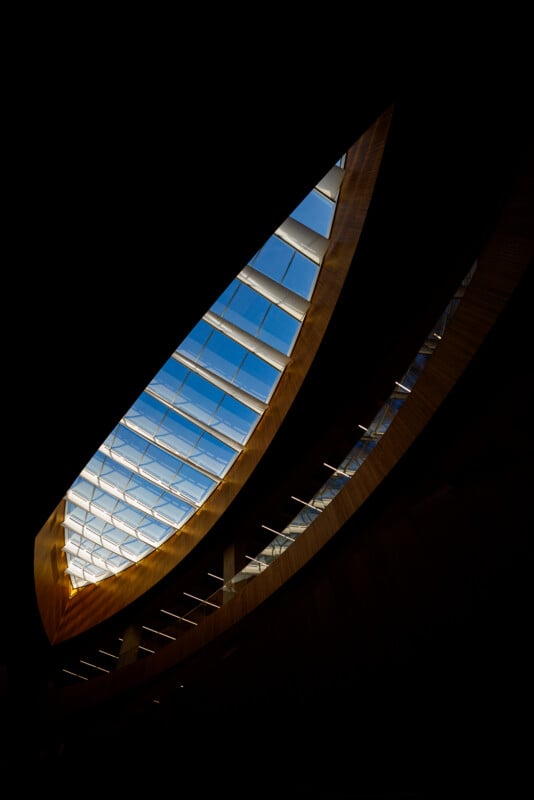

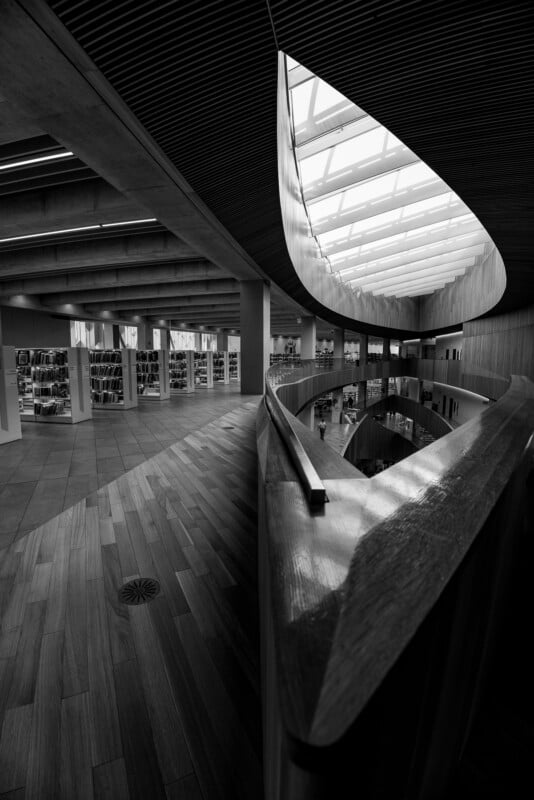
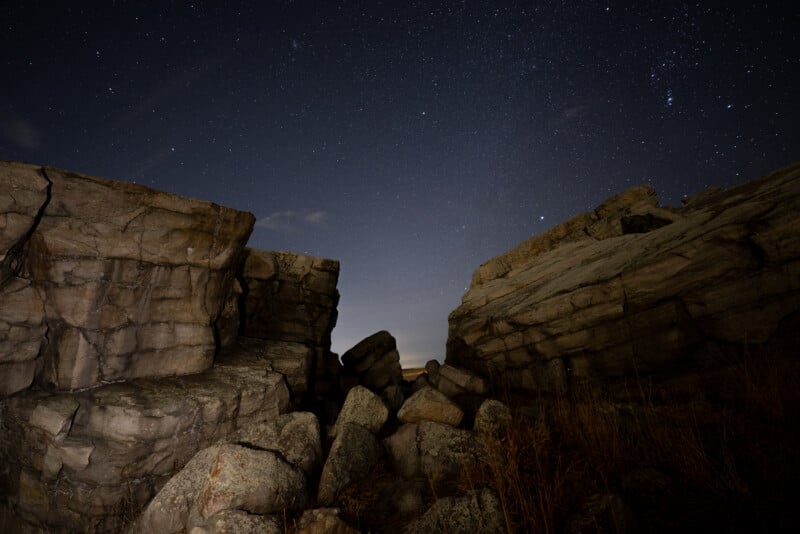
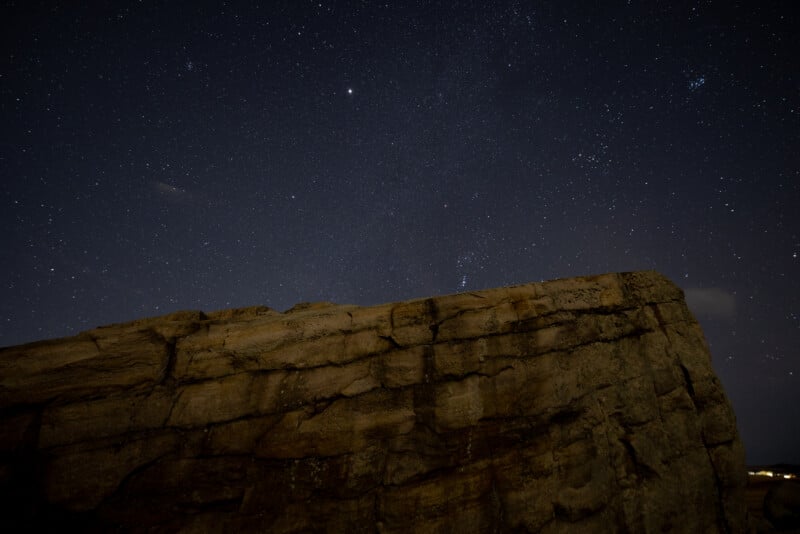
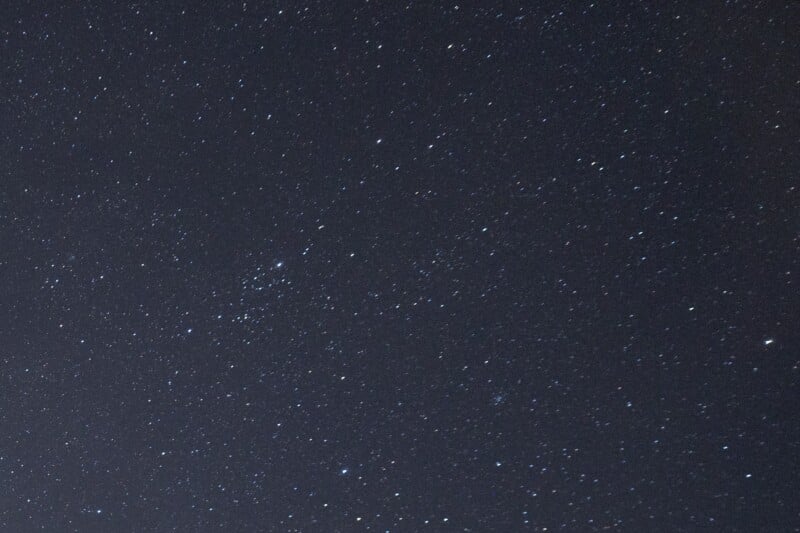
This is definitely a lens that prospective Canon users will look to when shooting the heavens. Coma is very well controlled, but corner sharpness leaves a lot to be desired. Getting accurate focus is tricky because the field curvature of the lens means that the center being in focus does not apply to the corners.
At f/1.4, the stars would often streak towards the center of the frame, and although heavy cropping can cut this out, it reduces the utility of having such a wide lens to begin with. I think this issue stems largely from the compact design of the lens. In order to maximize space, the lens gives up on image circle coverage and the corners become a problem. I’d happily use this lens for astrophotography shots, but I would either stop down or crop, both of which are less than ideal.
As a video lens, the 14mm will provide smooth manual focusing, and the VCM autofocusing motor is completely silent. Canon bodies track faces now in both photo and video applications beautifully without any issues. The lens does show a little bit of focus breathing, however, causing the field of view to change slightly when focusing the lens. Videographers will certainly appreciate the extremely wide-angle view that the 14mm can achieve, and the smaller size is excellent for dramatic gimbal use.
Canon 14mm f/1.4 L VCM: Compact Compromise
All of the VCM prime lenses have to find a balancing act between being useful for photography and videography. However, this balancing act gets more complicated as the focal length gets more extreme. There is a lot to love about the 14mm VCM because the optical performance is there in many ways.
For videographers, the excess ghosting, fairly well controlled breathing, extreme wide-angle look, and smaller size, will be characteristics that can be seen as desirable. For photographers, these turn out to liabilities.
The corner quality really hurts when it comes to astrophotography, and the distortion can be a pain to fix in post. Ghosting which can look interesting when panning across a subject in video, often looks distracting when shot in stills.
Overall, the 14mm lens has its heart in the right place, but there is a reason why competitors 14mm f/1.4 lenses tend to be big and bulky. I feel like Canon is trying to push this expensive $2,600 lens down two different paths and the compromises might be too much for some users.


Are There Alternatives?
In terms of autofocusing full-frame glass, there aren’t any other options since Canon’s RF mount is closed — this is Canon’s first 14mm lens for it. You could adapt the older EF version but it’s getting long in the tooth. The manual focus options from companies like Samyang could be a good option for astrophotography situations where the electrical connection or autofocus aren’t as important, although this still isn’t ideal.
Should You Buy It?
Yes. I can only barely recommend this lens though, and a big part of that is due to the lack of viable alternatives. Canon is very skilled at restricting its mount to third parties and this latest 14mm leaves some things to be desired.