Empty Promises: A Deep Dive into Flickr Pro for 2026
Flickr is one of those platforms that refuses to die, like a beloved old truck that leaks oil but still starts every morning. Flickr is one of the original photo-sharing communities, and if you’ve been around long enough, you probably remember when it was the internet for photographers. I’ve been on Flickr since the early days, and at one point, it genuinely felt essential. In fact, I had a pro account for over a decade.
Back when Yahoo owned Flickr, it was the place to share photos, discover other photographers, and learn by immersion. Groups were active, comments were thoughtful, and browsing images on Flickr felt like wandering a global gallery curated by passion rather than algorithms. It wasn’t just a photography forum, but it functioned like one. You could discover other photo nerds who were into really niche formats of photography. Awesome!
Today, Flickr is one part archive, one part social network, and one part awkward relic. Flickr to share work still happens, but it’s quieter, slower, and more fragmented. Think Flickr now, and you’re thinking nostalgia mixed with a UI that hasn’t quite decided what decade it’s in.
What Does Flickr Pro Actually Offer?
Flickr Pro is positioned as the “serious” tier, the pro version for people who want more control and fewer annoyances. On paper, Flickr Pro removes ads, unlocks advanced stats, allows unlimited uploads, and gives you priority technical support.
A pro account gives you unlimited storage, ad-free browsing, private photos, and better analytics. Sounds fine, right? In theory, this should be a good value, especially if you upload a lot and want everything in one place.
The problem isn’t what Flickr Pro says it offers. The problem is whether those things matter anymore, and whether they’re worth paying for Pro at the current price several times higher than what many of us originally signed up for. Paying for Pro used to feel like supporting a community. Now it feels more like paying rent on an abandoned mall.
Why Do People Still Use Flickr?
People still use Flickr for a few reasons, and none of them are especially modern. First, habit. A lot of us joined Flickr years ago and never fully left. There’s history there, comments, groups, and a photostream that documents your evolution as a photographer.
Second, the social aspect still exists, just faintly. There are still niche communities, genre groups, and people who genuinely engage. If you like Flickr, it’s probably because you like the slower pace and less performative nature of interaction.
Third, Flickr is one of the few platforms that still treats images with respect. High-quality images aren’t aggressively compressed the way they are on many social platforms. Upload a JPEG at full resolution and it still looks like a photograph, not a screenshot of a photograph.
But let’s be honest: most people who still use Flickr are hobbyists, long-time users, or photographers who never fully bought into Instagram-style photo sharing.
Uploading Photos: How Flickr Handles Files Today
Uploading images to Flickr is straightforward, and in fairness, it works. In fact, I think Flickr has the best uploading experience you can get — metadata is pulled right over, and once there, the images require minimal tweaking for captions, keywords, etc. You upload photos, organize them into albums, and they appear in your photostream. The upload process itself is stable, and for bulk uploads, it’s reliable.
You can upload photos manually or via integrations, and Flickr handles original photos without aggressive compression. That part still matters to a photographer who cares about image quality. You can upload photos in batches, manage metadata, and control privacy.
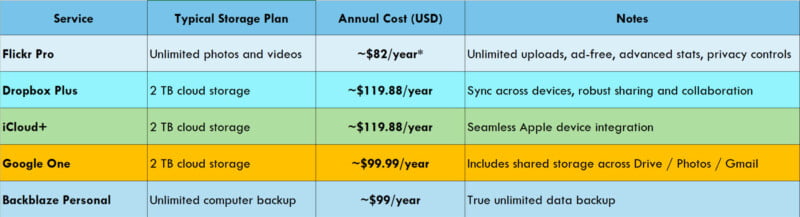
But uploading alone doesn’t justify a subscription. Plenty of services allow uploading photos at scale now, including cloud storage platforms like Dropbox. Flickr’s upload experience hasn’t meaningfully evolved in years, and while it’s functional, it’s not innovative.
Unlimited Uploads and Unlimited Storage: Marketing vs Reality
Let’s talk about the word unlimited, because it gets thrown around a lot. Flickr Pro offers unlimited uploads and unlimited storage, which sounds amazing until you realize that storage is cheap everywhere now.
Unlimited photos used to be a killer feature. Now it’s table stakes. Google Photos, iCloud, Dropbox, and other cloud storage solutions already handle massive libraries efficiently, often with better syncing, redundancy, and long-term guarantees.
Get unlimited storage on Flickr, sure, but what are you actually getting beyond a place to park files? Flickr is not a serious photo management system. It’s not Lightroom. It’s not a DAM. It doesn’t integrate deeply into modern workflows.
Unlimited uploads are nice, but unlimited uploads to what? A platform that isn’t driving meaningful traffic, sales, or discovery for most photographers anymore.
SmugMug and Flickr: Promises vs. Reality
When SmugMug acquired Flickr in 2018, the messaging was clear, emotional, and honestly pretty compelling. This wasn’t framed as a typical tech acquisition. It was pitched as a rescue mission. Flickr was losing money, yes, but SmugMug positioned itself as a values-aligned steward stepping in to protect something culturally important. The language mattered: photographers first, community first, long-term thinking over trend chasing.
At the time, SmugMug said Flickr would remain Flickr. There would be no forced merger, no pivot into whatever the social media flavor of the month happened to be. Instead, the plan was to fix the fundamentals, modernize the infrastructure, and then refocus on what made Flickr special in the first place: photographers connecting with other photographers. Not influencers. Not brands. Not algorithm-optimized content mills. Just people who cared about the craft.
And to be fair, some of those promises were delivered. Flickr was finally decoupled from Yahoo login, which was long overdue. Image display sizes increased, performance improved, and the platform became more stable behind the scenes. Pro members got better support, longer video uploads, higher-resolution display, and bundled discounts with services like Pixsy. If the promise had been “we will stabilize Flickr and stop the bleeding,” SmugMug largely succeeded.
But that wasn’t the full promise. The emotional core of the 2018 messaging was about revival, not just survival.
What never really materialized was any serious reinvestment in the community layer. Groups—the single most important social structure Flickr ever had—remained clunky, visually outdated, and hard to discover. There was no meaningful attempt to modernize how photographers find each other based on style, interests, geography, or intent. No clear pathways for mentorship, critique, or learning. No visible partnerships with working photographers to lead communities, curate conversations, or provide education. The tools stayed largely the same while the rest of the internet moved on.
Instead, the most visible change came through monetization pressure. Free accounts were capped, then increasingly restricted. Over-limit images were deleted. Download access was reduced. Prices for Pro went up. The justification was always the same: Flickr is expensive to run, Flickr needs support, and Flickr must be sustainable. All of that may be true, but sustainability without visible ambition feels less like stewardship and more like maintenance mode.
This is where the disconnect really set in. SmugMug talked about working for photographers, not advertisers, yet non-Pro users are now shown ads that actively compete with photographers’ work. They talked about strengthening the community, yet most community features feel frozen in time. They talked about Flickr as a home for photography, yet discovery remains largely passive and opaque, with little sense that anyone is actively shaping how people find and engage with one another.
What makes this frustrating is that Flickr was uniquely positioned to do something no one else has pulled off. Every photographer is hungry for a better social platform—one where discovery isn’t dictated by a black-box algorithm optimized for outrage or engagement metrics, but by shared interests and intent. Flickr already had the raw ingredients: scale, history, trust, and a culture that once valued thoughtful interaction. With real leadership and visible effort, it could have become the anti-Instagram without even trying to be.
Instead, Flickr feels like a platform that exists because it already exists. The infrastructure is better. The lights are on. But the spark—the sense that someone is actively investing in making Flickr matter again—has been missing for a long time. And that absence of visible care is, more than pricing or features, what’s kept the community from fully reinvesting its time, energy, and belief.
The tragedy isn’t that Flickr failed. It’s that it survived without ever seriously attempting to become what it so clearly could have been.
Who the Hell Is Flickr Pro Even For? (The Big Analysis)
Now we get to the real question.
Who is Flickr Pro actually for?
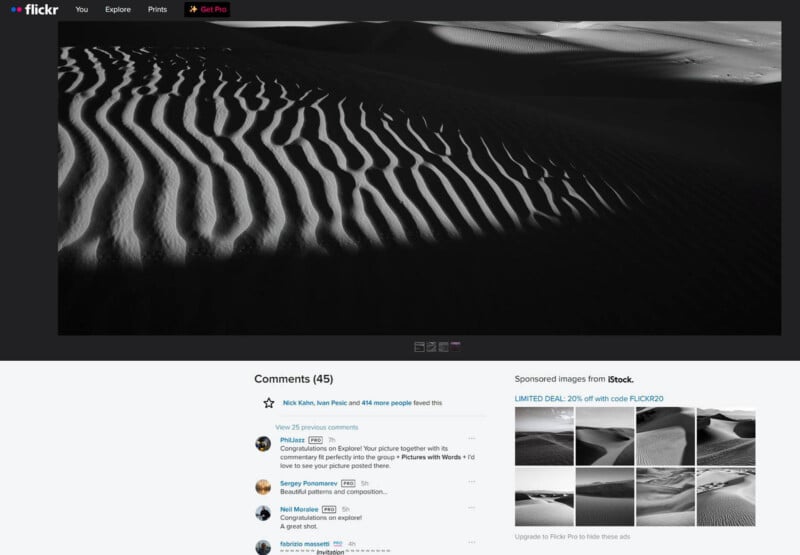
Let’s start with non-pro members. If you’re on a free account, Flickr now shows ads for iStock. Here’s the insane part: those ads are often based on images that look like yours. That means anyone browsing your work who isn’t a pro member is being actively encouraged to not buy your photography, but instead license stock images that resemble it.
Think about that. If someone is looking for photographs, Flickr is redirecting them away from you. That alone should be a deal-breaker for any professional photographer. It’s also incredibly disingenuous on the part of Flickr, and honestly, I think they should be ashamed of this. I don’t personally mind ads, but this is another level of sinister.
Now let’s look at the other side. Most professionals already have solutions that Flickr Pro offers. Storage? We already have it. Clean viewing experience? That’s called your own website. Photo management? Lightroom does that better. Analytics? Basic, limited, and not especially actionable.
So who’s left? The serious hobbyist who wants unlimited storage and nostalgia? Maybe. The long-time user who doesn’t want to migrate? Sure. But a pro member expecting real professional value? That’s a tough sell.
The price is simply not a good value anymore. The price increase pushed Flickr Pro into a range where expectations rose, and Flickr didn’t rise with them. Paying for Pro feels more like charity than strategy.
Flickr is one of those platforms where you can tell the product exists because it already existed, not because it’s actively competing in the modern photo-sharing space.
Key Takeaways: What to Remember
- Flickr is still alive, but it’s no longer essential.
- Flickr Pro offers features that many pro photographers already have elsewhere.
- Unlimited storage is no longer a compelling selling point.
- SmugMug promised more than it delivered.
- Ads actively undermine photographers.
- Professionals gain little from paying for Pro.
- Flickr works best as an archive, not a growth platform.
- Nostalgia is doing a lot of heavy lifting.
If you still use Flickr, that’s fine. If you like Flickr, that’s fine too. But let’s stop pretending that Flickr Pro is some must-have professional tool. In 2026, it’s a relic that survives on goodwill, habit, and a community that deserved more than it got.
About the author: Matt Payne is a full-time professional landscape photographer, workshop instructor with Muench Workshops, and host of the long-running photography podcast F-Stop Collaborate and Listen. He is a co-founder of the Natural Landscape Photography Awards (NLPA) and Nature First, initiatives focused on ethics, authenticity, and trust in nature photography. Matt’s work centers on thoughtful representation of the natural world and building community within photography.