Astronomers Discover Gigantic Iron Bar Running Through Ring Nebula
It’s one of the most eye-catching objects in the Universe, but now astronomers have identified an unexpected structure inside the Ring Nebula.
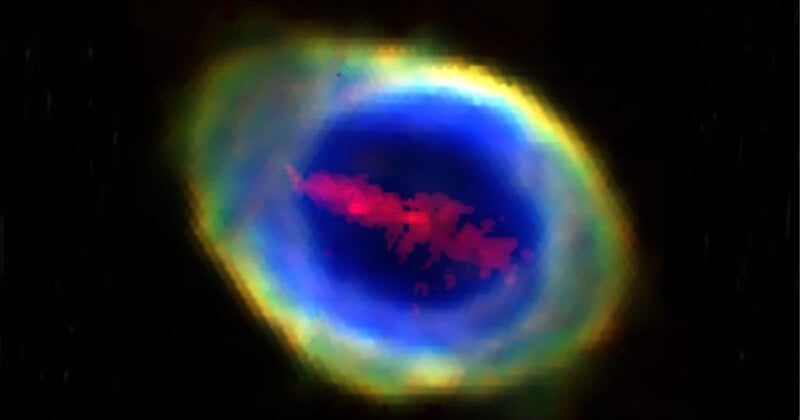
A new imaging instrument mounted in Spain’s Canary Islands called WEAVE (the WHT Enhanced Area Velocity Explorer) has found a bar-shaped cloud of iron atoms stretching across the nebula’s interior.
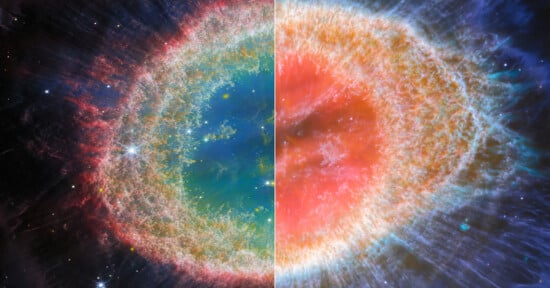
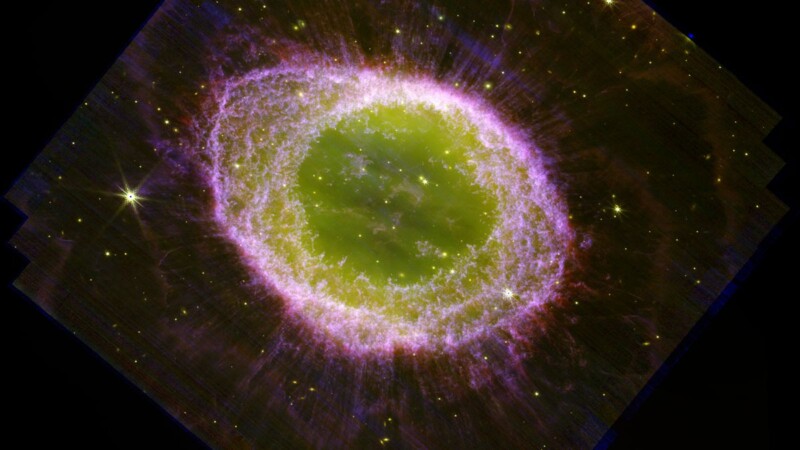
The Ring Nebula, also known as Messier 57, lies in the constellation Lyra roughly 2,600 light-years from Earth. Discovered by French astronomer Charles Messier in 1779, it is one of the best-known planetary nebulae and has been spectacularly imaged by Hubble and James Webb space telescopes.
The nebula formed when a star about twice the Sun’s mass exhausted the nuclear fuel in its core, expanded into a red giant, and expelled its outer layers. What remains is a compact white dwarf roughly the size of Earth, surrounded by a glowing shell of gas composed mostly of hydrogen and helium. The nebula is estimated to be about 4,000 years old, which is recent by cosmic standards.
The newly detected iron structure is unusual. The bar of iron atoms extends about 3.7 trillion miles (6 trillion kilometers) across the face of the nebula and contains a quantity of iron comparable to the mass of Earth’s molten iron core. Observations show that no other detected chemical element appears concentrated in the same bar-like feature.
“It is exciting to see that even a very familiar object — much studied over many decades — can throw up a new surprise when observed in a new way,” astronomer Roger Wesson of Cardiff University and University College London, lead author of the research published in Monthly Notices of the Royal Astronomical Society, tells Reuters.
“It’s a classic object for professional and amateur astronomers alike to observe. Although it’s too faint to see with the naked eye, it’s quite easy to spot with binoculars. In a small telescope, you can see the ring-like appearance.”
When processing the WEAVE data, researchers were able to examine the nebula’s spectrum across its entire structure, allowing them to map chemical composition in detail. That process revealed the iron feature.
“By obtaining a spectrum continuously across the whole nebula, we can create images of the nebula at any wavelength and determine its chemical composition at any position,” Wesson tells the BBC.
“When we processed the data and scrolled through the images, one thing popped out as clear as anything — this previously unknown ‘bar’ of ionized iron atoms, in the middle of the familiar and iconic ring.”
The origin of the iron bar remains uncertain. One hypothesis is that the iron may have come from a rocky planet that was destroyed when the parent star expanded and expelled its outer layers. If correct, this could offer a distant preview of what might happen to the inner planets of our solar system, including Earth, when the Sun reaches a similar stage billions of years from now. Another possibility is that the bar formed through processes connected to the nebula’s creation rather than from a planet.
“No other chemical element that we have detected seems to sit in this same bar. This is weird, frankly. Its importance lies in the simple fact that we have no ready explanation for it, yet,” adds study co-author Janet Drew of University College London.
“The origin of the iron might trace back to the vaporization of a planet. But there could be another way to make the feature that doesn’t involve a planet.”
Wesson notes that while a planet like Earth contains enough iron to account for the observed mass, the bar’s shape is difficult to explain.
“A planet like the Earth would contain enough iron to form the bar, but how it would end up in a bar shape has no good explanation,” he says.
Researchers plan further observations to determine whether other elements are present in the structure and to establish how common such features might be in other nebulae.