Await Digital Camera Uses ‘Film Rolls’ and Delivers 4 x 6 Prints

For a company that’s made its name in high-end cables, chargers, and Bluetooth trackers, Rolling Square isn’t known for making cameras. First teased at IFA 2025 in Berlin, the Swiss brand unveiled its Await Camera at CES 2026 in Las Vegas and is set to bring it to market within the next few months. It is a throwback to disposable film cameras and relies heavily on prints.
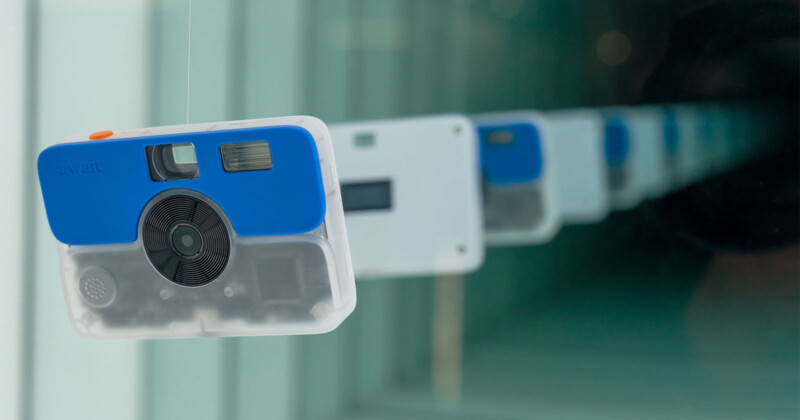
The camera’s purpose is a throwback to disposable film cameras with a contemporary twist. Pocket-sized and lightweight, the Await is fully digital, though limited to 24 shots per “roll” provided by Rolling Square as a service. Without a rear screen to preview images, the idea is to shoot the old-school way, using a viewfinder with a single shutter button and a flash. You get a fixed focus with no manual control over shutter speed, aperture, or ISO.
Once the full roll’s done, you wait 24 hours just to see the images in the dedicated app before sending them in to receive 4 x 6 prints later in the mail, harkening back to an era where taking photos had no real instant gratification. Since no one is actually processing film in this endeavor, Rolling Square believes the expected $70-$100 price for the camera will be attractive to anyone interested in retro photography.
A Digital Camera That Sort of Works in Analog
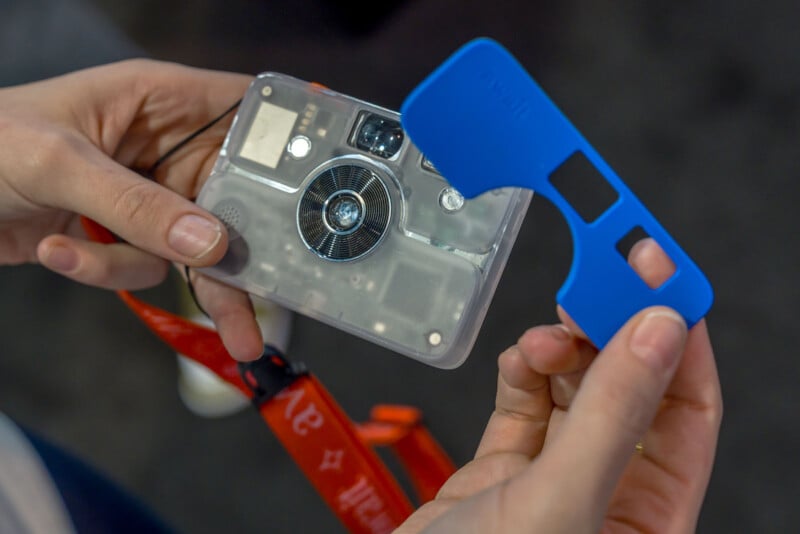
Weighing just 95 grams and measuring 3.86 x 2.66 x 0.59 inches (98 x 67.5 x 15.5 millimeters), the Await is easy to slip in and out of a pocket. At first glance, it looks like something 3D-printed in a basement, but the ultimate craftsmanship feels sturdy and thoughtful. The plan is to make the front panel at the top removable, allowing users to swap in other colors or designs, some of which users can design and 3D print themselves using 3D models Rolling Square will publish after launch.
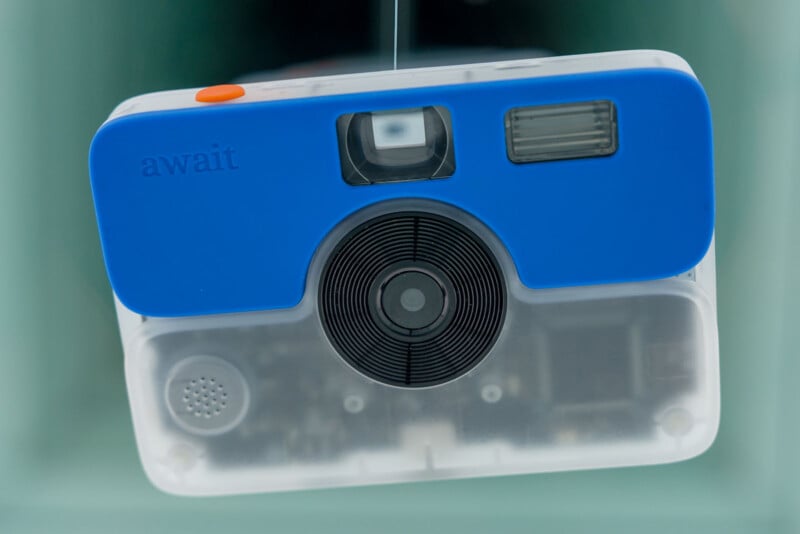
That also goes for other accessories on the device. Remove the four screws from the rear panel, and you can screw in another panel overtop that would presumably be MagSafe-compatible, for instance. Nothing is for sure yet but some form of aesthetic modularity looks to be part of the rollout to make the Await feel more personal. That’s also why color options and finishes still aren’t final. An orange lanyard will come standard with the camera to help carry it around.
A 220 mAh battery powers the camera, with a single USB-C port for charging. Rolling Square reps claim a full charge will last for at least three rolls, which largely depends on the xenon flash. It’s perhaps the most interesting choice in making this camera. Rather than go with a much cheaper LED flash common in smartphones, the xenon flash is a nod to disposable cameras of the past and is more likely to freeze movement in low-light conditions.
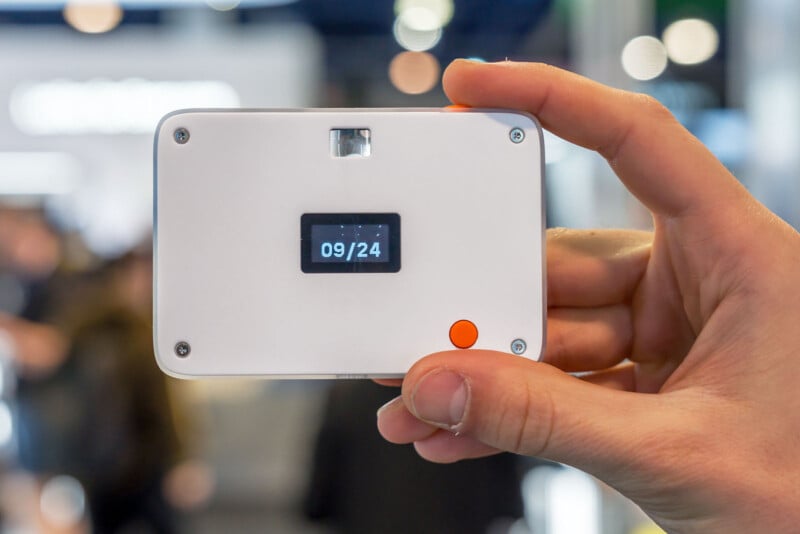
There’s no rear screen for live previews or anything else all that substantial, save for a tiny monochrome OLED display showing shot count and battery status. The orange shutter is obvious at the top, while a matching button on the back cycles the flash on or off. The camera will automatically power down after two minutes of inactivity. When empty, it takes 90 minutes to fully recharge.
Despite the standard tripod mount underneath, Rolling Square oddly didn’t include a timer, which reps say they will rectify through a future firmware update. Without that, it’s hard to see how a user could take a group photo and scoot over to enter the frame themselves.
Throwback to Kodak Film Stock
Apart from the 8-megapixel sensor inside, it’s not clear which sensor it is, nor its actual size. Reps insist the goal isn’t to produce high-res photos with clinical sharpness anyway. In fact, they’ve chosen not to use higher-quality sensors, partly because of costs and partly to avoid images that look “too clean” and undermine the intended aesthetic.
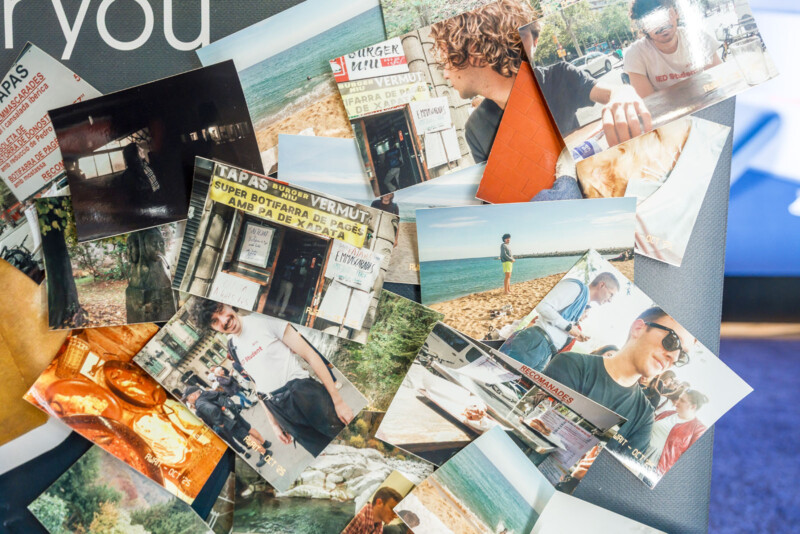
Hence, the default filter is based on old Kodak film stock, though it’s unclear which one. Even looking at the prints displayed in the booth, I can’t be sure but if I were to hazard a guess, I would say maybe Kodak Gold 200. The nostalgic inference is clear enough, especially considering that what you take is what you get. No filters, no editing, no aggressive manipulation. The idea is to capture something that feels timeless rather than driven by trend. I asked about the possibility of additional filters and color variations that simulate other film stocks, but there’s no word on that being in the mix here.
The broader intent is to change a user’s thinking and behavior when taking a photo. Limited to just 24 shots, there’s no way to check, edit, or delete images on the camera itself. Chances are, by the time you get to the last shot in the roll, you may have forgotten how you composed the first one. The optimal shooting range is between one and five meters, with only the optical viewfinder available to frame and compose a scene or subject.
Patience and the Value of Waiting
Once you finish a roll, the camera syncs wirelessly with a companion app available on iOS or Android to upload the files to the cloud. Initially, it only shows low-res image previews instead of the full files. You have to wait 24 hours to see high-res versions before picking what you want, much like the old days of waiting to pick up developed prints.
Once the higher-res images appear, you can delete unwanted frames from the roll to prevent them from being printed. The catch is that it doesn’t change what the roll costs, as the price stays the same whether it yields 24 prints or only four. Nor can you combine prints, like accumulating 24 images from separate rolls over time and only printing those selections for one price. It’s a structure that deliberately reinforces the idea that the “cost” is tied to the act of shooting, not to the number of prints produced.
There are two workflows to choose from. In Manual mode, rolls accumulate in the app until you select which ones to send for printing and when. Automatic mode skips all that and sends every completed roll to print immediately. Either way, the premise is a “frictionless photo experience”, so photos simply arrive days later, unprompted, recreating the feeling of receiving developed film.

This “pay-per-roll” model stands in contrast to both traditional film, which requires purchasing, developing, and processing (that can be expensive these days), and modern digital photography, where images often remain unprinted and forgotten in cloud storage.
Each roll will cost approximately $10, depending on region, and includes both printed photos and digital copies, plus shipping. Standard 4 x 6 prints, then ship directly to your home. The roll price includes shipping for most regions, though costs may vary depending on geography. Rolling Square reps tell PetaPixel that they’ve made arrangements with printers based in the U.S. and Europe to facilitate orders. Users ordering outside those regions may benefit more if they live closer to either one, though details have yet to be finalized.

An Old School Approach
The contradiction in terms is that the Await Camera is digital by design, yet intentionally restrictive in practice. This is no competitor to a smartphone or point-and-shoot digicam, but more a complement in slowing down the act of photography by imposing thought and consideration to every frame.
Photographers accustomed to a sense of control, be it shooting in RAW or simulating film through cameras or phones may find this camera a tough sell. Rolling Square sees its target audience as the same as others trying to capitalize on renewed interest in film: casual users, Gen Zers, travelers, and old souls drawn to the experience of taking fewer, more deliberate photos.
Currently, plans are to launch the device either directly to market or as a crowdfunded project in the $70-$100 range within Q1 2026