France Plans to Mark 200 Years of Photography in 2026
To mark the 200th anniversary of the world’s oldest surviving photograph, France is holding the Bicentennial of Photography, a series of events to celebrate the medium. There will be exhibitions, festivals, fairs, lectures, and much more across the course of 2026 and 2027
The celebrations start just next week at the Grand Palais in Paris with a free event titled ‘200 years of history, paper, ink and debate,’ offering a journey through archives, techniques, and emblematic images of photography. There are plenty of events still to be announced, including at the Nicéphore Niépce Museum.
“By celebrating photography’s birth, we aim to develop, support, and promote exhibitions and meet-ups nationwide, in urban and rural areas, by awarding labels to selected projects,” the Minisetère De La Culture says in a statement.
“These events will be featured on an interactive, vibrant map, allowing the public to discover and appreciate photographic masterpieces spanning from the 19th century to the present.”
Under the guidance of the Centre national des arts plastiques, a ministry that promotes visual arts, there will be a call for projects that “reinvent photography” — a lucky few will receive financial support to pursue their work.
“It will establish a framework for examining contemporary practices, emerging technical and artistic possibilities, the dangers of their misuse, and the challenges posed by artificial imagery, which is now viewed as both an advancement and a threat to human roles,” adds the ministry.
Why 2026?
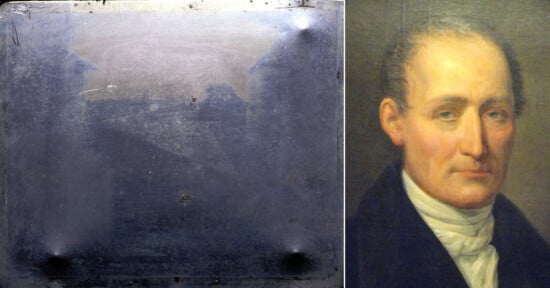
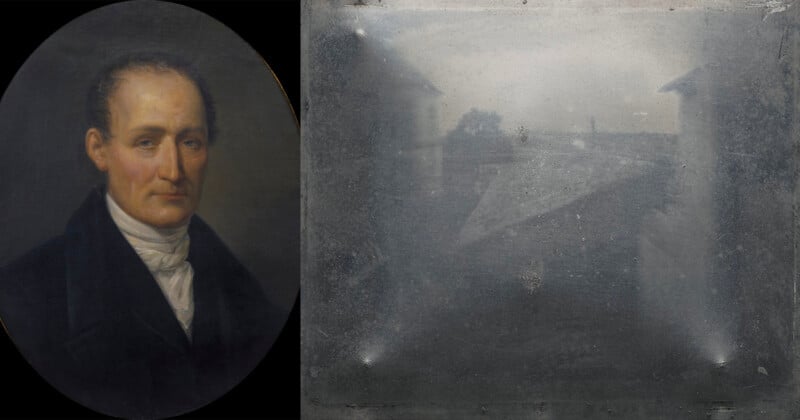
The world’s oldest surviving photograph, View from the Window at Le Gras, was taken by Nicéphore Niépce in Chalon-sur-Saône in either 1826 or 1827. It is an extremely hazy, abstract image of Niépce’s estate that required an eight-hour exposure and a bitumen-coated pewter plate. What is truly amazing about it is that it can still be viewed to this day in Austin at the University of Texas.
In a previous article, PetaPixel explained that View from the Window at Le Gras is not the first photograph ever taken, but the first one to be permanently fixed.
A few years after he took View from the Window at Le Gras, Niépce began working with Louis Daguerre as the two tried to invent a better method of permanently fixing an image. Niépce died in 1833, but Daguerre continued the work and in 1839 presented the daguerreotype process, which became the world’s first mass photography method.
For further details on France’s bicentennial of photography, head to the Une Image Pour Rêver website.