The Vanishing Local Newsrooms Where Photographers Barely Exist
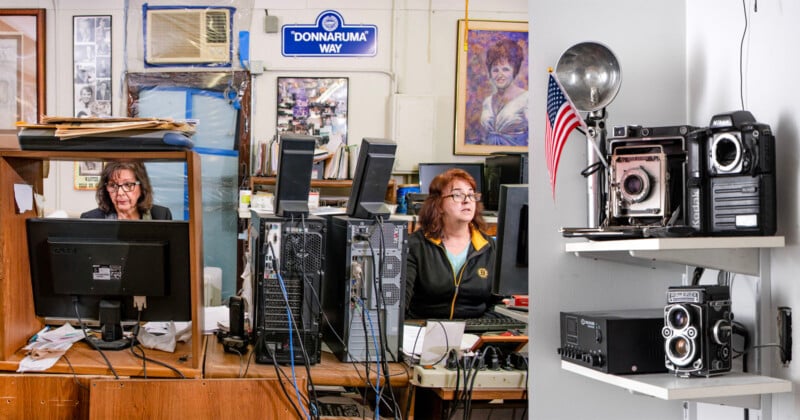
Two women sit at cluttered desks with computers in an office; to the right, shelves display vintage cameras, an old radio, and an American flag. A "Donnaruma Way" sign hangs on the wall behind them.
Work in the Post-Gazette newsroom in Boston, left, a collection of old camera equipment sits on display in The Emporia Gazette newsroom in Kansas, right.

Photographer Ann Hermes calls her project Local Newsrooms a love letter to community journalism, but it’s also an important documentation of a fast-disappearing industry.

The online web page, such as the one you’re reading this article on, has long supplanted print media as the most popular way people get their news. But print continues to hold on — especially in rural areas serving an older audience.
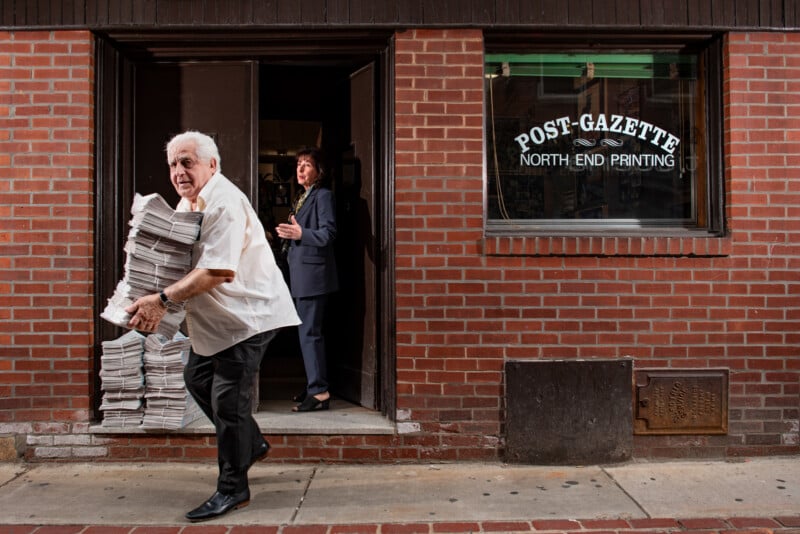
An older man carries a large stack of newspapers outside a brick building labeled "Post-Gazette North End Printing" as a woman stands in the doorway behind him.
Louie Graffeo delivers copies of The Post-Gazette for his girlfriend, publisher and editor, Pamela Donnaruma in Boston, Massachusetts.
Stacks of bundled newspapers and paper packets are piled high in a cluttered basement with exposed pipes, wires, and electrical panels. Handwritten labels with dates are visible on many of the bundles.
The Post-Gazette newspaper morgue sits in the cellar below the newsroom.
Two men sit across from each other at separate desks in an office, working on computers. The desks are cluttered with papers and office supplies. The room has pink blinds, framed photos, and certificates on the walls.
Alameda Sun reporter, Ekene Ikeme, left, and co-publisher, Dennis Evanosky, right, work on deadline in Alameda, California. The paper is now closed.

While some local newsrooms survive on a skeleton staff of two or three people, those hardy souls tend to be news writers. Hermes tells PetaPixel that out of the 50 local newspapers she visited, not much more than five still had photo departments.

“I can’t tell you how many newsrooms I’ve walked into, where the reporters will come to me with their cameras and say, ‘Can you show me how to use this?’” Hermes says.

Hermes cut her teeth as a press photographer in local newsrooms similar to the ones she has been documenting.

“We are the first ones to go in most newsrooms,” Hermes says of the plight of photographers. “We’re seen as not as important or not as needed… But you can’t really blame a lot of these newsrooms because we’re talking about papers that are working with a staff of two or three.”

“It breaks my heart because I look at these small newsrooms in small towns that have no visual staff whatsoever, meaning they don’t have any photographers.”

A man sits sideways on an office chair with one leg up on a wooden desk, using a laptop. He is looking to the side. A water bottle and a poster are on the desk. The setting appears to be a casual office.
Reporter Duncan Freeman at his desk in The Chief newsroom in New York.
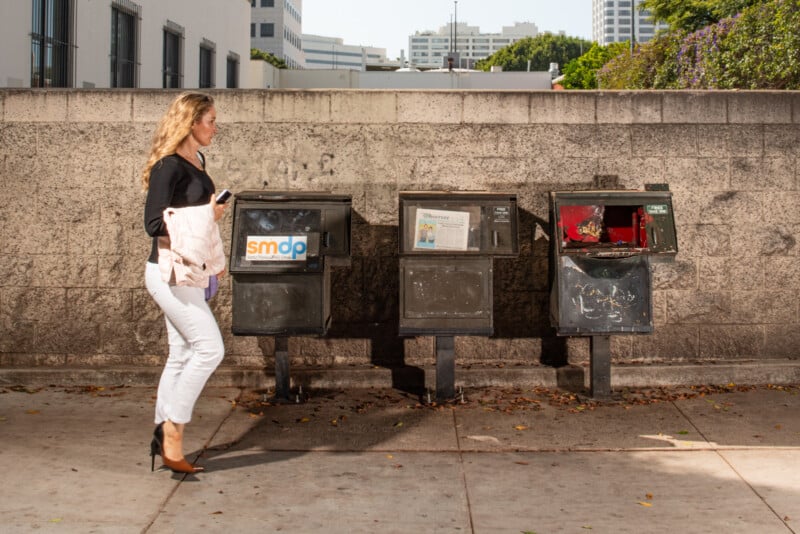
A woman in white pants and black heels walks past three weathered newspaper dispensers on a city sidewalk, next to a concrete wall, holding a white jacket and cellphone.
The Santa Monica Daily Press newspaper bins.
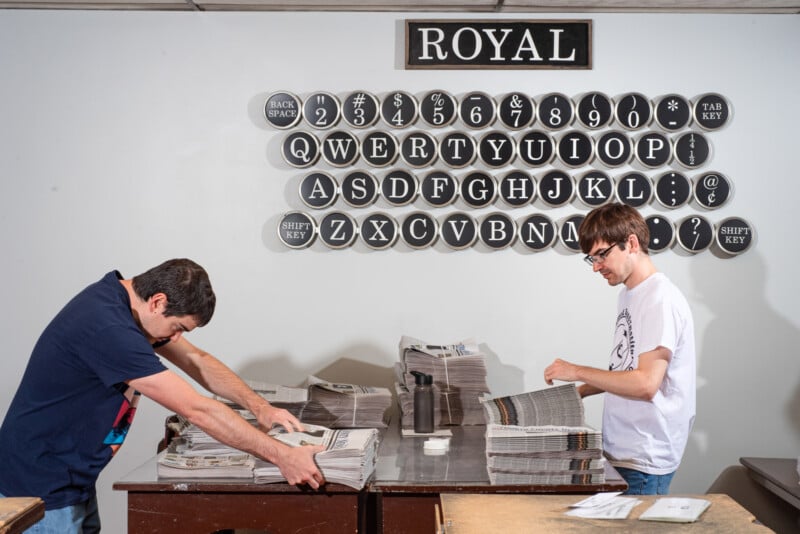
Two people sort newspapers on a table in front of a wall decorated with large round buttons arranged like a vintage typewriter keyboard. A "ROYAL" sign hangs above the buttons.
From left, North County News staff Joel and Jesse Heidel sort the newspaper and attach mailers in the newsroom in Red Bud, Illinois. The locally owned newspaper went from a staff of six to four in the past decade.

For Local Newsrooms, Hermes visited more rural newspapers than metros. That’s partly because a family-owned operation is more likely to give her access. She also finds more “interesting things happening on the local level” than in a big city.

“I do seek [rural newsrooms] out, especially when they are near a news desert,” Hermes says. “There’s some great research that’s been done to locate counties that are news desert counties. So I try to find rural newspapers that are either right up against a news desert county or are about to become a news desert.”

While research on news deserts carried out by the Columbia Journalism Review and Poynter is comprehensive, Hermes wanted to build “robust visual coverage” of the issue to support the literature.

“I also selfishly just wanted to capture these spaces and people that I find admirable and endearing and have a lot of care for,” she adds. “I wanted to dedicate my time to photographing something that I love and I hope that love letter style comes through in the images that I made.”

A wooden mail organizer with dozens of cubbyholes, each filled with rolled newspapers or magazines, neatly arranged in rows. The cubbies are labeled with small paper tags.
Newspaper morgue in The Marion County Record newsroom.
Two people sit at a desk; one types on a laptop while the other holds a camera, showing it to the first person. A water bottle and woven baskets are also visible on the desk.
From left, reporter Adam Drapcho and photographer Jon Decker discuss stories during an editorial meeting in The Laconia Daily Sun newsroom Laconia, New Hampshire.
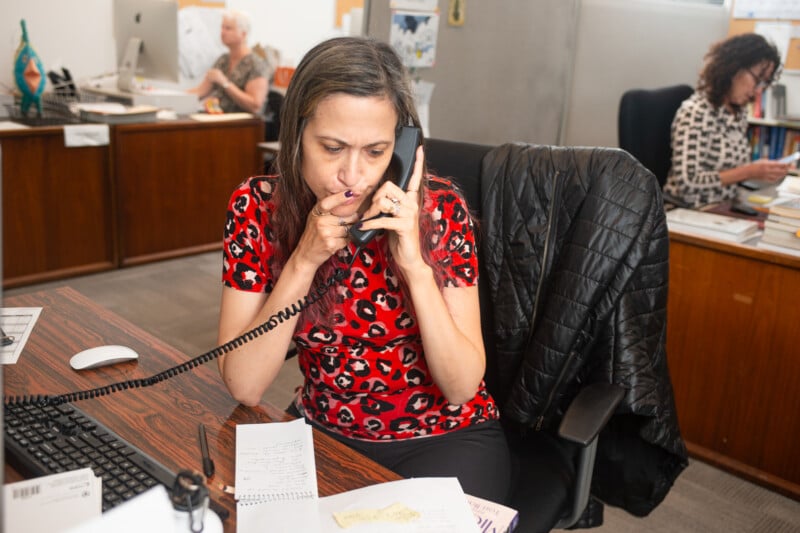
A woman in a red leopard print shirt sits at a desk, talking on the phone and writing notes. Her desk is cluttered with papers. Other people are working at desks in the background.
J. the Jewish News of Northern California reporter, Maya Mirsky, makes for a story from her desk in the newsroom in San Francisco.
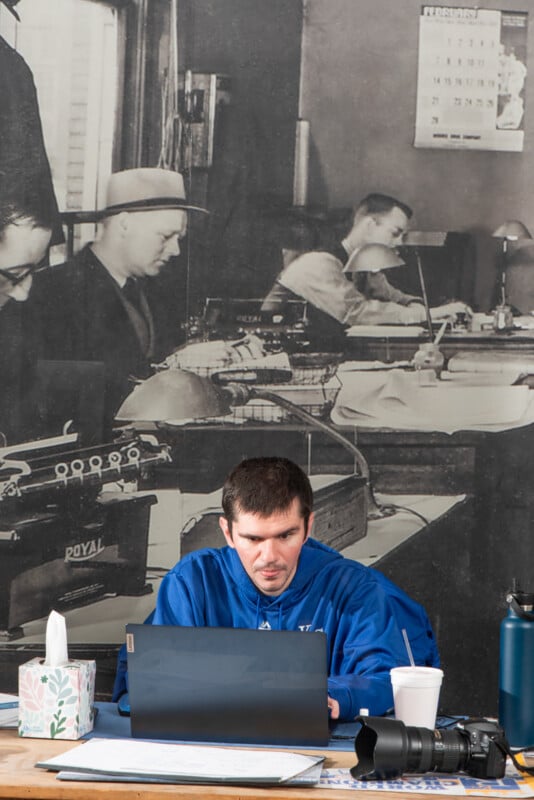
A man in a blue hoodie works intently on a laptop at a desk cluttered with a drink, tissue box, camera, and water bottle. Behind him is a large black-and-white mural of office workers at desks with typewriters.
Sports reporter John Sorce works at his desk in The Emporia Gazette newsroom in Emporia, Kansas.

Hermes says she approached Local Newsrooms much the same way she would a normal photojournalism assignment, except she brings studio lighting with her.

“Because most of these spaces have fluorescent lights that are abysmal to work with,” she explains. “I wanted to elevate the themes to be a little bit more cinematic. And I also wanted you to be able to see every nook and cranny, every coffee stain on the carpet. I wanted the audience to see just how workaday these places are.”

Studio lights can sometimes prove detrimental to a photo shoot; occasionally intimidating the subject. But Hermes says news people are the “perfect subject” to work with.

“You don’t have to explain what you’re doing to them; they already get it,” she says. It’s enabled Hermes to make work that is authentic and candid because journalists are willing to be authentic and candid in front of the camera.
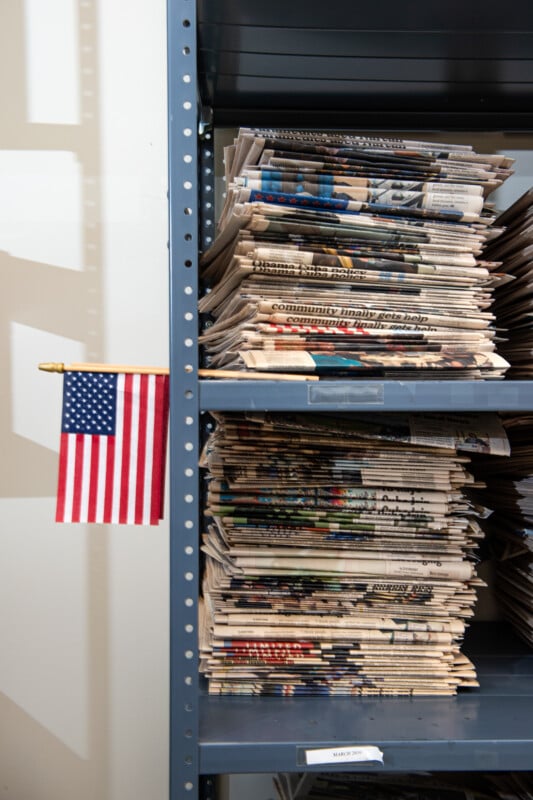
A small American flag is attached to a metal shelf stacked with several piles of folded newspapers. The newspapers are organized into two columns on the gray shelves.
The newspaper morgue in The Bradenton Herald newsroom in Florida.
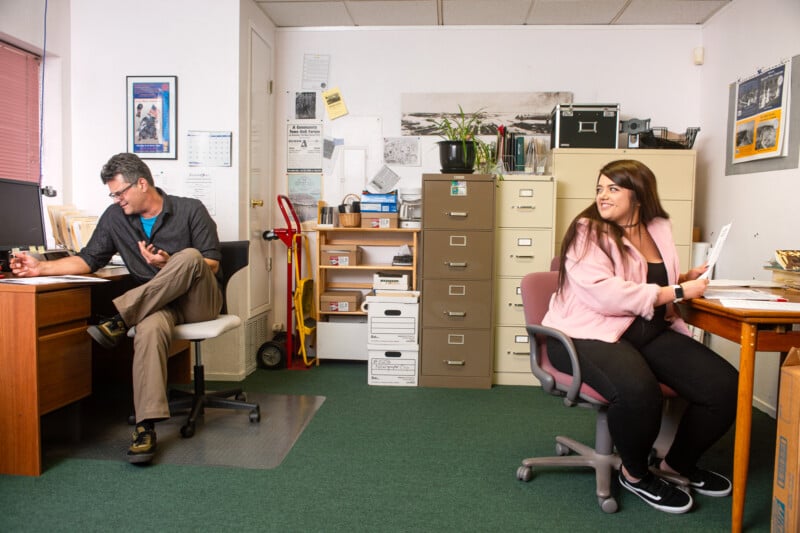
Two people sit at separate desks in a busy office. The man on the left looks at his phone, while the woman on the right, holding paperwork, looks back at him. The office is filled with shelves, cabinets, and office supplies.
Alameda Sun owner, Eric Kos and copy editor Veronica Hall examine proofs of the weekly newspaper before sending it to the printing press.
A row of yellow and blue newspaper vending machines stands in front of a red wall with a visible crack running down the center. The ground is paved, and the sky is clear and blue above.
Broken newspaper bins sit in the parking lot of The Auburn Journal in California. The newspaper sits close to two news desert counties.

Newsrooms are full of quirks: some of the ones Hermes visited still had the printing press attached to the newsrooms, even if they weren’t always operational.

“In one newsroom I visited, they had turned it into a video production room, but they kept the old printing press with the last edition still on the press. Like a memorial. I thought that was a nice juxtaposition.”

Hermes says she’s a “little obsessed” with newspaper morgues, a local paper’s archive of all its editions.

“In a lot of cases, the only record of this entire town’s history is right there,” says Hermes. “In a lot of cases, it’s never been digitized. So I wanted to capture a lot of those spaces because I thought they were really interesting.”
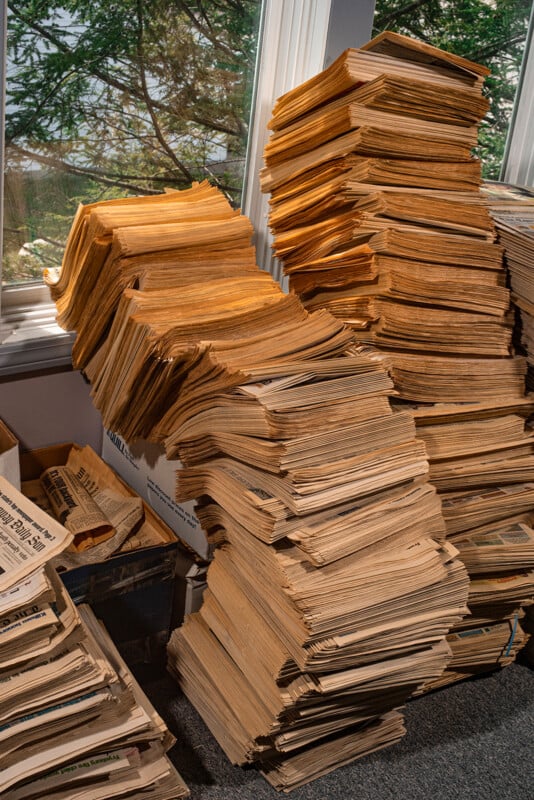
Tall, uneven stacks of old, yellowed newspapers are piled by a window, with sunlight streaming through. The newspapers appear worn and fragile, and the surrounding area looks cluttered.
The Conway Daily Sun newspaper morgue in Conway, New Hampshire.
A man works at a desk in an office behind a glass wall. In the foreground, shelves display newspapers and magazines. Above, a large sign reads "Owensboro Messenger and Inquirer.
Messenger-Inquirer editor, Don Wilkins, works from his desk in the newsroom in Owensboro, Kentucky.
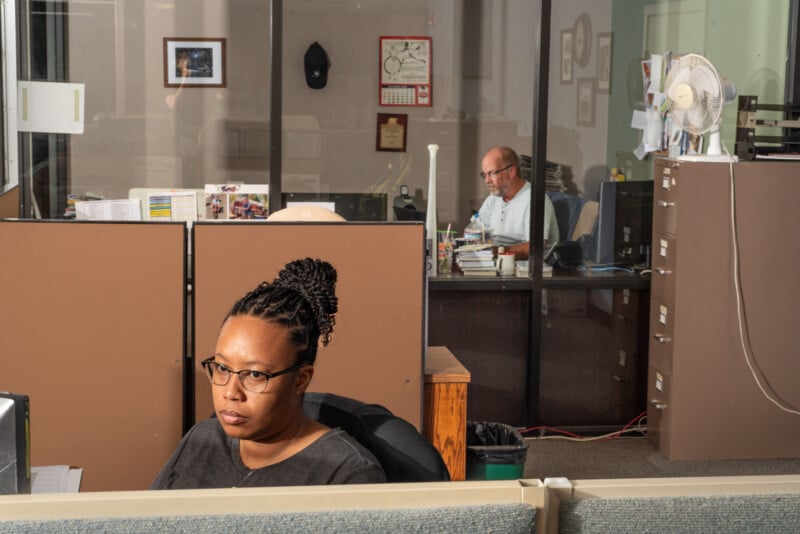
A woman with glasses works at a desk in an office cubicle, while a man sits at a desk in a separate office behind a glass partition filled with papers and folders. Both appear focused on their tasks.
Auburn Journal reporter, Stacey Adams works on deadline in the Auburn Journal newsroom on July 10, 2023 in Auburn, California.

Fittingly, Hermes met her husband while working in a newsrooms and was pregnant for much of her project. More of her work can be found on her website and Instagram.


Image credits: Photographs by Ann Hermes

Discussion