Webb Captures First-of-its-Kind Image of One-of-a-Kind Triple Star System
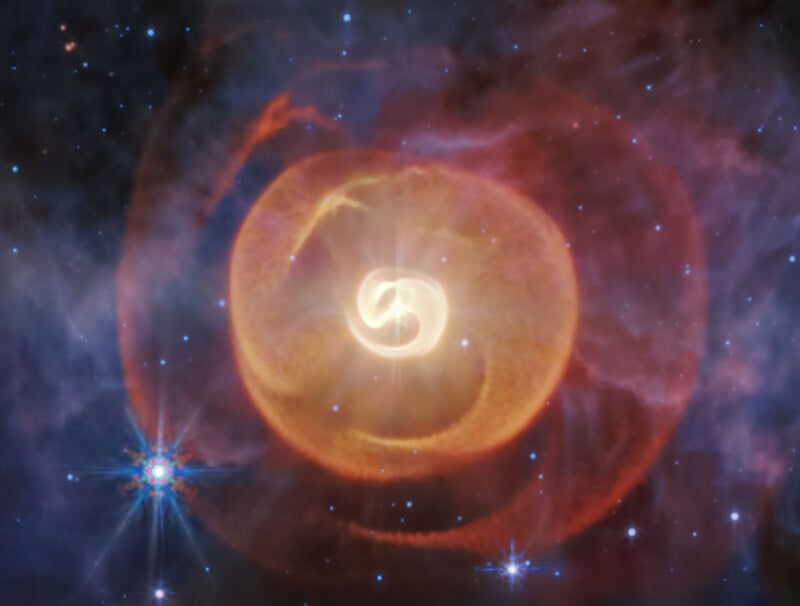
The NASA/CSA/ESA James Webb Space Telescope can add yet another “first” to its growing list of achievements. Using its mid-infrared camera, Webb detected four shells of dust around the unique triple-star Apep system. Prior images have shown just a single shell. One researcher likens Webb’s imaging capabilities to turning on the light in a room that has always been dark.
Beyond the scientific accomplishment of Webb’s new image of Apep, it is also among Webb’s most beautiful and visually spectacular photos to date, which is a high bar to clear. The final image combines several years of data from the European Southern Observatory’s Very Large Telescope (VLT) in Chile with rich, detailed images captured by Webb’s Mid-Infrared Instrument (MIRI).
MIRI features both a camera and a spectrograph. It is Webb’s only mid-infrared instrument, and astronomers and scientists use it to study relatively cooler cosmic objects and very distant ones. In this case, Apep is a one-of-a-kind triple star system located about 8,000 light-years from Earth, which is relatively nearby in the cosmic neighborhood. It is located in the constellation Norma.
What makes Apep special is that it features three stars that are all gravitationally bound to one another, two of which are Wolf-Rayet stars. These three stars appear as a single point of light in Webb’s image, but the impact they have on each other and the broader system is on full display.
“This is a one-of-a-kind system with an incredibly rare orbital period,” explains Ryan White, PhD student at Macquarie University in Australia. “The next longest orbit for a dusty Wolf-Rayet binary is about 30 years. Most have orbits between two and 10 years.”
Wolf-Rayet stars are already exceedingly rare. Of the hundreds of billions of stars in the Milky Way Galaxy, scientists believe only around one thousand of them are Wolf-Rayet stars.
“Of the few hundred Wolf-Rayet binaries that have been observed to date, Apep is the only example that contains two Wolf-Rayet stars of these types in our galaxy — most only have one,” NASA says.
When a pair of Wolf-Rayet stars near each other, “their strong stellar winds collide and mix, forming and casting out heaps of carbon-rich dust for a quarter century at a time,” NASA explains.
Only one shell of this dust around Apep has ever been imaged before, although scientists have long believed that more outer shells may exist. Ground-based telescopes alone have not been up to the task. The shells were emitted over the past 700 years, NASA says.
Not only did Webb finally enable scientists to see more than one shell of dust, but it also confirmed that the system does, in fact, have three stars gravitationally bound to one another. The VLT observed the third star in 2018, but Webb delivered a “smoking gun.”
In the case of Apep, the two Wolf-Rayet stars eject dust, which is then “slashed,” as scientists put it, by the third star, which is a massive supergiant. The massive supergiant “carves holes into each expanding cloud of dust from its wider orbit.”
Speaking of the stars’ orbits, this is another key discovery. Webb’s more detailed data enabled astronomers to determine how often the pair of Wolf-Rayet stars actually “swing by one another:: once every 190 years. During these unusually long orbits, the stars are close to each other for 25 years at a time.
“Looking at Webb’s new observations was like walking into a dark room and switching on the light — everything came into view,” says Yinuo Han, a postdoctoral researcher at Caltech. “There is dust everywhere in Webb’s image, and the telescope shows that most of it was cast off in repetitive, predictable structures.”
The two Wolf-Rayet stars were once more massive than their companion, but over a very long period, they have ejected much of their mass. Even still, scientists believe that both Wolf-Rayet stars in Apep are “between 10 and 20 times the mass of the Sun,” while the supergiant companion is up to 50 times more massive.
Eventually, these Wolf-Rayet stars will explode as supernovae, and their remaining materials will be shot off into space. They may also become a black hole if either one of them emits a gamma-ray burst.
Yinuo Han is the lead author on a new paper, “The Formation and Evolution of Dust in the Colliding-wind Binary Apep Revealed by JWST,” which was published this week in The Astrophysical Journal. Ryan White is the lead author on a separate research paper also published this week in The Astrophysical Journal, “The Serpent Eating Its Own Tail: Dust Destruction in the Apep Colliding Wind Nebula.”
Image credits: Image: NASA, ESA, CSA, STScI; Science: Yinuo Han (Caltech), Ryan White (Macquarie University); Image Processing: Alyssa Pagan (STScI)