Lexar’s New Magnetic SSD Is Probably Good, Just Not as Good as They Claim

Lexar has announced the ES5 MagSafe-compatible external SSD that promises extremely fast read and write speeds when used in tandem with a Samsung Galaxy S25 or Apple iPhone 17 series phone. And while it probably will work just fine, the promised read and write speeds are a bit misleading about what users can actually expect.
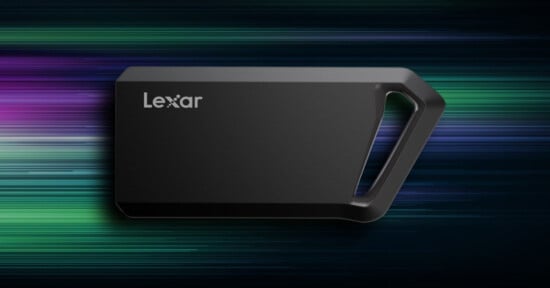
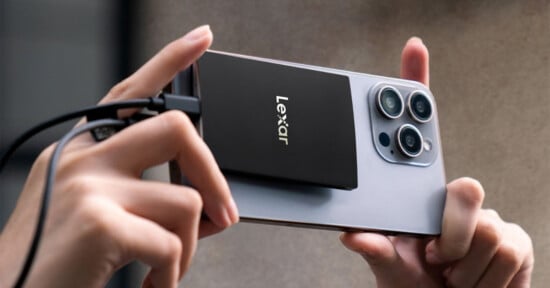
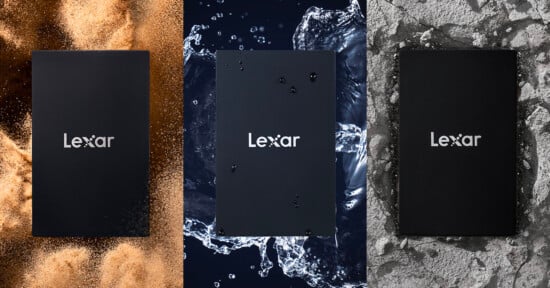
The Lexar ES5 Magnetic Portable SSD is advertised as a high-speed storage solution that attaches directly to iPhones and “other magnetic surfaces.” The company says that it has transfer speeds up to 2,000 MB/s read and 2,000 MB/s write, is IP65 dust and water resistant, can survive a drop of up to three meters, has a thermal design that promises “optimal temperature and high performance,” and compatibility with both Samsung Galaxy S25 smartphones and the iPhone 17 series.
It is available in 1TB and 2TB configurations for $119.99 and $199.99 starting today, with a 4TB capacity coming in early 2026 (pricing was not released for the 4TB version at the time of publication).
With those specifications and the built-in MagSafe, it looks like a no-brainer for those who want up to 4TB of additional storage for capturing video on a smartphone — especially the new iPhone 17 Pro and its ability to shoot in ProRes RAW.
The thing is, while it is highly likely that the ES5 will support ProRes RAW capture, that isn’t for sure and this little SSD isn’t quite as good as Lexar is making it sound. For starters, the SSD doesn’t appear to actually be new, but is likely just a rehoused version of the Armor 700 it released last year.
On that note, it’s worth pointing out that the ES5 has the same limitations as the Armor 700. Those promised super-high read and write speeds only apply to USB 3.2 Gen 2×2, a note Lexar hides deep in the fine print on the bottom of its product page. No modern Apple product supports USB 3.2 Gen 2×2, and as a result, the iPhone will default to capping at USB 3.2 Gen 2 speeds, which is half of what Lexar promises.
On an iPhone 17 Pro, the Lexar E25 Magnetic Portable SSD will only ever be able to transfer as fast as 1,000 MB/s read and write. Additionally, Lexar doesn’t actually say that the SSD is viable for ProRes RAW capture, even though that’s what is expected given the marketing. Lexar only officially notes support for ProRes Log capture:
“With the ES5 Portable SSD magnetically secured to a mobile device, users can shoot up to 4K at 60FPS for iPhone 15, 4K at 120FPS for iPhone 16 and 17 (or newer), and up to 8K 30FPS with Samsung S25 (or newer),” Lexar writes.
“Apple plans to release Final Cut Camera version 2.0 with support for ProRes RAW at a later date. Lexar will evaluate and test product compatibility once the update becomes available.”
On that note, it’s also worth pointing out that Samsung Galaxy S25 users will get even worse performance, as not only does Samsung not support USB 3.2 Gen 2×2, the S25 Ultra only uses USB 3.2 Gen 1, which cuts peak transfer performance versus an iPhone in half — expect to cap at 500 MB/s transfer speeds with the ES5 on Samsung’s latest smartphone.
Because there are more variables associated with ProRes RAW capture versus ProRes Log, Apple actually says it can’t give a target data rate because so much changes based on what is being recorded.
“Apple ProRes RAW data rates generally fall between those of Apple ProRes 422 and Apple ProRes 422 HQ, and Apple ProRes RAW HQ data rates generally fall between those of Apple ProRes 422 HQ and Apple ProRes 4444,” Apple says.
The iPhone 17 Pro can record both ProRes RAW and ProRes RAW HQ, and the latter is the second most data-intensive ProRes format available behind ProRes 4444.
So with that in mind, 1,000 MB/s transfer speeds are probably enough to support ProRes RAW capture on iPhone 17, but without testing this specific SSD, it’s hard to say for sure since other factors are at play, like controller compatibility and thermal management. Since Lexar hasn’t said specifically that it works with ProRes RAW, it’s worth approaching the ES5 with some level of caution if that is the desired recording format.
All that can be said for certain here, though, is that Lexar’s new magnetic portable SSD is only at best half as fast as Lexar is claiming for its intended use, despite marketing it specifically for a device that can’t take advantage of the USB format.
Image credits: Lexar