That Time Mathew Brady’s Assistant Almost Killed Ulysses S. Grant

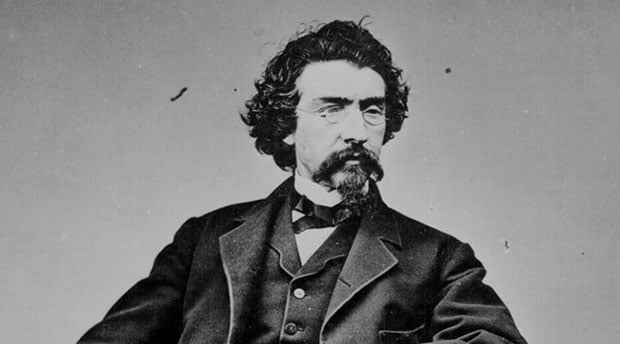
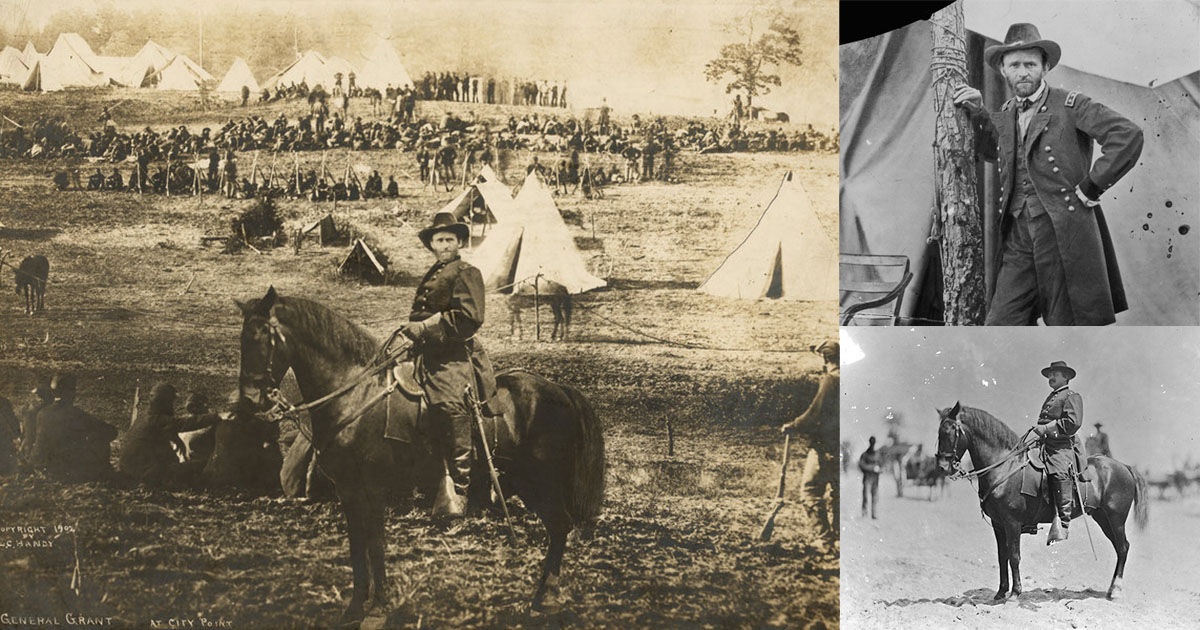
Mathew Brady is the most famous American photographer of the 19th century, but would his legacy be any different had President Ulysses S. Grant died in his studio? It very nearly happened.
While Grant was sitting for Brady, a skylight above Grant’s head collapsed sending chunks of glass down to the studio below where Grant was placed. Miraculously, Grant was unharmed.
The story comes from James E. Kelly, a keen American Civil War historian who, despite being just six years old when the fighting began, conducted extensive interviews with generals and soldiers to aid in his main occupation of sculpting and illustrating.
Kelly interviewed Brady several times. Brady pioneered photography in the United States, opening a New York studio in 1844 and going on to take famous pictures of Abraham Lincoln, Frederick Douglass, and John Quincy Adams.

Civil War historian Cecily Zander published an extract from Kelly’s memoirs of Brady recalling the time Grant ‘traveled East’ in the spring of 1864, not long after he had been made the new Commander-in-Chief of the Union Army. Brady met him from the train and invited him to his studio the next day for a portrait session. Grant agreed.
“Next day I thought they would come about 2 PM,” Brady told Kelly. “So had three cameras ready and a man behind a screen to take as to color, etc., and waited for him. We waited all afternoon, until I was all worked up. It was a short day, the light began to fade, and I was all fagged out [exhausted]. I said, ‘Well, we might as well give up — he is not coming’.”
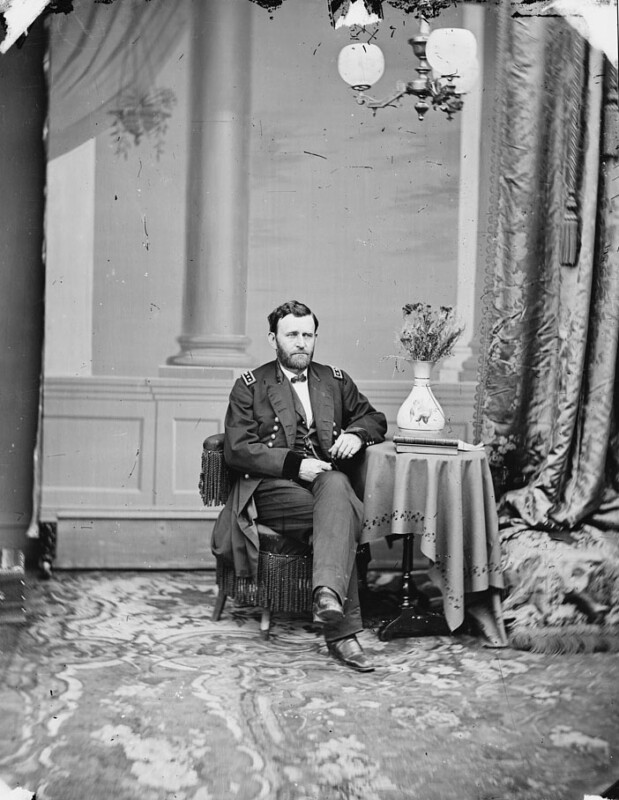
But just as Brady was about to give up on Grant, a carriage pulled up outside with Edwin Stanton, the U.S. Secretary of War, and Grant. Brady’s studio had a skylight above it, which he kept covered during the day. But since the light had faded, Brady sent up an assistant to remove the canvas from the skylight, which was a heavy glass plate about three-fourths of an inch.
“He was a clumsy Dutchman, and as we were talking, there was a crash, and down came that heavy glass in a shower all around us — pieces as large as your hand, of all triangular shapes, cutting and smashing everything, and sticking in the table and floor,” Brady recalled to Kelly.
“Stanton jumped up and grabbed me, his face as white as a sheet. Pulling me into a little room, he said, ‘Not a word of this! They will think it is a conspiracy—it must be kept quiet!’ Looking up we could see the legs and arms of the Dutchman hanging down.”
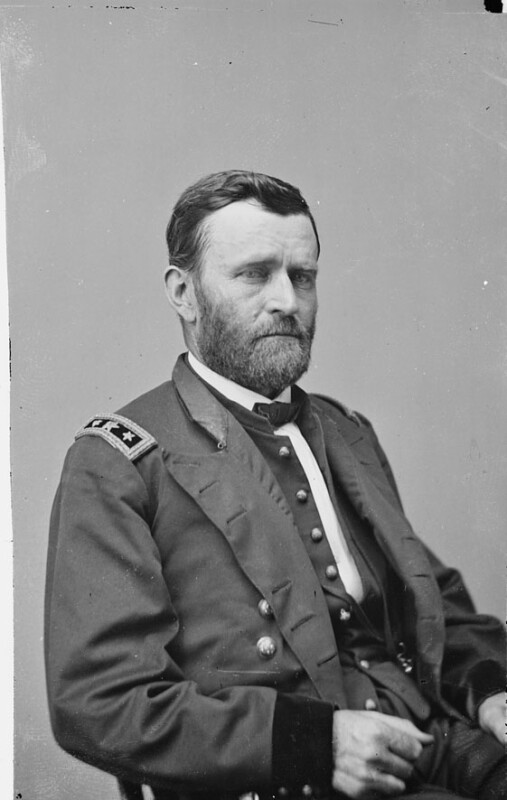
Kelly inquired how Grant — who had been sitting beneath the skylight — had reacted. “He never moved,” said Brady. “Not a muscle; his face was firm and unconcerned. He gave that slight sneer with his nose, and looked as if nothing had happened.”
Grant kept his cool as shards of glass rained down all around him, any one of which “might have gone through his skull.” But Grant simply continued with the photo session as if nothing had happened.

That Grant acted so stoically is entirely in keeping with what historians know about the 18th president. Known for his unflappable nature on the battlefield, it comes as no surprise that a photographic studio mishap would not shake him.
Image credits: Library of Congress / Mathew Brady