Photographers Are Finally Getting the Credit They Deserve In News Media

When The Washington Post sent a reporter to Utah to cover the shrinkage of Great Salt Lake, the writer collaborated with local independent photographer James Roh who knows the territory, and helped with crucial reporting. This is increasingly the norm.
The resulting story, published online on August 17 and in print on August 19, displayed a double byline: By Ruby Mellen and James Roh.


“We give bylines to photojournalists when they help with the reporting,” said Mellen. “James (Roh) is based in the region and was super helpful in his knowledge of the landscape and sharing his contacts from the area, hence his name on the story.”
Mellen is a reporter on the newspaper’s climate desk, based in Washington, DC. Roh is an independent photographer/videographer in Salt Lake City, Utah.
The Big Picture: Mutual Respect and Collaboration
“The needle has been moving toward more credit for visual journalists,” says Boyzell Hosey, senior editor of visual storytelling at ProPublica. “Overall, there is more awareness of the important role of visual professionals, more appreciation, and more respect.”
If a photojournalist helps develop and shape a story at ProPublica, then a byline is warranted, says Hosey, a longtime photo editor recognized for leadership by the National Press Photographers Association (NPPA).
In Utah, Roh gets assignments from a range of clients, including news outlets. He views visiting writers as partners/teammates. Collaboration, he says, improves the experience and the storytelling, which relies on visuals to engage audiences.
The digital version of The Washington Post’s article about the Great Salt Lake featured 11 of Roh’s photos and videos. The story was published on the front page of The Post’s print edition, with one of Roh’s photos on the front and more inside.
Longtime professionals in news journalism say credit for photographers has expanded.
Fifteen years ago, award-winning photojournalist Melissa Lyttle — then with the St. Petersburg Times (now Tampa Bay Times) — touted collaboration and lamented a “service mentality” that could relegate photographers to filling orders.
“With too many stories, photojournalism is treated as an afterthought and handled with a service mentality,” Lyttle wrote in Nieman Reports in 2010. “Assignments arrive from the newsroom — ‘Go take a picture of this person doing that’ — and the photo department fills the order.”
On the flip side, Lyttle said she was working closely with writer Lane DeGregory on an emotionally challenging story about a 14-year-old and her newborn baby. Both were in foster care. Lyttle’s collaboration with DeGregory led to a partnership and more powerful stories together.
“During our five-month reporting partnership on ‘The Girl in the Window,’ a story about a feral child found locked in her biological mom’s closet, we bonded as friends, and with our shared commitment and passion for storytelling. We pushed each other to become better journalists,” she wrote.
Their project was named Best Published Picture Story in the 2009 Best of Photojournalism awards sponsored by the National Press Photographers Association (NPPA). And DeGregory’s written story won a Pulitzer Prize for Feature Writing that year.
Deep Expertise
Some photographers are subject experts or area experts — sometimes both.
New York-based photojournalist Victor J. Blue has been working in Guatemala for more than two decades. When The New York Times Magazine recently published a poignant report on 36 Maya women survivors of sexual assault seeking justice, Blue’s name was listed first: “Photographs and Video by Victor J. Blue.”

On August 10, The Times featured Blue via its Times Insider column that explains “who we are and what we do,” casting the photographer as an expert on the aftermath of the Guatemalan civil war.
What was Blue’s biggest challenge in working on this story, asked Times reporter Sarah Bahr, who covers culture and style.
“Figuring out a way to lace together the stories and testimonies of so many women,” Blue replied. “It’s quite a complicated case.”
Blue, a voracious reader, encourages photojournalists to read and become area experts.
“I think it helps photographers to strive to become area experts in the contexts they most dedicate their time and energy to,” says Blue. “Reading widely, building sources, and keeping up with changes in these contexts over time is key.”

A Range of Credits
On August 21, Mother Jones posted a photo essay on federal tactics to detain asylum seekers, with credit to Blue for text and photos.

The New York Times published a digital report on August 19 by its Atlanta bureau chief, Rich Rojas, about a shanty boat floating the Louisiana bayou bound for New Orleans. The article featured video and stills by New Orleans-based photographer Annie Flanagan. The Times’ credit: “Visuals by Annie Flanagan.”

Based in Cincinnati, photographer Madeleine Hordinski completes assignments for top new outlets. Variables that affect credit for photographers, she says, are the publication’s style guide/guidelines and whether the piece is a written article with supporting images or a photo-driven or heavily-visual feature or project. Some publications’ print layout and web design have set language and placement for photographers’ bylines, while other publications have more flexibility for each project or story.
Hordinski has received boldface credit at the top of published news content (Photographs by Madeleine Hordinski), standard credit with still pictures and video, and contributor credit when she helped with reporting or pitched the story to the publication.

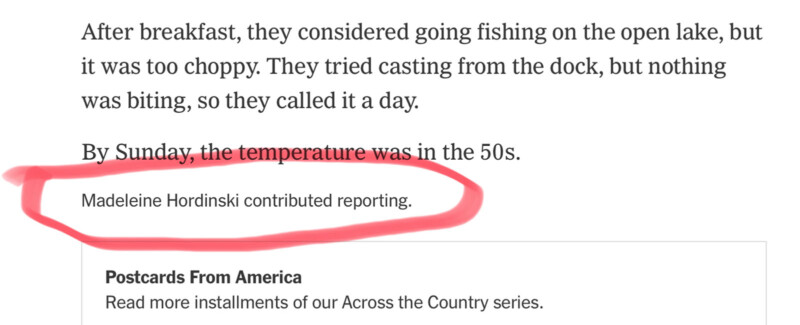
A 2023 story in The New York Times about Lake Erie winters on Put-in-Bay credited Hordinski as the photographer and also included a credit line at the end: “Madeleine Hordinski contributed reporting.”
The lines between photographer and reporter are being increasingly blurred.
About the author: Ken Klein lives in Silver Spring, Maryland; he is retired after a career in politics, lobbying, and media including The Associated Press and Gannett in Florida. Klein is an alumnus of Ohio University and a member of the Dean’s Advisory Council of the Scripps College of Communication. Professionally, he has worked for Fort Myers News-Press (Gannett), The Associated Press (Tallahassee), Senator Bob Graham, and the Outdoor Advertising Association of America (OAAA).
Image credits: Header photo licensed via Depositphotos.