Red Bull’s 2019 Zero-G F1 Pit Stop Is Still an Awesome Watch
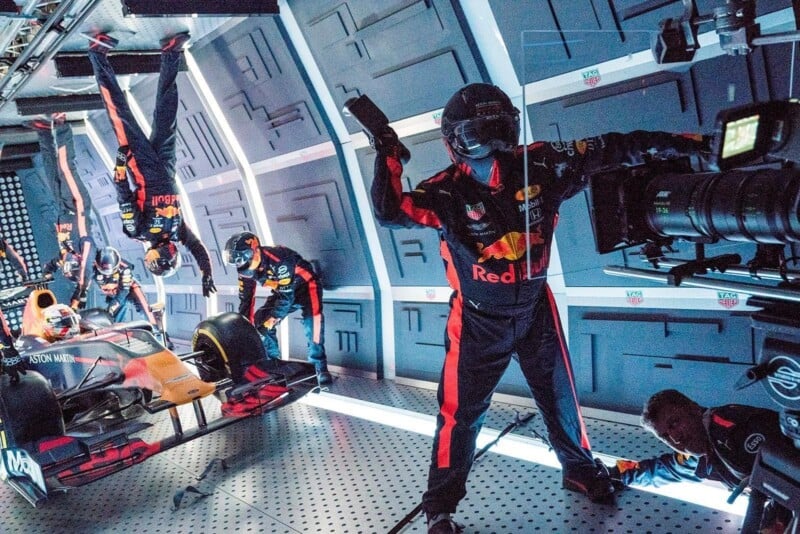
At first glance, it plays like visual effects wizardry, an F1 car suspended midair, mechanics orbiting it with balletic precision, but the reality behind Red Bull Racing’s zero-gravity pit stop is far more ambitious and well worth revisiting.
Created back in 2019, Red Bull recently brought the Zero-G project back into the limelight online as the new Formula 1 season gets underway, a reminder of the kind of boundary-pushing ideas Red Bull has become known for over the years.
This was not a simulation. It was a meticulously engineered collision between motorsport, aerospace physics, and filmmaking, executed inside a flying laboratory where gravity itself became the primary adversary.
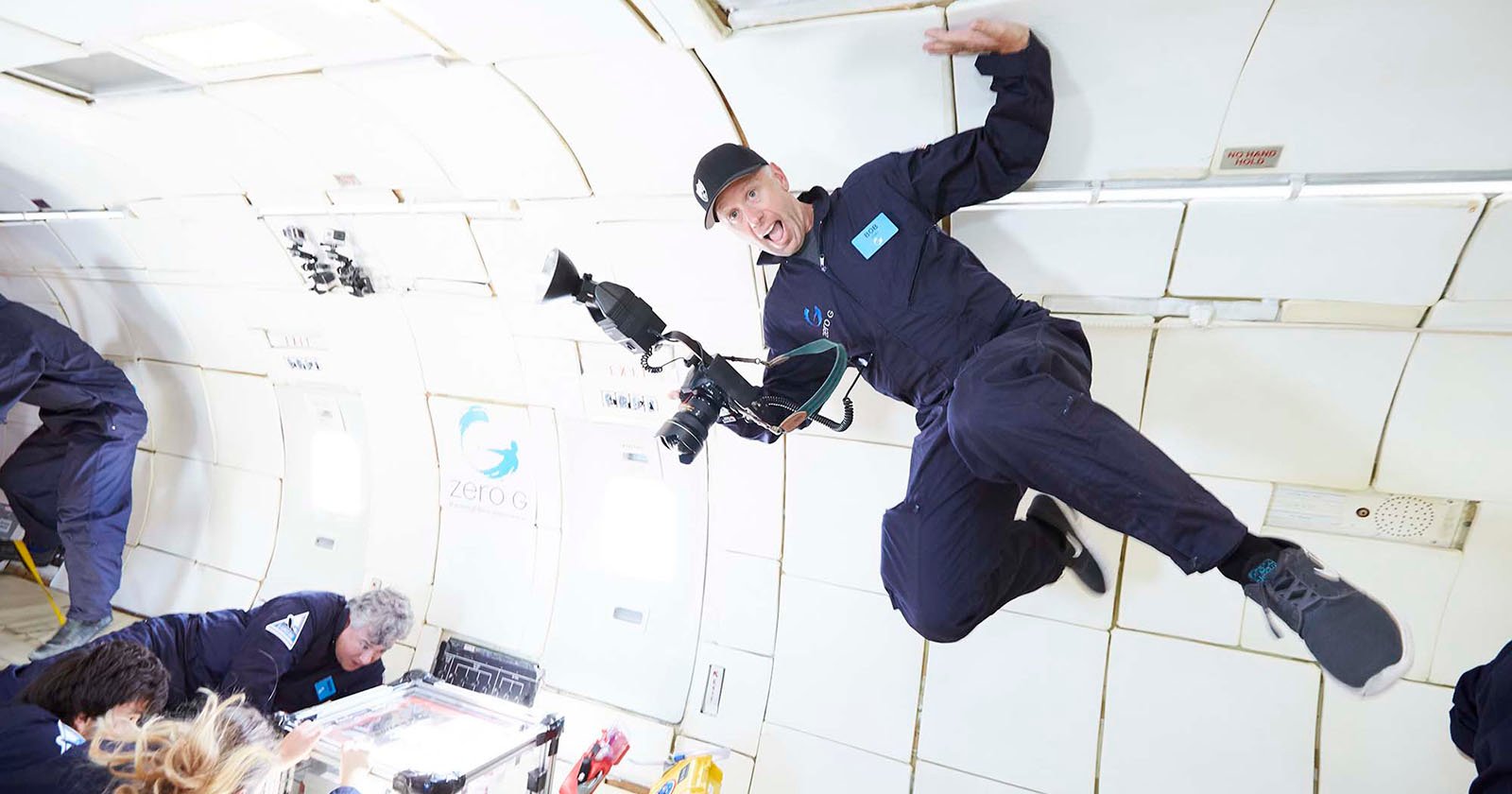
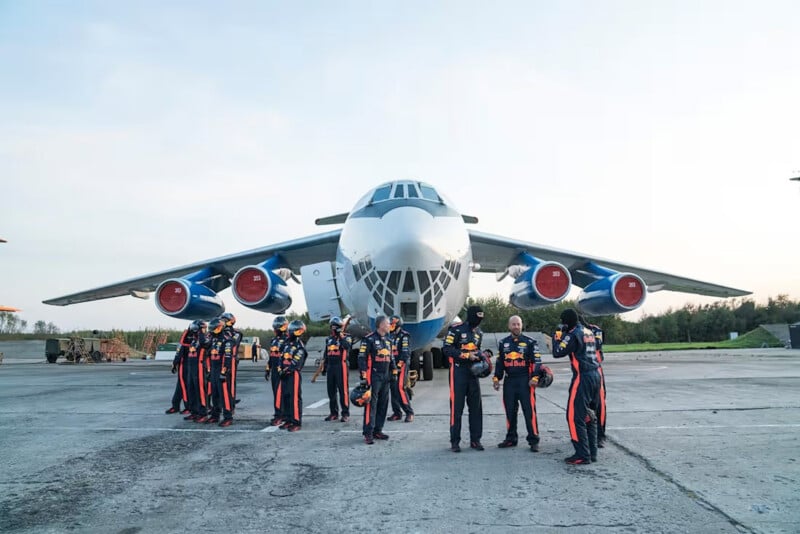
The setting of the Zero-G Pit Stop was a modified Ilyushin Il-76 MDK, a hulking aircraft designed to simulate weightlessness through parabolic flight. Operated in collaboration with Roscosmos, the plane transformed into a rolling production studio, one that, for roughly 22 seconds at a time, abandoned the rules that make both pit stops and cinematography possible.
Engineering a Floating Video Set
Before a single frame was captured, the production hinged on a problem more architectural than cinematic: how to stage a pit stop in a space where “floor” and “ceiling” lose meaning.
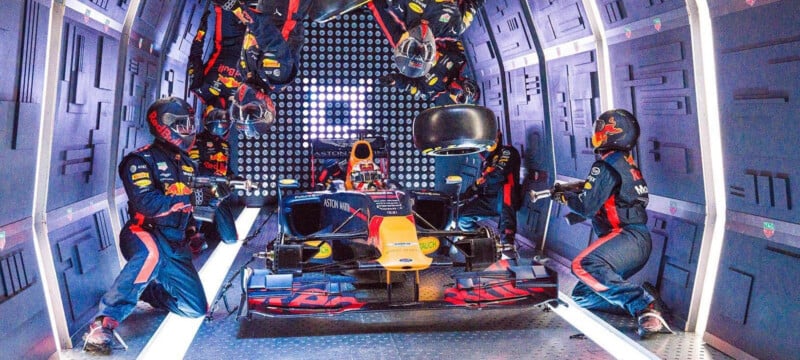
Inside the cargo bay, a bespoke rig was constructed to house the 2005 RB1 chassis, chosen not for nostalgia but for practicality. Narrower and more resilient than its modern counterparts, the car offered just enough clearance in a fuselage already crowded with lighting rails, camera mounts, and safety tethers. Every element had to be secured for both extremes: the crushing force of a 2G climb and the sudden release into weightlessness.
To previsualize the chaos, director Andreas Bruns relied on an analog approach. Storyboards evolved into a full-scale Styrofoam mock-up built in Russia, allowing both the pit crew and cosmonaut trainers to rehearse blocking and movement. In zero-G, choreography is not about footwork; it is about anchoring. Positions were defined not by where someone stands, but by where they can hold on.
Shooting in 22-Second Windows
Filming unfolded across seven flights and roughly 80 parabolas, each offering a fleeting window of weightlessness. Strip away setup and reset time, and the production was left with approximately 15 seconds of usable shooting per attempt. That constraint dictated everything.
With around 25 shots on the list, the margin for error was razor-thin and the team had just two, maybe three takes per setup. Each parabola required rapid recalibration: camera repositioned, crew reset, problems diagnosed and solved in the two to five minutes before the next climb.

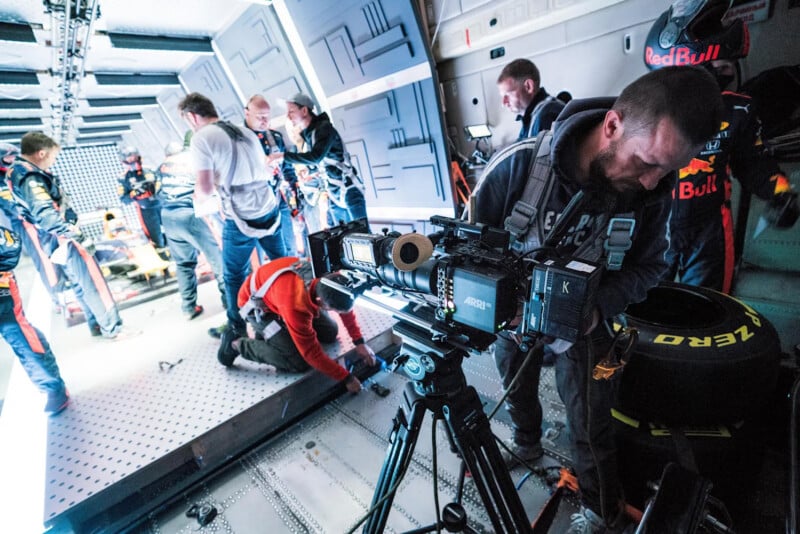
“We used one, sometimes two, Arri Alexa Mini cameras with anamorphic lenses to shoot cinemascope — but also to have that characteristic bouquet only anamorphic lenses can provide. For a few rigged shots we needed to use DSLRs and action cams to achieve certain angles and movements,” explained “Zero-G” director Andreas Bruns.
Traditional filmmaking hierarchies collapsed under these conditions. Camera operators were not just framing shots, they were stabilizing themselves midair, often tethered or wedged into the set. Even the act of panning became physical negotiation, as inertia replaced friction and every movement risked unintended drift.
A custom-built camera slider, part motion-control rig, part safety solution, became essential. In an environment where a loose camera could become a projectile, controlled movement had to be engineered into the system itself rather than left to handheld improvisation.
“The biggest restriction was the size of the plane — I nicknamed it the Sardine Can. We had to work up a storyline that would overcome those size limitations. I also wanted to build-up a dramaturgical arc for our general stunt, playing tricks on our viewers, not revealing everything right away to make them wonder what the hell is going on — until the packshot reveals the full potential of what it means to be in zero-G,” Bruns said.
When Physics Fights Back
What makes the footage compelling is not just the spectacle of weightlessness, but also why it continues to resonate years later, as the sport returns for another season.
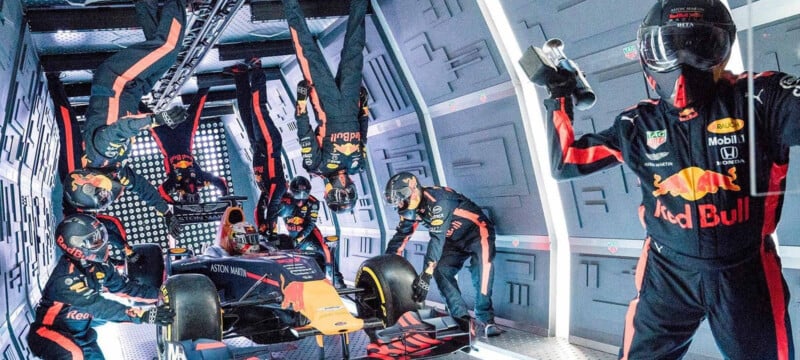
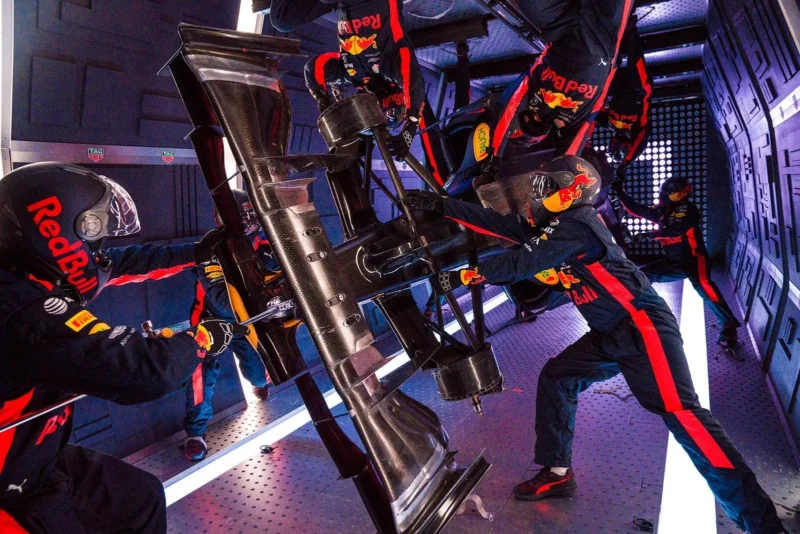
On Earth, a pit stop is a study in controlled force, mechanics push against the ground, leveraging body weight to counteract the torque of wheel guns. In “Zero-G,” that equation collapses. Every action produces an equal and destabilizing reaction. Pull the trigger on a wheel gun, and your body rotates instead of the nut.
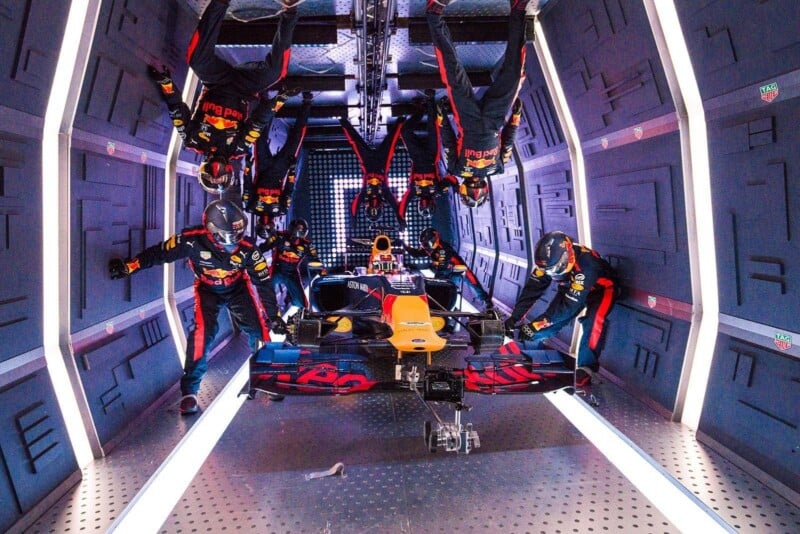
The solution was counterintuitive: embrace inversion. By splitting the crew between “floor” and “ceiling,” and flipping the car relative to them, the team created opposing forces that stabilized the operation. It is a visual trick born not of editing, but of necessity, one that gives the final footage its disorienting elegance.
Even then, control was tenuous. Mechanics anchored themselves with foot straps, relying on ankle stiffness as their only point of resistance. The result is a pit stop that feels simultaneously precise and precarious, every movement calculated yet vulnerable to drift.
Cinematography Without a Horizon
For the camera team, zero gravity erased one of the most fundamental tools in visual storytelling: orientation.
Without a fixed horizon, composition had to be rethought. Frames were built around motion rather than stability, with the floating car acting as the only constant in a shifting spatial field. Depth perception became fluid, foreground and background swapped roles as crew members drifted through the frame.
Lighting, too, had to adapt. Fixtures were rigged into the set, their placement dictated as much by safety as by aesthetics. Shadows behaved differently without a grounded reference point, adding to the footage’s surreal quality.
“For our set decoration, we used the mixture of film and concert lights. How many? A lot! We had more than four tonnes of equipment and set constructions installed in the aeroplane,” said Zero-G producer Dmitry Timonov.
Perhaps most striking is how little of this feels controlled in the final cut. The camera does not dominate the scene, it participates in it. There is a subtle sense that the lens is subject to the same forces as the subjects it captures, lending authenticity that no amount of CGI could convincingly replicate.

The Cost of Reality
The decision to shoot practically came with a physical toll. The same parabolic motion that creates weightlessness also induces disorientation, earning the aircraft its nickname, the “vomit comet.” Crew members, including the director, trained in advance, even subjecting themselves to roller coasters to prepare for the G-forces.
Still, adaptation was uneven. The vestibular system, tuned for a world with gravity, struggles to recalibrate in such short bursts. Between takes, the production became a balancing act between creative ambition and human limits.
Beyond the Stunt
It would be easy to frame the Zero-G Pit Stop as merely a marketing spectacle, and it is, in part, but it also reflects a long-running pattern of ambitious, unconventional projects that Red Bull continues to revisit and celebrate. It’s not surprising the company is sharing it again on social media, years later, not only because the 2026 F1 season just started but because the content is still just as mesmerizing now as it was in 2019.
Every creative decision, camera placement, choreography, and even the choice of car, was dictated by physics. The result is a piece of content that still holds up today. Not because it is extreme, but because it is real.
As the new F1 season gets back underway, it serves as a reminder that beyond the racing itself, Red Bull has long been just as committed to pushing creative and technical limits off the track. Often, the most compelling images come not from bending reality in post-production, but from confronting it head-on, even when that means taking a film crew to 33,000 feet and asking them to work without gravity.
Image credits: Red Bull Racing, Zero-G BTS stills by Denis Klero