Photographer Creates Something Original, Everyone Assumes It’s AI
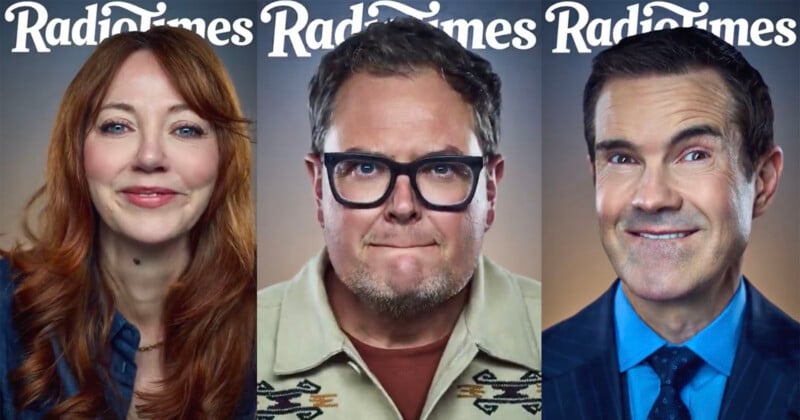
A photographer behind a genius marketing campaign that’s caused a stir online tells PetaPixel it is “frustrating” that people immediately assume it’s AI.
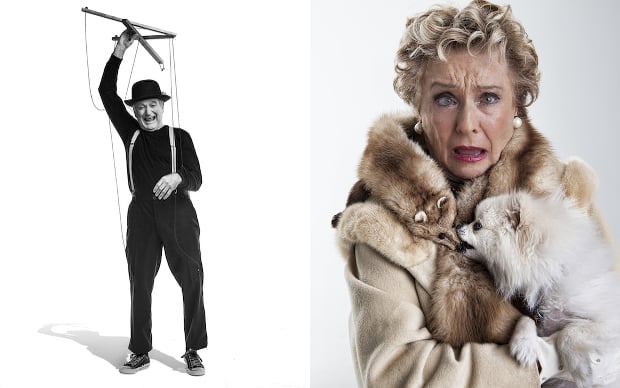
British photographer Robert Wilson created the conceptual shoot for Radio Times magazine about a TV show called Last One Laughing, in which U.K. comedians make each other laugh while trying to keep a straight face.
Wilson produced 12 individual Radio Times covers for this week’s edition, and made a looping video from his high-res photos showing the comedians as they try not to laugh.
Who will be the first to crack a laugh and who will keep a straight face the longest?
Meet this year's legendary line-up of comedians spotlit across 12 covers, as they compete to be the Last One Laughing.
Last One Laughing photographed exclusively for Radio Times by Robert… pic.twitter.com/ppHORNTeIt
— Radio Times (@RadioTimes) March 9, 2026
But the video, which consists of hyper-realistic, razor-sharp photos, caused many people to accuse it of being AI. Wilson tells PetaPixel that that is categorically not the case.
“You try and push boundaries of technology, then, because people aren’t used to seeing it, they immediately think it’s AI,” Wilson says. “That is rather frustrating, but more frustrating is the fact that when it’s pointed out to people that they’re wrong, rather than embracing something that someone’s created, they seem to double down on their accusations.”
It was on X where the biggest vitriol towards Wilson’s work was: U.K. podcaster Don McGowan declared: “an established publication like the Radio Times, sinking to this AI garbage, is why print media has run its course.” X slapped a Community Note on his post stating it was created by Wilson. But rather than admit he was wrong, McGowan writes: “Still an odd choice to me to make something like an AI-generated video.”
It was a similar story on Instagram where Wilson explained to one person that he had taken 210 high-res photographs to make the video. “Then that’s an awful lot of work to produce something that looks exactly like AI,” the snarky commenter replied.
How Did the Photographer Create the Radio Times Cover
Wilson explains to PetaPixel that for the moving footage, he locked off the camera and shot RAW photos at 30 frames per second.
“I graded the RAW files with photography software rather than for moving footage as there’s so much more latitude in the RAW file,” he explains.
“Once graded, the images were placed back into a 30 FPS timeline and voilà, you have moving footage that looks exactly like the stills/print images that have a slightly hyperreal feel.”
Wilson says it’s a new method and he wasn’t planning to reveal his practical process, but says that after seeing so many people believe it was AI, “I feel like I’ve had to justify myself.”
The accomplished photographer, who has shot for major brands and publications all over the world and visited Afghanistan as an official artist for the British Army, says he doesn’t use AI in his work.
“The only way I use AI is when I’m sketching ideas for a shoot,” he explains. “I sometimes give it the scenario and see what it comes up with. It might then give me ideas on lighting direction or composition that I hadn’t thought of… but that’s the only way I use it.”
In a way, the AI accusations are a compliment to Wilson’s original work.
“If it’s something people are not used to seeing and it’s caught their attention, they immediately think it’s AI, rather than thinking it might be a creative doing what creatives do… being creative!”
More of Wilson’s work can be found on his website and Instagram.
Image credits: Photographs by Robert Wilson