Why You Should Repeatedly Explore the Ordinary With Your Camera
It may be commonplace to you, but your audience members may be unfamiliar with the things in your life. Consequently, to them, your ordinary subjects may seem exotic and unusual. However, there are other good reasons to photograph the commonplace repeatedly.
When I lived in Dar es Salaam, Tanzania, I had friends there who had never seen snow. Meanwhile, here in the UK, despite never being more than 70 miles from the coast, some people have never seen the sea. I suspect that may be true of many more people in the central United States.
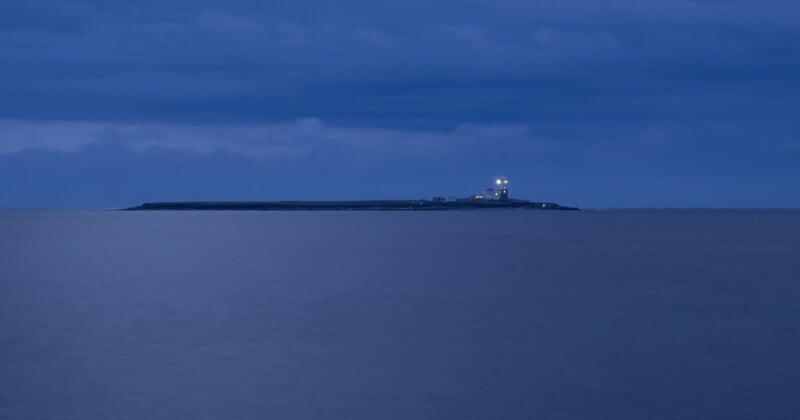
So, just as the vast plains and lofty mountains of Montana will be alien to me, a photo of a lighthouse on an island in the sea here might seem unfamiliar to you. That unfamiliarity starts to make the image more compelling to the viewer. However, there is more to photography than just depicting the unusual.
Everything Changes
No matter where you are, the great thing about nature is that it is constantly changing. Every time you head out to take a photo, there will be differences between that photo, the previous one, and the next. Sometimes, those differences will be subtle and sometimes dramatic.
That is true of most photography. Even in the studio, there can be subtle changes in the positioning of lights, and the same model won’t ever strike the same precise pose or have an identical facial expression today as yesterday.
Irrespective of those changes, photographing the same scene repeatedly will help you become intimately acquainted with it, enabling you to adapt accordingly. As a result, you will learn which compositions and camera settings work for you, and those that don’t.
Who You Should Please With Your Photos
The three crucial words there were “work for you.”
Photography has so many rules that some say we must follow. However, it is an art form, and all art is about personal expression. Often, art challenges preconceived ideas about itself. One could argue, therefore, that intentionally challenging those rules is something we should strive for. Nevertheless, one must have the skills to deliberately and repeatedly deviate from the norms; creating art shouldn’t be an occasional happy accident.
That notwithstanding, unless you are photographing for a client who has been prescriptive in their needs, the only person you must please with your images is you. Paying heed to those who judge your work, rather than working to your own tastes, can stifle both innovation and the development of your own style.
So, if you are intentionally pushing the boundaries and breaking the rules, and somebody (especially an anonymous person on the internet) sends uninvited criticism of your creative work—whether it is photography, painting, music, or writing—you can be sure you are doing something right. It is invariably they who are lacking in understanding. So, don’t be put off by them.
Putting Repetition into Practice

Coquet Island sits in the North Sea off the coast of Northumberland, in Northeast England. It’s a mile offshore from where I live. In the summer, this rocky outcrop is home and breeding ground to thousands of puffins and various terns, including the rare roseate tern. It also hosts a colony of grey seals that wallow on the rocks on the seaward side of the island.
Although not iconic like the Eiffel Tower, Brandenburg Gate, or the Empire State Building, Coquet Island has a rich history that makes it a notable local landmark. It was used as a monastic cell in the 7th Century, served as a retreat for St Henry of Coquet in the 12th Century, and then became the setting of a Benedictine priory. Much later, it was fortified against the Scots in the Scottish Wars. Later still, it was used as a hideout for some very unsuccessful counterfeiters who made appallingly bad coin forgeries. In the mid-1800s, the lighthouse was built on the island.
Locally, it is a fascinating subject for artists of all types, including photographers. I find it a captivating subject. Moreover, I use it to experiment and practice, reinforcing my camera and compositional skills.
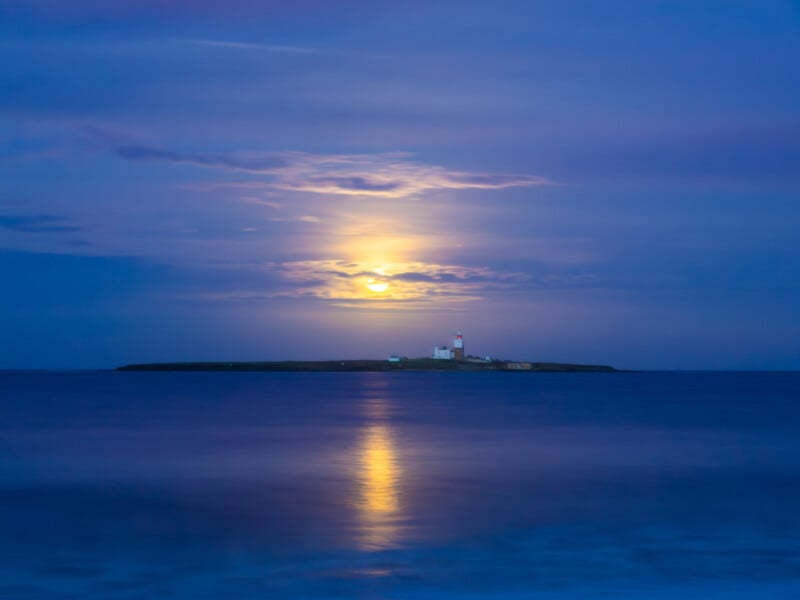
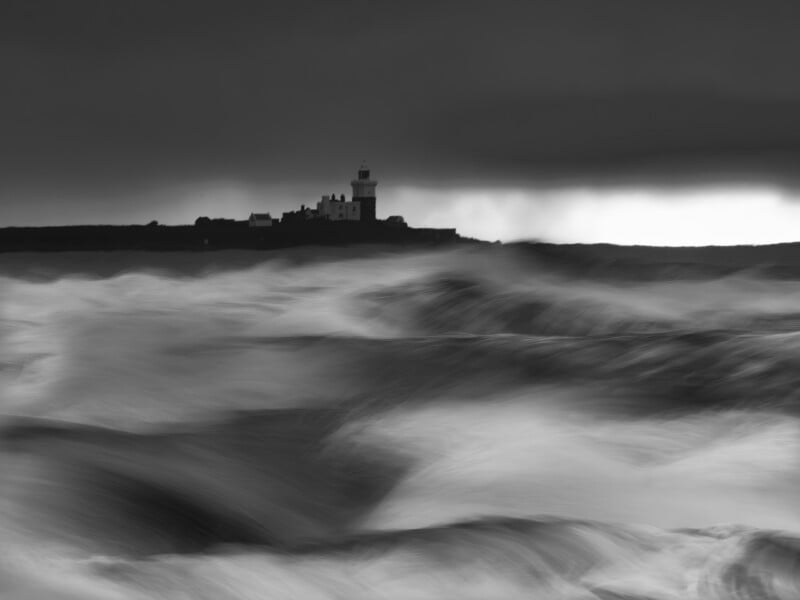
For a couple of weeks in the spring and autumn each year, the island can be photographed from my hometown with the sun rising behind it. Each sunrise can be entirely different. Furthermore, the dawn light changes rapidly, so photos taken from the exact location can change from minute to minute. The sea state can also vary from dead calm to extremely rough. Plus, the tide times change daily. Every dawn is different. Not only that, like everyone else’s, my tastes are subjective and can evolve. The compositions I liked ten years ago may not be the same as I do now.
So, for three early mornings over the last couple of weeks, I got up early to experiment with the many different options open to me there.
Day 1

When I arrived, it was about 6:30 am and still dark. Having just come back from holiday, I was taken by surprise by the lighthouse. Where there used to be one sweeping red light, there were now two intermittent white lights atop the lighthouse tower.
It was cloudy. Consequently, I wasn’t going to see the sun come up. So, I set my camera on my tripod and played with different compositions, shooting some long exposures. It’s not everyone’s cup of tea, but I like the simplicity afforded by a smooth sea and sky.
I started by placing the island in the middle of the frame and then tried raising and lowering the camera angle to find which composition I liked the best. I then tried zooming in and out with my 12-40 f/2.8 lens and repositioned myself to see if it made a difference.
Depending on where you are in the world, if you have ever shot at dawn, you will have noticed how quickly the light changes. Sunrise here isn’t anywhere near as quick as it was when I lived on the equator, but it’s much faster than it was up near the Arctic in mid-winter. However, as fall progresses, sunrise becomes a more drawn-out affair here. Even so, within three minutes on this autumnal morning, with everything remaining equal, the shutter speed changed from 3.2 seconds to 2.0 seconds, which is a ⅔ of a stop difference. If the sky is clear, that change is much faster.

Day 2
It’s not unusual for there to be a cloud bank on the horizon out at sea. On the second day, I knew this was the case as soon as I stepped out of the door. Above me, the sky was clear. However, towards the sea it was not.
The clouds were not moving quickly, so even when shooting minute-long exposures, they just appeared slightly blurred, a look I didn’t find attractive. Moreover, the brighter sky above me and outside the frame made the sea appear brighter than the bank of clouds in the photo. Consequently, the images seemed to be top-heavy and thus imbalanced. I went home and had breakfast.

Day 3
My third shoot was on a clear morning. Faster variations in lighting caused me to change the exposure settings quickly. At sunrise, long exposures were only possible by using an ND1000 filter in combination with the inbuilt ND filters of my camera. My compositional choices were different, too. The positioning of the camera became more critical because achieving balance involves aligning the sun with the island.

Moreover, since it was a few days after the first day of shooting, the tide was out. That exposed all the black rocks along the shore, which I know from experience doesn’t look great in a photo. Therefore, instead of shooting from the high vantage point of the breakwater, as I had a few days earlier, I made my way across the rocks to the water’s edge.
In Conclusion
It is always worth experimenting and practicing, even if you don’t walk away with photos that are wall-hangers. I wasn’t that pleased with any of the images I took on these days, but that doesn’t matter to me. The shoots still served an educational purpose.
Furthermore, when I share them, someone who has never seen the sea might be intrigued by our little island and its lighthouse.