Haunting Remastered Aerial Footage Reveals the Devastating Aftermath of World War I
Aerial footage showing the aftermath of the First World War’s Western Front in Flanders, Belgium, has been given new life after being remastered in HD and colorized.
The original footage from 1919 — months after the Great War ended — was shot by Lucien Le Saint as he flew with pilot Jacques Trolley de Prévaux in an Astra-Torres airship. Surveying the terrible damage below, the film captures the devastated battle scenes of Ypres and Passchendaele. As well as the shell-scarred fields of Flanders, where allied forces had been fighting mainly German soldiers.
Glamourdaze, an Irish film restorer, explains that Trolley de Prévaux and Le Saint flew from the Belgian coastline to the French city of Verdun. “They meticulously recorded the war-torn landscape for posterity,” writes Glamourdaze. “This footage, a testament to the unprecedented devastation caused by the First World War, would remain unseen by the public for nearly a century.”
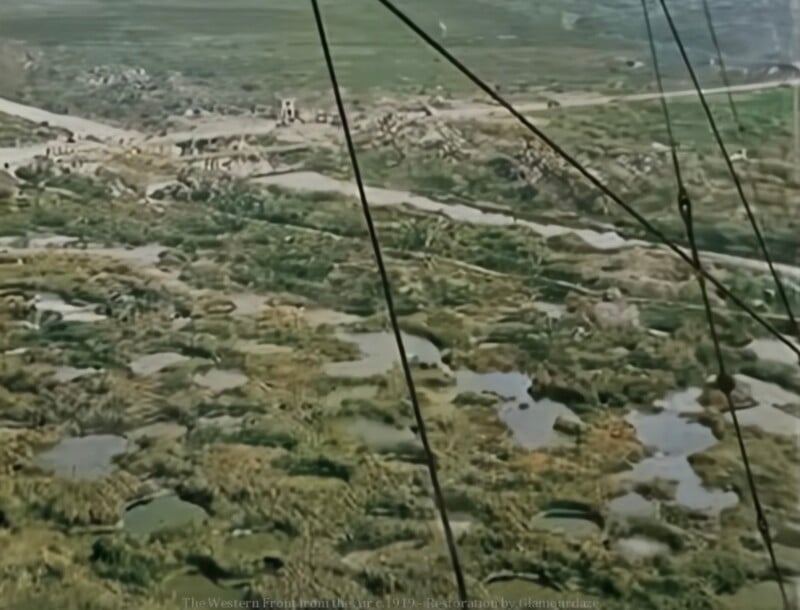
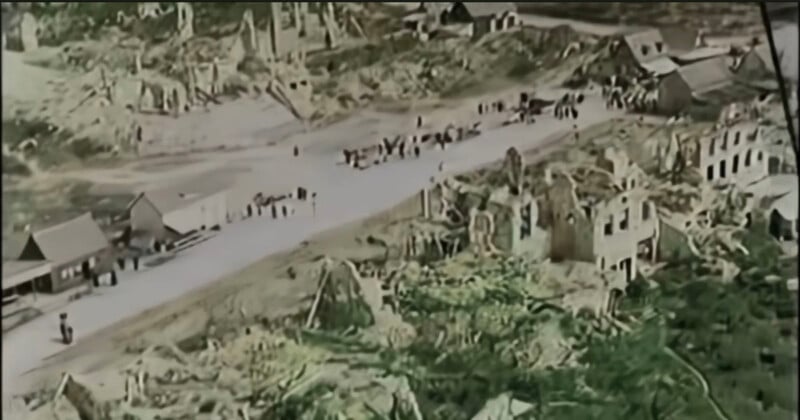
The 1919 footage was lost until a 2010 BBC documentary titled The First World War From Above discovered it in the French Army film archives in Paris. The pilot, Trolley de Prévaux, was a French Navy officer and later became a member of the French Resistance during the Second World War.
About one minute into the film, Trolley de Prévaux turns toward the camera, capturing his likeness. This moment would later turn out to be extremely emotional for his daughter, Aude Yung, as she never knew her father or her mother.
As mentioned, Trolley de Prévaux and his wife Lotka joined the French Resistance, which fought against the Nazi occupation during the Second World War. In 1944, Trolley de Prévaux and Lotka were arrested by the Gestapo, tortured, and later executed.
“In a desperate act of protection, her mother, Lotka, had only moments to hand baby Aude to a neighbour,” Glamourdaze explains. “This separation meant that Aude grew up never knowing her parents. More poignantly, she had never even seen a photograph of her father — until she finally watched this film. For one brief moment, her father turned to the camera.”
How the Footage Was Remastered
The original 78-minute film has no sound and was 16 frames per second. Glamourdaze explains that it was restored by a “combination of manual frame-by-frame colorization as well as the use of deep exemplar-based video colorization techniques.”
The footage has been upscaled and the frames interpolated to a higher frame rate of 120FPS. “Finally, I produce a soundtrack which helps build a new immersive experience for the viewer,” Glamourdaze adds.