
Mind-Boggling Shots of the Ocean on Fire From a Gas Leak
An underwater gas leak in the Gulf of Mexico led to viral imagery this week of the sea on fire. The mind-boggling shots show firefighting vessels spraying water to put out the sea.
An underwater gas leak in the Gulf of Mexico led to viral imagery this week of the sea on fire. The mind-boggling shots show firefighting vessels spraying water to put out the sea.

Tetyana Dyachenko is a Ukrainian photo retoucher who often does restorations of vintage photos that are extremely damaged -- often seemingly beyond recovery. Yet using her Photoshop skills, Dyachenko is able to recover (and recreate) extremely fine details in the photos.
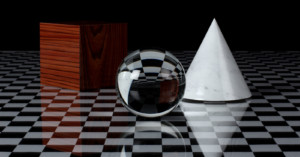
These days, more and more of what you think are real photos are actually CGI renderings. But have you seen "CGI renderings" that are actually real photos?
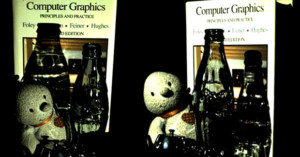
Want to see some mind-blowing research into photography (from the mid-2000s)? Check out the video above about "Dual Photography," a Stanford-developed technique that allows you to virtually swap the locations of a camera and a projector, allowing you to take pictures from the perspective of the light source instead of the camera sensor.
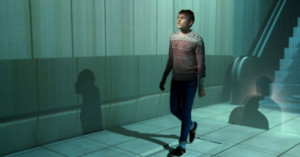
Last year, we shared an interesting video showing a blank white room that could be completely transformed in an …

This has to do with filmmaking rather than photography, but check out this jaw-dropping shot from the 1997 movie …

Here's an awesome TED lecture in which digital artist Erik Johansson discusses creating realistic "photographs" of impossible scenes.
Erik Johansson creates realistic photos of impossible scenes -- capturing ideas, not moments. In this witty how-to, the Photoshop wizard describes the principles he uses to make these fantastical scenarios come to life, while keeping them visually plausible.
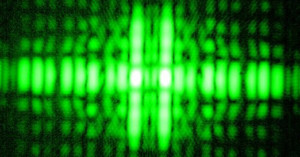
German scientists have been awarded a Guinness World Record for “fastest movie” after successfully capturing two images of an …
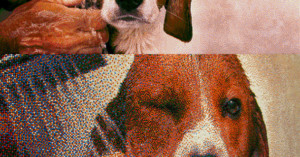
For a fine arts project at his university, art student Joel Brochu spent a whopping 8 months meticulously recreating a photograph using tiny nonpareils (the tiny sprinkles used on cakes and donuts). 221,184 individual sprinkles were placed on the 4-foot-wide board, which was covered with double-sided tape and a thin layer of glue. Each sprinkle was placed by hand using jewelry tweezers.
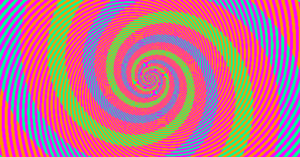
We’ve shared a couple stories in the past month on how human eyes are very subjective and …
According to the smart folks over at MIT, this video shows footage that …
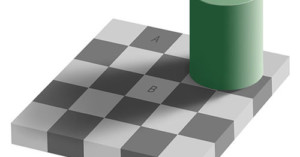
Here's a mind-bending video in which someone created the famous checker shadow illusion in real life. The optical illusion takes advantage of the way our brains process lighting and shadows.
As with many so-called illusions, this effect really demonstrates the success rather than the failure of the visual system. The visual system is not very good at being a physical light meter, but that is not its purpose. The important task is to break the image information down into meaningful components, and thereby perceive the nature of the objects in view. [#]
Interesting huh? Our eyes aren't very good as a light meters, since they're easily deceived by context.
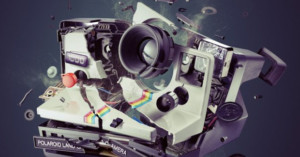
Photography studio StaudingerFranke created this mind-boggling image of a Polaroid OneStep Land Camera …

As the world of photography collides with the world of computing in smart phones, we will undoubtedly be seeing …
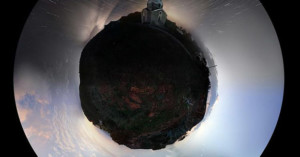
Chris Kotsiopoulos of GreekSky created this mind-boggling panoramic photo of the sky that …
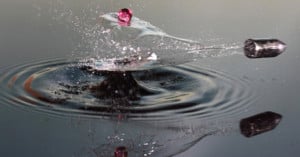
If you think shooting fast moving animals is difficult, try shooting bullets slicing water drops. That's the kind of mind-boggling photography that Alexander Augusteijn does. There's no tricks or clever Photoshop manipulations involved... just dedication and a whole lotta patience.