PetaPixel

Who Owns Illegal Public Street Art Found on Private Buildings?
Who Owns Illegal Public Street Art Found on Private Buildings? slavelabour

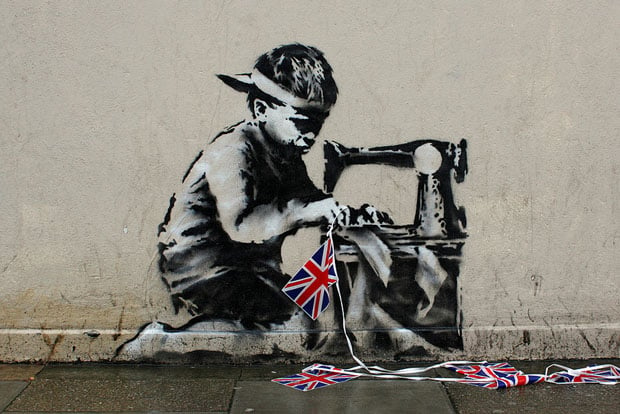
Who owns public art illegally placed onto private buildings? That’s a question that came up recently after a famous Banksy work in London was ripped out of the side of a building, shipped across the Atlantic, and put up for auction with an estimated final price of over half a million dollars.

The piece in question (shown above) is titled “Slave Labour,” and first appeared on the side of a discount store in North London in May 2012. CNN reports that many residents grew quite fond of the piece and the attention it gave the neighborhood.

Unfortunately for those residents, the piece was abruptly cut out of the wall last week. News soon emerged that the owner of the building had ordered the extraction in order to “preserve” the work.

Well, “preserve” is apparently synonymous with “profit off” in the owner’s mind: “Slave Labour” has turned up in the catalog of an auction house in Miami, and will be sold this Saturday in the “Modern, Contemporary and Street Art” collection for an estimated $500,000 to $700,000.

Needless to say, the locals who once enjoyed the piece aren’t very happy about this development. The case has also triggered a discussion regarding who technically “owns” the art, since it was installed without permission in a public location on a private building.

The Miami art dealer behind the upcoming auction, Frederick Thut, defended the sale to the BBC, saying “the work was painted on a private wall and the owner of a private wall can do whatever he wants with his own wall.”
Who Owns Illegal Public Street Art Found on Private Buildings? jr

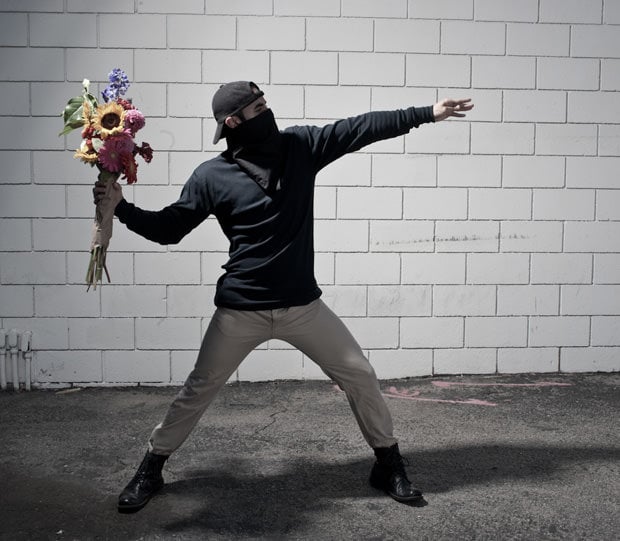
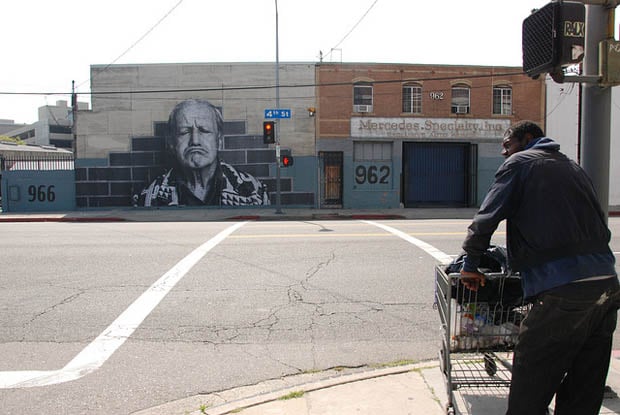
Photographer JR also installs his photographic street art in public locations. Might these also be extracted and sold?

While this particular case isn’t very relevant to the world of photography, the concept of public street art is. In 2010, the photographer known as JR won the prestigious $100,000 TED Prize for his large-scale photos installed in slums around the world.

If the Banksy sale does go through and end up fetching a sizable figure, we may soon find many other examples of famous street art installations being ripped out of their original “canvases” and sold to private art collectors.


Image credit: Banksy by DeptfordJon, on the street by collectmoments


  • Michael Choi

    Man if I was the landlord and some art buyers even try to damage my wall without my permission then I would just paint it over it and call it my own work of art lol.

    Funny how patent lawsuits, copyright wars and now illegal graffity is valued as art and fighting over ownership. What’s next? Fine art landscape photographers getting sued for taking photos of someone’s private property? It’s kind of sad how everything is getting more complicated and only gonna get worse.

  • James Champagne

    I don’t like your choice of word “dispose”.

  • James Champagne

    It’s disrespectful to move art out of it’s intended location. To this you may say “But we mean to preserve it” – what I see is that you mean to profit. You would only be preserving the image, it would lose its meaning out of context. This was meant as a statement for the world to see, that’s why it was done in public.

  • http://profiles.google.com/neotechni Techni Myoko

    Banksy is a douche, and a criminal.

  • gogminsam

    great post

  • Macjim

    As far as I’m concerned, it’s graffiti and graffiti should be cleared away. If the owner of the property decides to cut it out and sell it, then that’s the owners prerogative. It’s strange how graffiti, which is just vandalism, goes from being something that we all wish wouldn’t happen as it is wrong, but then becomes a work of ‘art’ just because some so called art historian decides this is a work of art. So, if the ‘artist/vandal’ leaves his graffiti on a wall or whatever then he gives up ownership to it too as it belongs to whomever owns the vandalised property, and if that owner decides some idiot is willing to pay a fortune for it, then we can’t complain.

  • notbanksy

    Since when is art and legality mutually exclusive? Graffiti can exist as art and still be illegal. You may not appreciate it, just like I don’t appreciate neo-impressionism, but it doesn’t stop either from being art.

  • http://www.facebook.com/igor.kennn Igor Ken

    Well Bansky once stole a famous quote of Picasso: “A good artist is a good thief”… so I guess the irony of selling his art by ripping it off one’s building, apart from being an artistic move by itself, does make sense following Bansky’s philosophy

  • http://www.facebook.com/people/Stephen-Randolph/1577664331 Stephen Randolph

    If the work is sold for 1/2 a million or even 5-10k? it leaves to question was the building defaced or enhanced by the painting? <<>> clearly it added character and value to their neighborhood and it boosted the residence’ esteem. Art is a powerful tool for making things bearable giving people hope and ambition, where once were grey bleak street are now color and humor Yes as long as the art is on his building, technically he owns it. if painted Inside the building no question!. .BUT . outside ? IT’S a GIFT to “the passer bye” the public may Rightfully claim it as communal property a right for municipal ownership, by him removing the work for sale they may too deserve if not all a cut of the sale proceeds on the art?. . . . . He can’t make copies once he removes the art he is merely the owner of a copy, with no rights to make copies, he has no copy rights ownership if it is no longer attached to his building..

  • :V

    While people assume this, it is wrong.
    The contract needs to specifically state you are buying the rights to the work, or else the artist holds them forever.

    When buying the rights you tend to pay an arm or a leg, since you are usually purchasing them to reproduce the artwork for profit.

  • http://www.facebook.com/dan.scott.505 Dan Scott

    Regardless of whatever someone else does to my property–with my permission or without–it is still my property. I can do whatever I want with it.

  • http://www.facebook.com/people/Ed-Guidry/1193366881 Ed Guidry

    “the TRUE OWNER’s of the painting are the people who walked or rode past it day by day. they are the ones it was painted for.”
    You sound like a communist.

  • http://www.facebook.com/jonwoodbury Jon Woodbury

    So here’s my question. I have every right to photograph something in a public place. Can I own the copyright to a photograph I have taken of the illegal work on a private wall? This feels like a copyright rabbit hole…

  • http://www.bobcooleyphoto.com/ bob cooley

    If you were purchasing to republish the work, then copyright is an issue – in this case (an auction)’rights’ don’t come into play – its a single physical piece of artwork, not a published piece. When you purchase artwork at a gallery, or have artwork commissioned, you are buying the physical artwork, but not the rights to republish.

    As owner of the physical work, you DO have the right to re-sell that artwork. This falls under first-sale doctrine.

  • http://www.bobcooleyphoto.com/ bob cooley

    Agreed. While i agree Banky’s work is Art (and personally I’m a fan of it) – leaving it on someone else’s property is illegal, and therefore abandoned.

    To simplify the argument, it someone were to toss a garbage bag into your yard, and made no subsequent attempt to recover it, its yours (it would be different if someone threw a frisbee in your yard and they came looking for it). Please note, I’m not saying Banksy’s work is garbage, I’m just simplifying the argument.

    Because it’s been left without claim, its abandoned property, and the artist no longer has any legal ownership over it.

    It’s a double edged sword for street artists, and I can sympathize – you want to take back public space without regard to the laws, but its those same laws that protect artists when art is sold and shown through legal means.

    It’s a tricky situation emotionally/ethically, but legally its pretty simple.

  • http://www.thenerdynurse.com/ The Nerdy Nurse

    Technically whoever painted it is defacing private property. The owner of the building has the right to “clean” it any way they please.

  • Sten

    Nope. Just because you tagged my building does not prevent me from using it to its full legal extent, including (if I chose) taking pictures of it and selling them. You cannot unilaterally impose restrictions on me or the use and enjoyment of my personal property just by throwing paint on it.

    Your analogy of buying a song fails as when I buy a song I’m entering into a legal contract of sorts. No such contract in this case.

  • Sten

    He does own the building, and he didn’t lose the right to take pictures of his property and sell them just because someone threw paint on it.

  • Bruce Garner

    Yes, the owner can clean it away however they want. The artist has no right to the paint on your wall. He does still retain the rights to the design. Odds are that he made sketches and practice paints before painting on the wall. Those legal drawing would be without question copyrighted and protected by law.

    If you, as the building owner, declare the graffiti to be undesirable, you can file a complaint with the police and press charges. Laws vary from place to place so any number of things could happen, I would guess anything from a fine to jail time for the artist.

    However, if you decide to try and market the graffiti and make money from it, you will have a hard time convincing a judge that you suffered a loss worthy of punishing the artist.

  • hugh crawford

    Common sense ≠ what the law says, and people profit off of crimes all the time, but that is irrelevant.

    If someone draws on a wall , they own the copyright to the drawing.

    If someone takes a photo of a wall, they own the copyright to the photo.

    In both cases the owner of the wall owns the wall , but not the copyright.

    In many countries and in the US if the wall owner permits an artist to make a mural, the artist has the right to prevent the owner of the wall from altering or destroying it.

    In the USA the Visual Artists Rights Act applies. A few years ago in LA, Kent Twitchell’s Ed Ruscha mural was painted over without his approval and Twitchell won $1.1 million in damages.

  • http://www.facebook.com/abram.gotthardt Abram Gotthardt

    OR Maybe you should use spell check…

  • Mc.Carthy Marie

    The artist obviously owns the art and more importantly the copyright in the art. Uk law is pretty clear that when a work in which copyright exists is created the work and all the rights in it belong to the creator except if the artist is an employee who creates the work in the course of his employment. The fact that the artist trespassed on the owner’s building does not give him ownership of the work. The remedy for the owner of the building is to sue for trespass and/ or damage to his building. He cannot arbitrarily claim ownership.

  • Mc.Carthy Marie

    I do not think it is quite so simple. The owner of the building could very likely paint over the work or demolish his wall and the work with it. The fact that he removed it and is selling it is proof that he suffered no damage and since all the rights in the work belong to the artist the building owner has no rights at all. Would you say that if an artist steals some canvas on which he painted a work that the owner of the stolen canvas owns the piece of art? No. The canvas owner would be entitled to compensation for his canvas and the artist might go to jail for theft,but in no way could the canvas owner lay claim to the work.

  • http://www.facebook.com/cory.hauptman Cory Hauptman

    Much of the discussion here has been about the building owner vs the artist ownership. I think the more important question is; is it morally right to take a piece of art out of the public sphere and sequester it into the private sphere for the sake of profit? Are we so driven by profit that a neighborhood that had grown fond of a piece of art can now be denied that enjoyment so one person can make some cash? The whole point of street art is that it is a public expression, often against any type of authority or copyright or rules. It is for the street and for the public. I think of this situation as a atrocity, a second public defacement (in addition to the first defacement of putting up the street art). It jut doesn’t sit well with me.

  • kinz 69

    look guy’s and doll’s who care’s who own’s it!!!?? no one..!!! artist’s place this art there to show our art work off to prove that not all artist “tag” we are stating a point that graff….streetart….urban art is also a way of life as it is for most artist whether it be portraits oil paintings so fort.yes it maybe illegal but if it makes that building look better whats the big issue??? its all art why cant we just appreciate it :) be lucky

  • kinz 69

    this is the problem none of you have a open mind!!!!!!!!!!!!!

  • :V

    Oh I know this. I’m just stating that rights should not be ‘assumed’ bought unless your contract specifically states you bought them.

    There are the rights you buy to reproduce as the owner.
    There are the rights that come to be able to resell the singular piece of art.

    Most people don’t realize that the both of these are separate and you have to negotiate the first set.

  • http://www.facebook.com/profile.php?id=815545443 facebook-815545443

    My opinion is that if an action is committed illegally (graffiti) they reserve ownership of said work and should incur all ramifications of the piece (whether it be fines, fame, or compensation).

    The owner of a property should reserve the right to remove or leave the graffiti at their discretion, and should be allowed to press applicable charges (vandalism, trespassing, etc…).

    They should not become intellectual property owners of said artwork if they didn’t have anything to do with the creative process, but arguments can be made that their canvas (building) contributed to the artworks aesthetics, making the property owner partial intellectual property owners (but not full owners).

    The property owners should be allowed to manipulate, distort, or repurpose the illegal artwork anyway they see fit, seeing as it is their building and the reserve the right to purpose their building as they see fit within city regulations.

    These revised artworks if purposed for commercial sale should remain partial ownership of the property owner, but the vandal would still remain a partial intellectual property owner and could seek compensation after he has paid his fines for vandalism, etc.

  • http://www.facebook.com/profile.php?id=1612507716 András László József Halák

    While the owner of the building owns the wall, he or she does not own the paint that the artwork on the wall is composed of. And since the artwork CAN be separated from the wall with special technique, I think he does not own the artwork by just being the owner of the wall.

  • http://www.facebook.com/todd.gardiner Todd Gardiner

    Copyright does not HAVE to enable the artist to make a profit off of the crime. It prevents other people from doing so, in the form of copying the creative work.

    The right to make additional copies (or more often, to prohibit others from doing so) still resides with the artist.

    The requirement for the owner of the building would be to cover over the artwork before photographing the building, possibly with paint.

    But…

    It is pretty hard for an artist trying to remain anonymous to enforce their copyright through the courts, isn’t it? That’s were your common sense is effective.

  • http://www.facebook.com/todd.gardiner Todd Gardiner

    So posting wall-sized porn images on your private property has no impact on the community?

    I don’t really know what all the mumbo-jumbo Mick O. was talking about for derived property rights, but he is right that the form of private use when bordering public space has an impact, one that is often regulated by local governments.

  • http://www.facebook.com/todd.gardiner Todd Gardiner

    This legally falls under abandoned property.

  • http://www.facebook.com/todd.gardiner Todd Gardiner

    Let’s try another scenario.

    What if the painting on the wall was a copyright infringement of an existing work. Thus the painter’s legality in making the painting on the building is not a factor in ownership of the copyright image.

    Does the building owner continue to have the right to make copies of this work and distribute it?

    What about copyright law makes it so the illegal painting of an original work forfeits its copyright to the building owner, but the infringement painting does not? Copyright law doesn’t have any specific language related to whether it was in violation of laws during the act of creation. And Property Right law doesn’t say anything about copyrights, just about physical property, in regards to abandonment or “found items”.

  • http://www.bobcooleyphoto.com/ bob cooley

    Ed, I see where you are going with the line of thought, and in essence its correct, but there’s no license (or rights) transfer – it falls closer to being a sale of an individual piece of art, which would fall under First-Sale doctrine.

    The person buying the (physical) artwork is allowed to sell the physical artwork (under First-Sale), but had no rights to profit from reproduction (making copies for commercial use). The artist still retains the copyright for reproduction.

    I say ‘falls closer” because In this case the artwork wasn’t purchased, but becomes the building owner’s physical property because it was abandoned by the artist.

    I find it odd that someone down-voted you and @google-34a07a1bda0804aae00934fee8ab9fff:disqus in this whole discussion, its pretty clear-cut law.