
Photographers, This Industry Survey Wants to Hear Your Voice

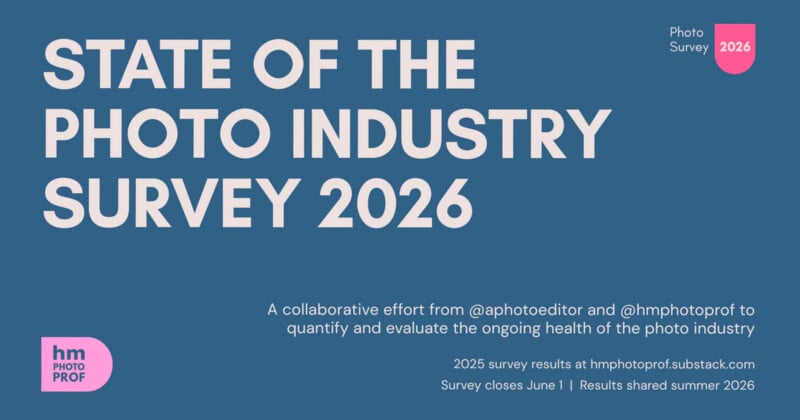
The State of the Photo Industry Survey is returning for 2026, with organizers hoping to build on last year’s extensive dataset to create a clearer picture of how professional photographers are navigating an industry that continues to evolve rapidly.
Led by photography professor Heather Morton alongside Rob Haggart of A Photo Editor, the survey aims to collect information on everything from photographer income and licensing practices to promotional strategies, video adoption, and overall industry outlook.
The project has increasingly become increasingly important within the professional photography community for its attempt to quantify a business landscape that is often discussed anecdotally but rarely measured at scale.
Why Industry Surveys Matter to Working Photographers
For many photographers, particularly freelancers and independent creators, reliable business benchmarks can be difficult to find. Day rates, licensing structures, usage fees, marketing effectiveness, and even long-term income expectations are often treated as private information within the industry.
The State of the Photo Industry Survey attempts to change that by aggregating anonymous responses into a broader statistical overview of professional photographic practice.
That information can be valuable for photographers at nearly every stage of their careers. Emerging professionals may use the data to better understand prevailing pricing structures or industry demographics, while more established photographers can compare their own business strategies against larger market trends.
The organizers say the goal is not simply to collect statistics, but to provide measurable context around how photographers are adapting to shifts in commercial work, hybrid video production, client expectations, and economic pressures.
What Last Year’s Survey Revealed
The previous State of the Photo Industry Survey drew responses from 1,294 photographers across 43 countries, with the majority based in the United States, Canada, and the United Kingdom.
The resulting report offered one of the more detailed public snapshots of the professional photography business in recent years, covering topics that ranged from gender demographics and experience levels to licensing models and income distribution.
Among the more widely discussed findings was the industry’s aging demographic profile. Roughly one-third of respondents were in the 40–49 age range, while photographers under 30 accounted for less than 3% of total participants.
The survey also highlighted significant income disparities across regions, experience levels, and gender. Most respondents worldwide reported earning under $50,000 annually from photography, although a notable percentage of U.S.-based photographers reported six-figure photography incomes.
The data also reinforced how strongly experience correlates with earning potential, while simultaneously revealing that photographers employ widely different approaches to licensing and usage fees.
Another key finding centered on hybrid production work. Nearly half of respondents said they primarily shoot still photography while also handling some video work, reflecting the growing expectation that commercial photographers operate across multiple formats.
A Broader Look at Business Practices
One reason the survey has attracted attention within the industry is its focus on the business realities of photography rather than gear or creative trends alone.
Questions cover topics such as gross and net income, creative fees, licensing arrangements, marketing approaches, client geography, and workload distribution. The survey also explores photographers’ outlook on the industry itself, including levels of optimism and perceptions of sustainability within the profession.
That broader business focus may ultimately prove more useful than isolated income surveys, particularly because photography careers often vary dramatically by specialization, geography, and client base.
The survey’s genre data from last year, for example, showed portrait and lifestyle photography among the most common professional categories, while sports, automotive, and landscape photography represented much smaller portions of the respondent pool.
The Importance of Multi-Year Data
With the 2026 edition now underway, organizers say one of the biggest advantages will come from having multiple years of comparable data.
Another dataset could help reveal how trends are shifting over time, particularly as photographers continue adapting to AI-driven workflows, changing social media visibility, evolving licensing expectations, and increasing demand for hybrid stills-and-video production.
Longitudinal comparisons may also provide insight into whether photographer income levels, usage practices, or promotional strategies are becoming more standardized or remain fragmented across different sectors of the industry.
Because much of the professional photography business remains decentralized and freelance-driven, large-scale surveys like this are one of the few ways broader economic patterns become visible.
Survey Details and Availability
The 2026 State of the Photo Industry Survey is open now to professional photographers and is conducted anonymously through Qualtrics. Organizers estimate the survey takes approximately 15 minutes to complete.
Participants are asked about areas including income, workload, licensing practices, promotional strategies, and business operations, though organizers note that many questions are optional.
The survey has received ethics clearance from the Sheridan Research Ethics Board and will remain open through June 1, 2026. Results are expected to be shared later this summer, with additional, deeper analysis planned afterward.
Image creditsState of the Photo Industry Survey. Header photo licensed via Depositphotos.com.
Affiliate Disclosure PetaPixel articles may include affiliate links; we may earn a commission if you buy through one.