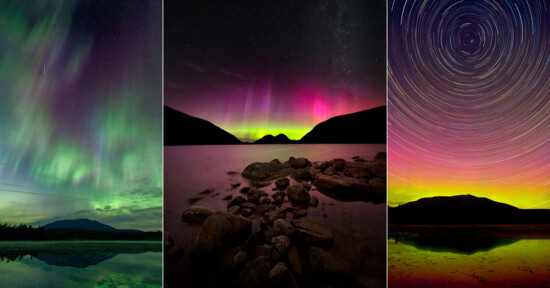
Equinox Aurora Lights Might be Visible in Northern US This Week
On Monday (March 16), the Sun fired off a coronal mass ejection (CME) and the National Oceanic and Atmospheric Administration’s Space Weather Prediction Center (SWPC) has now issued a geomagnetic storm warning for Thursday (March 19).
Geomagnetic storms are ranked on a scale from G1 (minor) to G5 (extreme), and forecasters expect conditions to reach G2 (moderate), with a chance of G3 (strong) levels.
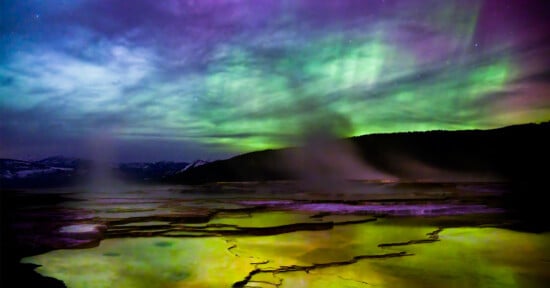
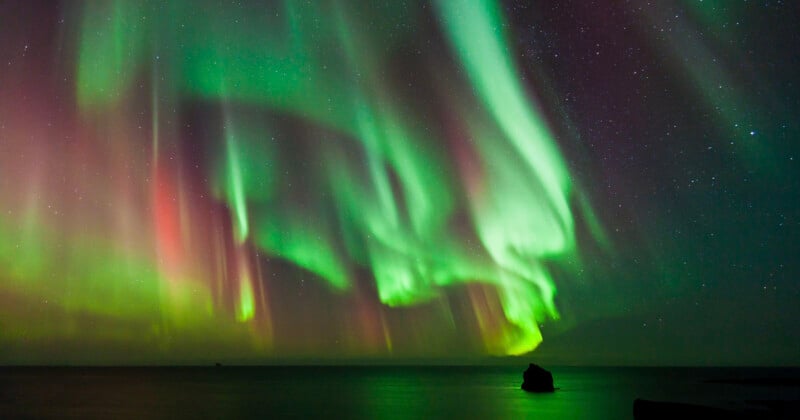
If those conditions develop, auroral activity could extend farther south than usual. A G2 storm may bring the northern lights into parts of the northern United States, while G3 conditions could push visibility deeper into mid-latitudes, potentially reaching areas such as Illinois and Oregon.
Space.com notes that the CME driving this forecast consists of plasma and magnetic fields. When such material reaches Earth, it can interact with the planet’s magnetic field and trigger geomagnetic storms, sometimes producing visible auroras.
“A coronal mass ejection (CME) is an eruption of solar material and magnetic fields. When they arrive at Earth, a geomagnetic storm can result,” the NOAA Space Weather Prediction Center writes in a post on X.
“A CME is anticipated to affect Earth with elevated geomagnetic response and dependent upon the orientation of the embedded magnetic field, potential exists for Moderate Storm levels.”
The agency also stated that “G2 (Moderate) geomagnetic storming is likely, with a chance for isolated periods of G3 (Strong) geomagnetic storming, on 19 Mar with the arrival of the 16 Mar CME.”
The timing of this event coincides with seasonal conditions that tend to increase geomagnetic activity. Around the spring equinox, Earth’s orientation allows its magnetic field to connect more effectively with the solar wind, a phenomenon known as the Russell-McPherron effect. During this period, both hemispheres receive equal daylight, and the alignment of magnetic fields can enhance the impact of incoming solar material.
“During the equinoxes, the orientation of the Earth’s poles is (almost) perpendicular to that of the Sun,” Dr. Ciaran Beggan, a geophysicist at the British Geological Survey, told Newsweek.
“This maximizes the ‘coupling’ between the solar wind and the Earth’s magnetic field. In summer or winter, one of the Earth’s poles is pointing at an angle from the solar wind so the coupling between them is lower and hence there are fewer storms on average.”
Additional viewing conditions may also be favorable. A new Moon on March 19 is expected to produce darker skies, which can improve visibility for faint auroras.
According to NOAA forecasts, the northern lights may be visible across a wide portion of the northern United States between the night of March 18 and the early hours of March 19. The best viewing window is typically between 10 P.M. and 2 A.M. local time, though this can vary depending on local weather and visibility.
States with stronger viewing potential include Alaska, Washington, Idaho, Montana, North Dakota, South Dakota, Minnesota, Wisconsin, Michigan, and Maine. Other states, including Iowa, Nebraska, Wyoming, and parts of Oregon, Illinois, Indiana, Ohio, New York, Vermont, and New Hampshire, may see weaker displays near the northern horizon if conditions intensify.
If you’re thinking about heading out to capture the potential auroras on camera, check out PetaPixel’s guide on capturing the northern lights.
Image credits: Header photo licensed via Depositphotos.