Japanese Companies Shipped 10.6 Million Lenses in 2025
Alongside data on digital camera shipments in 2025, which increased for consecutive years for the first time in nearly 20 years, the Camera & Imaging Products Association (CIPA) also shared its data on lens manufacturing and shipments in 2025, which also showed overall growth.
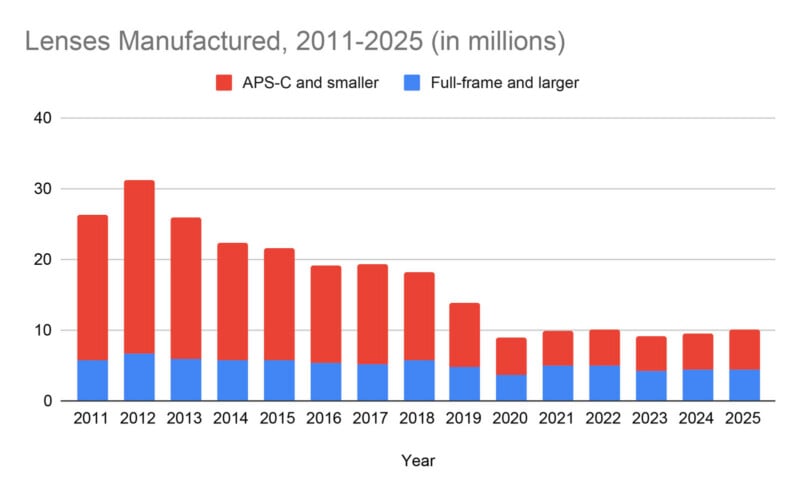
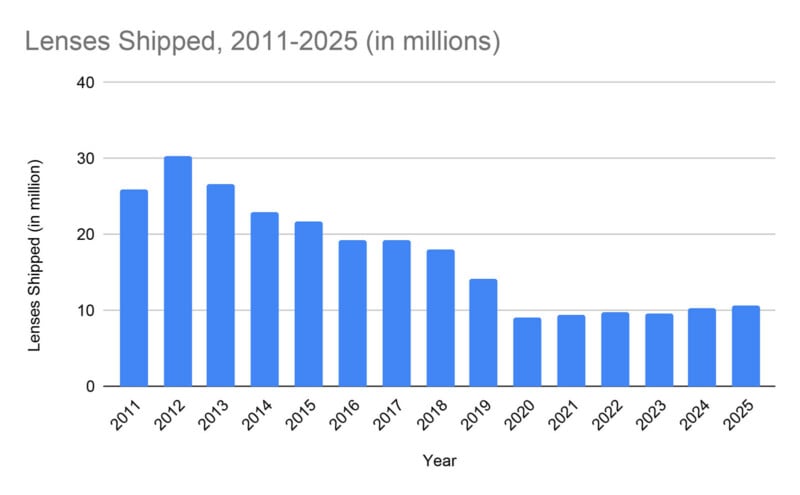
In 2025, Japanese lens manufacturers produced 9.99 million interchangeable lenses and shipped 10.6 million lenses worldwide. This is up from 9.6 units produced and 10.3 million shipped in 2024. It is worth noting that CIPA’s data includes many of the biggest movers and shakers in the photo industry but omits Leica, Hasselblad, and, of growing importance, Chinese and South Korean lens makers. Japanese companies are by far the most prolific in the photo industry overall, but it’s important to keep this in mind, especially when considering lens data.
With that caveat out of the way, it is good to see that interchangeable lens shipments increased yet again in 2025, continuing the positive trend from last year. This is notable because, generally speaking, the photo industry has almost exclusively contracted over the past 15 years. It is also notable because the biggest growth in the camera industry last year was with cameras with built-in lenses, which, obviously, don’t require interchangeable lenses.
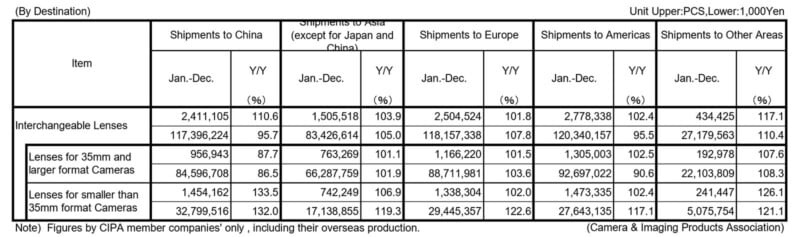
Although overall lens shipments increased in 2025, full-frame lens shipments decreased year over year. The slight dip, about 2.5 percentage points, was more than offset by the 7.6 percentage point uptick in lens shipments for crop-sensor cameras, which includes APS-C and Micro Four Thirds bodies. The decrease in full-frame lens shipments was due to the sizable dip in the full-frame market in China. Full-frame lens shipments increased in every other region, but China is an increasingly important photo market, so trends there matter a great deal.
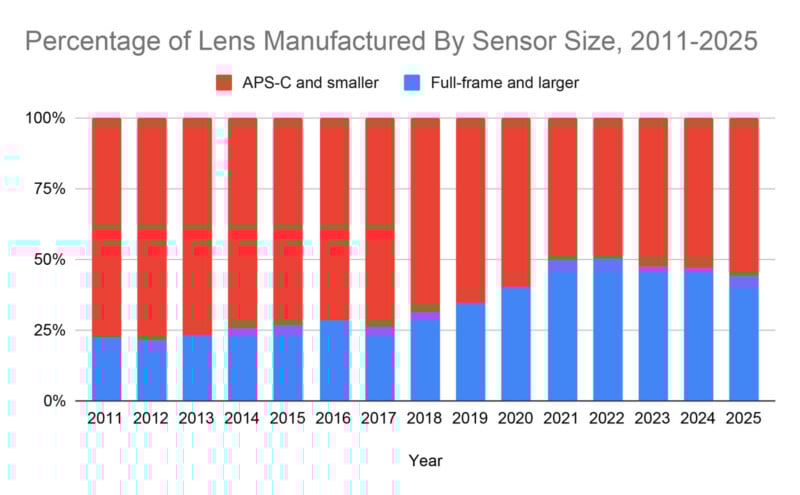
It is fascinating to see full-frame’s share of lens shipments decrease yet again in 2025, continuing a trend that has been happening for the past few years. For more than a decade, full-frame camera systems have become a larger part of the overall digital photography industry, reaching a high point in 2022, when approximately half of all lenses shipped were for full-frame cameras. This made a ton of sense, as smartphones disproportionately affected the entry-level camera space, where APS-C was supremely common.
It’s interesting to see APS-C claw back some of that lost share over the past few years, especially as companies like Canon, Nikon, and Sony spend fewer resources on developing their APS-C camera and lens offerings. While these three companies still make great APS-C cameras and lenses, to be sure, they clearly focus much of their efforts on full-frame products.
Fujifilm is a major player in the APS-C space, as its popular X System is exclusively comprised of APS-C cameras and lenses. The company is certainly increasing in popularity every year, so perhaps it is the major driver of APS-C’s growing share of global lens shipments.
In any event, it is good to see lens shipments increase each year, regardless of the size of the sensor the lenses are for. A growing digital photography industry is a healthy one.
Image credits: Header photo created using an asset licensed via Depositphotos. Data by CIPA.