How Lighting Brings ‘Wake Up Dead Man: A Knives Out Mystery’ to Life
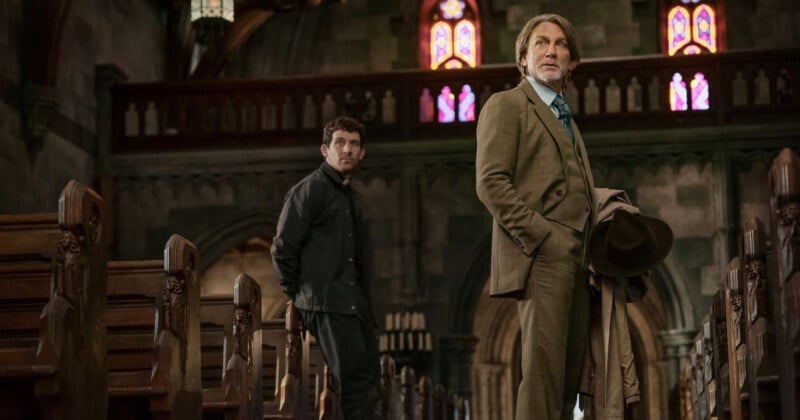
The cinematographer behind the hit Netflix movie Wake Up Dead Man: A Knives Out Mystery has revealed how he used lighting to give the film a rich, gothic look that changes with every scene.
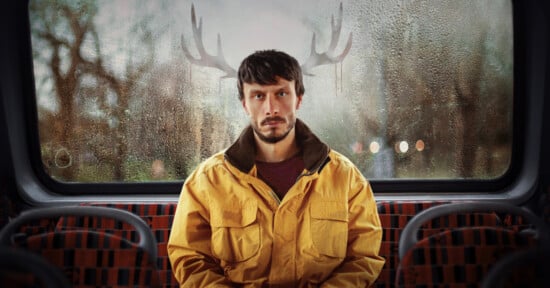
In Wake Up Dead Man, Rian Johnson’s third installment of the Knives Out series, Josh O’Connor plays an earnest Catholic priest Father Jud trying to restore moral order after a “perfectly impossible” murder at a rural upstate New York church. The death draws Knives Out’s private detective Benoit Blanc (played by Daniel Craig) into a tense investigation where faith, suspicion, and secrets threaten to divide a close community.
For Wake Up Dead Man, which rose to the top of Netflix’s charts this week, Johnson again teamed up with cinematographer Steve Yedlin — who had worked on the previous two Knives Out movies. According to a report by Deadline, Yedlin worked closely with Johnson to achieve a darker, more gothic tone in Wake Up Dead Man than the earlier Knives Out movies, primarily through lighting.
Johnson tells Deadline that with its backdrop of grand churches and crypts, Wake Up Dead Man is “more of a lighting movie than a camera movie” compared to the other two films.
“I feel like this is the most lighting movie of the three,” the cinematographer explains.
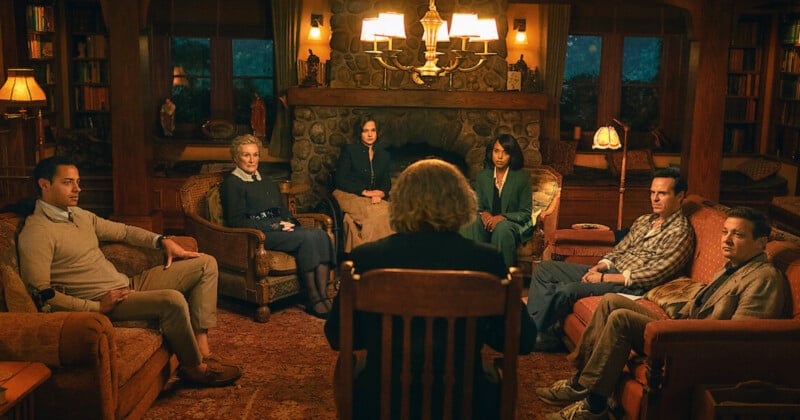
Yedlin says that early on, Johnson “had this idea of the light changing a lot… where we feel the clouds coming in front of the sun and all these different changes within scenes.” Much of the lighting is used to highlight characters during conversations, but consistent with the church setting, light often backlights characters in moments of clarity or darkens scenes in moments of despair.
“I grew up in Colorado, where the clouds moved very fast and lots of times you’d be having a conversation in the living room with your family, and suddenly it would be like God turned the lights out and just things go from very sunny to very dark,” Johnson tells Deadline. “And the notion of getting very theatrical with natural light shifts that you don’t see very often in movies.”
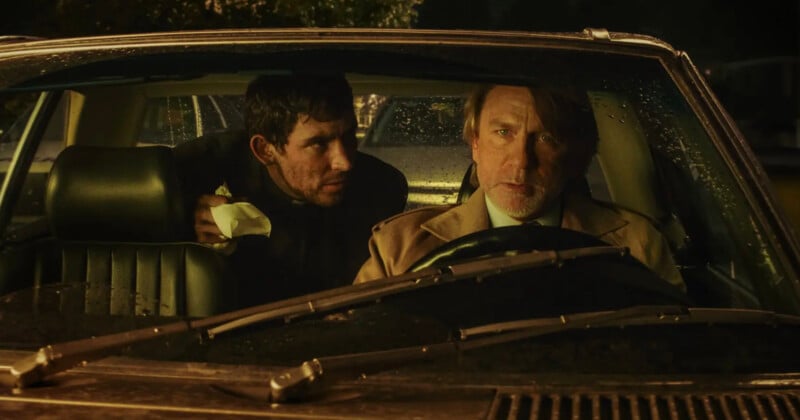
One of the scenes in Wake Up Dead Man that demonstrates the cinematographer’s use of light is early in the film when Blanc and Father Jud have a conversation about faith.
“The first time Blanc and Jud talk to each other about their view on faith and the sun coming out behind Jud during his speech… That one came out so pointed,” Yedlin says.
Another scene with notable lighting occurs at night in the movie, with Yedlin using a strobe light effect to achieve this look.
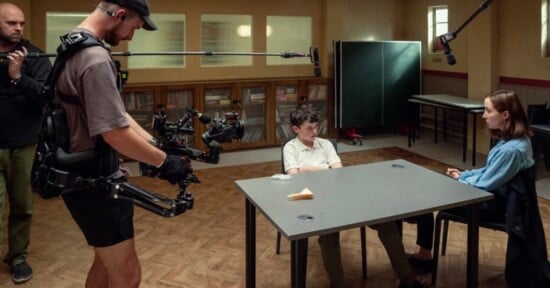
“There’s a bit of a freak-out sequence where I wanted to do this sort of dream effect with a bunch of different strobe lights going off in different sequences to create a nightmare vibe,” says Johnson. “It was so fun because Steve rigged it and gave me essentially a video game controller, so I could sit at the monitor and trigger all these lights… I’d start mashing buttons and then realize certain combos could do certain things.”
Image credits: All photos by Wake Up Dead Man / Netflix