More Cameras and Lenses Were Shipped in October Than Any Month in Past 3 Years

The Camera & Imaging Products Association (CIPA) released its latest data detailing global digital camera and lens shipments from Japanese manufacturers. After a terrible August, shipments bounced back in September. This bounce back continued in October, the most recent dataset available, which was the most prolific month for digital camera and lens shipments in the past three years.
CIPA provides the most comprehensive data of any organization for the overall state and health of the digital photography industry. While its data doesn’t include every manufacturer, it does include all the notable ones in Japan, which make up the vast majority of the industry.
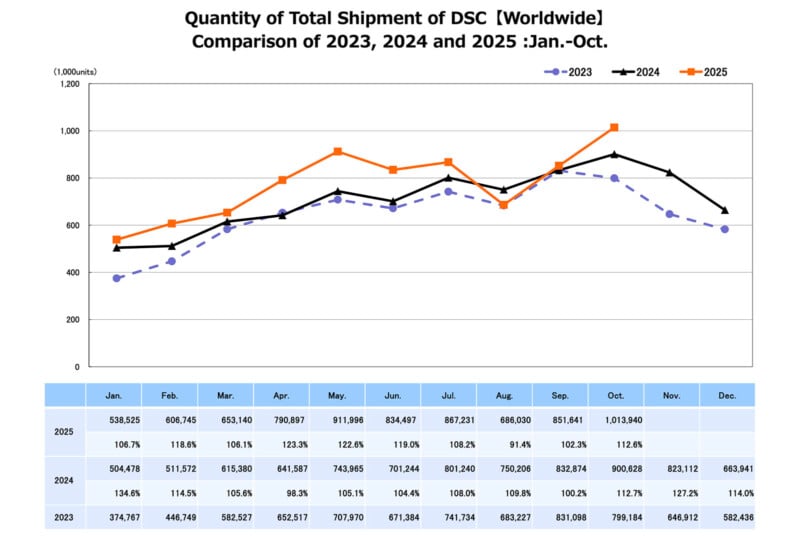
Overall shipments of digital cameras increased dramatically from August to September and again from September to October, making October 2025 the most prolific month for camera shipments since the start of 2023. Save for August, digital camera shipments have been higher in 2025 than in any of the two prior years, and 2024 was the first time that digital camera shipments had increased year-over-year since 2017. Given the instability of the global economy this year, it’s undeniably good news that 2025 is on pace to be a better year for the photo industry than 2024. It has undoubtedly been an excellent year for cameras and lenses from a qualitative perspective as well.
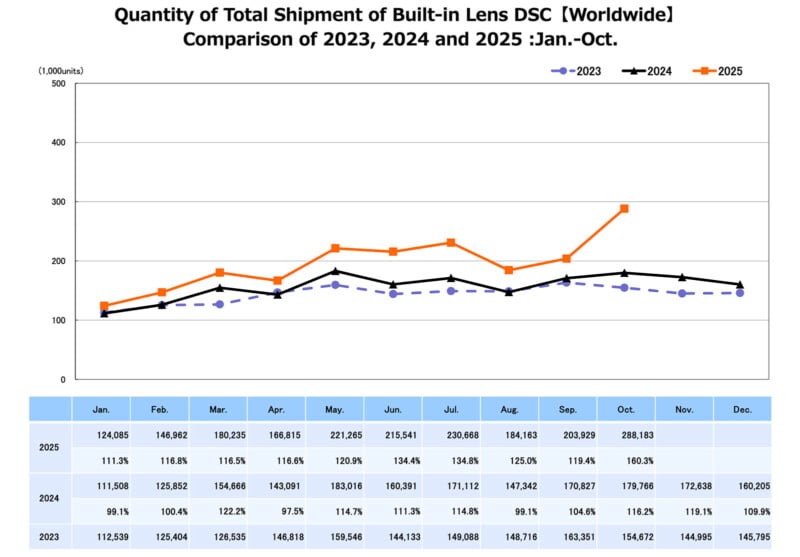
One of the biggest drivers of increased camera shipments in October was the rise in shipments of cameras with built-in lenses. It’s a safe bet that if the Fujifilm X100VI and Ricoh GR IV weren’t in short supply relative to demand, the numbers would have been even better.
Even when looking at interchangeable lens digital camera shipments, October 2025 still beat October 2024, which had previously been the best single month for ILC shipments over the past three years.

The only type of camera that has not had a good year so far is DSLRs, which continue to lose ground to mirrorless cameras. 57,195 DSLRs were produced in October 2025, bringing 2025’s total to 578,935. As Nikon Rumors reports, DSLR shipments are down nearly 30% so far this year compared to 2024. This trend is unlikely to change in 2026.
CIPA’s data goes beyond sheer numbers, as the organization also tracks camera production and shipments by sensor size and geographic destination. While full-frame cameras demand a lot of attention among passionate photographers, cameras with APS-C and smaller sensors comprise a much larger proportion of total interchangeable lens camera production — 420,454 to 264,115 units in October 2025.
The biggest destination for digital cameras in October was China, followed closely by the Americas, then Europe, Asia (except Japan), and finally Japan.
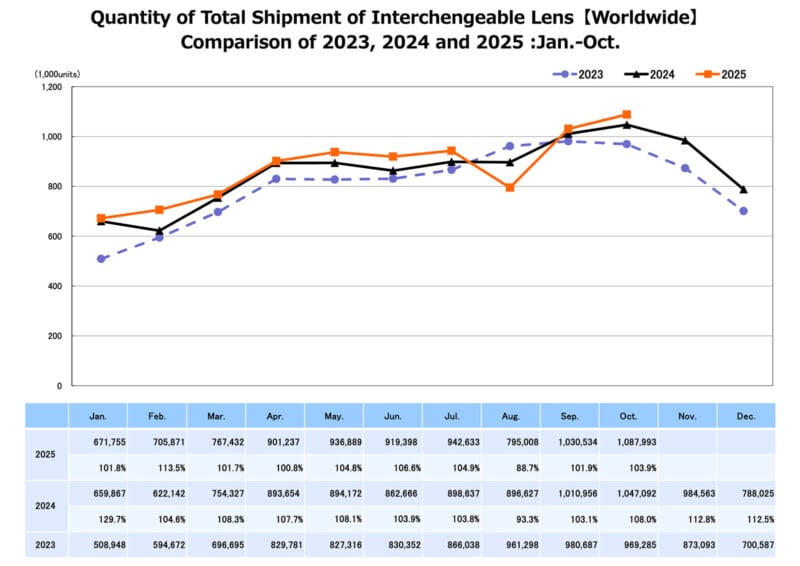
As for lenses, manufacturers in CIPA shipped 1,087,993 lenses in October, up from 1,030,534 in September and just 795,008 in August. October was the most prolific month for interchangeable lens shipments since at least 2023.
Although APS-C and smaller cameras accounted for over 61% of digital interchangeable lens camera shipments in October, lenses for APS-C and smaller sensors comprised 56.5% of total lens shipments. While this is not a significant difference, it stands to reason that photographers buying full-frame cameras, which are often more expensive, may also be more likely to buy new lenses.
Overall, despite a worse-than-usual summer slump and American tariff policy, which has significantly dampened photo companies’ outlooks for this fiscal year, CIPA believes 2025 will still beat last year in terms of digital camera and lens shipments. While the year-over-year increase looks slim, it is still much better than the period from 2013 through 2020, during which digital camera shipments and lenses decreased every single year, save for 2017, when they barely increased compared to 2016.
Image credits: Data and figures by CIPA. Header photo features assets from Sony, Ricoh, and Fujifilm. Additional assets licensed via Depositphotos.