Satellite Swarms Are Ruining Space Telescope Images, NASA Says
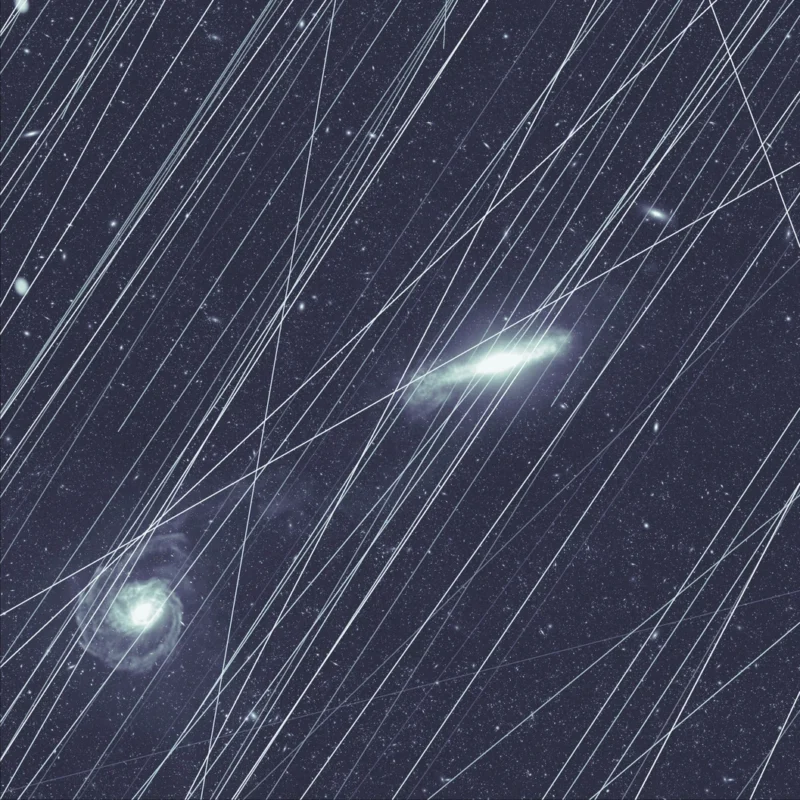
A new NASA-led study warns that the rapid increase of satellites in low-Earth orbit is causing growing light pollution that is affecting space telescopes, such as Hubble.
While satellites enable telecommunications services across the world, the new study, published in Nature, concludes that light reflected or emitted by satellites could contaminate a large share of the images taken by several major space telescopes over the next decade.
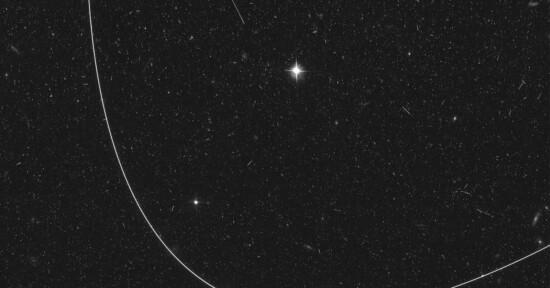
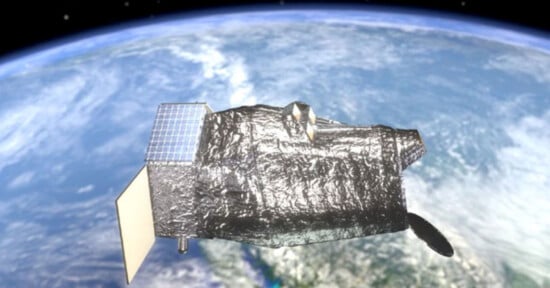
The research looked at four observatories: NASA’s Hubble Space Telescope and SPHEREx, and two planned missions, the European Space Agency’s ARRAKIHS and China’s Xuntian. The simulations suggest that around 40 percent of Hubble images and roughly 96 percent of images from SPHEREx, ARRAKIHS, and Xuntian could contain satellite streaks. The effect is less for Hubble because it has a narrow field of view.
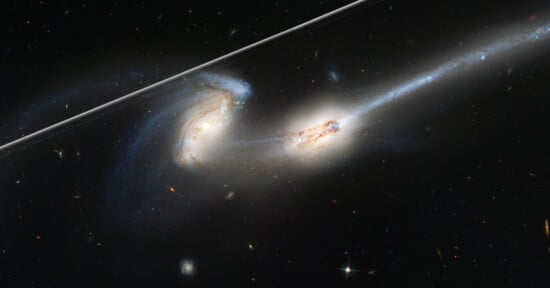
Orbiting telescopes can see a wide range of light wavelengths without distortions from the atmosphere, which makes them essential for studying faint galaxies, planets, and other targets. But as satellites pass across their view, they can leave bright streaks that obscure the faint signals astronomers are trying to detect.
“While until now most light pollution came from cities and vehicles, the rise of telecommunication satellite constellations is rapidly starting to affect astronomical observatories worldwide,” says Alejandro Borlaff of NASA’s Ames Research Center, lead author of the study published in Nature.
“As telescopes stare at the Universe attempting to unveil distant galaxies, planets, and asteroids, satellites sometimes cross in front of their cameras, leaving bright traces of light that erase the dim signal that we receive from the cosmos.”

Light contamination was once seen as a problem mainly for ground-based facilities. The assumption was that space telescopes, operating above the atmosphere, would be insulated from human-made interference. But satellite numbers have skyrocketed. There were roughly 2,000 satellites in low-Earth orbit in 2019. Today there are about 15,000. If current plans proceed, the study estimates that 560,000 satellites could be in orbit by the 2030s.
“To give an idea of how much this number increased recently, we have launched more satellites to low-Earth orbit in the last four years — 2021 to 2025 — than in the previous seven decades of space flight combined,” Borlaff says.
The team simulated the orbital patterns of major clusters such as Starlink, Guowang, and Amazon’s network, and combined them with properties of each telescope: altitude, trajectory, and field of view.
“Once we had the simulated telescopes observing our simulated universe, we only needed to count the number of times that the satellites crossed — or ‘photo-bombed’ – our observatories, and how bright they were at the moment of the event,” Borlaff explains.
Satellites produce interference in several ways: by directly reflecting light from the Sun with their solar panels, as well as reflecting light from the Moon and the Earth, which is intensely bright from low-Earth orbit.
“In addition to optical light, satellites also emit infrared radiation generated from the temperature of their components, as well as reflecting radio wavelengths from both the Earth and the antennas themselves,” adds Borlaff.
The result could be lost scientific information. Trails from satellites can resemble the streaks produced by asteroids, making it harder to identify potentially hazardous objects.
“Imagine that you are trying to find asteroids that may be potentially harmful for Earth,” Borlaff says while adding that an asteroid “looks exactly like a satellite.”
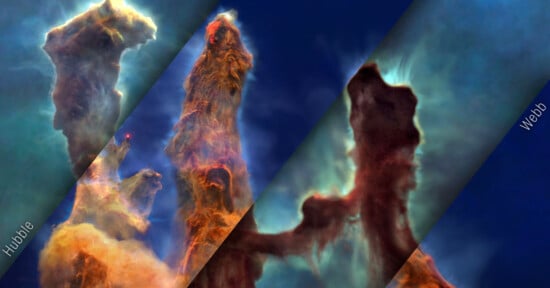
Some observatories are unaffected. Missions such as the James Webb Space Telescope and other spacecraft operating at more distant orbits, including Euclid and the Nancy Grace Roman Space Telescope, are positioned far from the satellites used for telecommunications.
Current satellite networks are dominated by Elon Musk’s Starlink, which accounts for nearly three-quarters of satellites already in orbit. But the study projects that within two decades Starlink may represent only about one-tenth of the total, as new competitors launch their own constellations.
The most direct response, according to the study, would be to launch fewer satellites. But the demand for global communication and data capacity continues to rise.
Image credits:NASA / Borlaff, Marcum, Howell (Nature, 2025)