Photographer’s Decade-Long Lawsuit Challenges if States Can Use Images Without Permission or Payment
An underwater photographer is still locked in a 12-year court battle over his images of Blackbeard’s shipwreck, a case that tests a law shielding U.S. states from copyright claims.
Underwater photographer and videographer Rick Allen filed a lawsuit against the state of North Carolina in 2013, claiming that it had stolen and published his photographs and videos of Blackbeard’s wreck without permission. Allen says the Department of Natural and Cultural Resources violated his copyrights by using footage owned by him and his company Nautilus Productions, without licensing it or paying him.
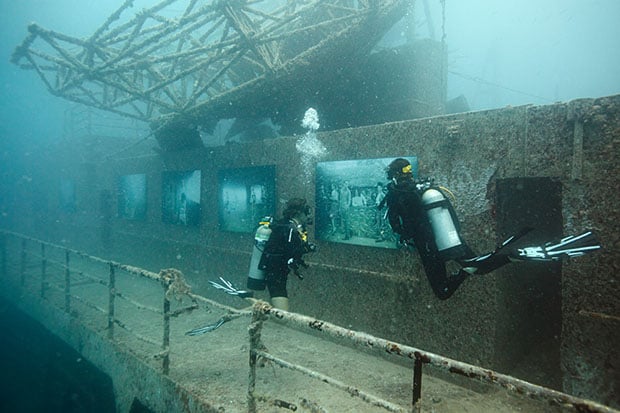
The photos and footage at the center of the dispute — which is still ongoing according to a recent report by CityView — show the shipwreck of Queen Anne’s Revenge. The ship was commanded by one of the most infamous pirates of all time, Edward Teach, better known as Blackbeard. Blackbeard’s ship, the Queen Anne’s Revenge, sank after it ran aground off the North Carolina coast in 1718 near Beaufort Inlet and Atlantic Beach.
In 1996, a marine salvage company called Intersal located the wreck. North Carolina, which by law owns shipwrecks in its waters, gave Intersal exclusive rights to access the site. Because the state cannot fund its own underwater searches, it partners with salvage companies in exchange for a share of recovered valuables. Intersal contracted Allen, who is based in Fayetteville, North Carolina, to produce professional photos and videos of the wreck. Allen began documenting the site and the work of underwater archaeologists in 1998.
“For almost two decades, Allen risked life, limb, and a small fortune documenting the excavation,” court papers filed to the 4th Circuit Court of Appeals say, according to Fayetteville-based news outlet City View. “This work was treacherous — working in high currents and low visibility. It took hours of dive time to capture mere seconds or minutes of footage.”
Allen says he provided the state with copies of his images for non-commercial educational and research purposes, but the Department of Natural and Cultural Resources exceeded this agreement by publishing them online without authorization, including on YouTube, for example. His lawsuit details videos and images allegedly copied and shared by the state department without permission, including footage of a recovered cannon, a raised anchor, and around 20 other videos made between 2008 and 2012.
The Rise and Fall of ‘Blackbeard’s Law’
Although the state initially agreed in 2013 to stop the copyright violations and pay Allen $15,000 for unauthorized use, the underwater photographer says further infringements continued. Then, in 2015, North Carolina passed “Blackbeard’s Law,” which allowed state agencies to freely use materials related to shipwrecks in their possession. Allen contends the state used this law to continue publishing his images, including in a film shown at a state maritime museum.
After the law’s partial repeal in 2016 and full repeal in 2023, Allen renewed his legal battle over the images of Blackbeard’s ship. The case reached the U.S. Supreme Court in 2019, which ruled in 2020 that state sovereign immunity prevented Allen’s copyright claim. Allen argues, however, that his case qualifies for an exception under U.S. law, comparing it to a 2006 Supreme Court decision allowing a disabled inmate to sue a state for rights violations. He asserts his copyrighted works constitute property improperly taken without due process.
CityView reports that Allen took his case to the U.S. Court of Appeals in Richmond, Virginia, on October 22, where a three-judge panel heard arguments. State Solicitor General Nick Brod told the judges the case should have ended, citing the Supreme Court ruling. Meanwhile, the photographer’s attorney countered that the issue of constitutional rights remains unresolved. The court is now reportedly due to issue a ruling, which could take months or longer.
“I’m cautiously optimistic,” Allen tells CityView about the upcoming ruling. “It’s been a long, challenging road.”
Image credits: Header photo licensed via Depositphotos.