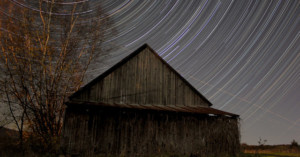
You’ve seen photos of star trails, and time-lapse videos of stars, but how about a combination of the two? Olivier Martel created this beautiful 18-second video using a technique we’ve never seen before: stacking star trail photos into a time-lapse video showing the trails forming.
After capturing roughly 500 photos (25s, f/3.5, ISO1600) from midnight to 5am in Quebec, Canada, he used a popular star trail stacking program called Starstax. In addition to stacking all the images into one, he had the program save the intermediate images at each step. He then turned those images into the stunning video seen above. The finished (and fully stacked) image can be seen here.
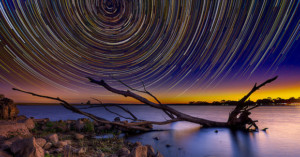
Photographer Lincoln Harrison captures jaw-dropping photographs of star trails. Shooting from the Australian outback, he spends up to 15 hours creating each image of the night sky. Shooting with a Nikon D7000, Nikon D3100, and a wide assortment of lenses, Harrison captures a large number of exposures of the foreground and stars separately. He then combines the images (sometimes hundreds of them) into amazing photographs showing the sky dominated by colorful star trails. Read more…
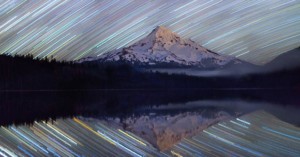
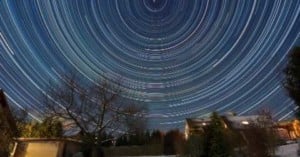
Night photographer Ben Canales made this image by stacking together roughly 50 different exposures in order to show all of the star trails across the sky. Regarding the color seen in the stars, Canales writes,
The different colors of the star streaks are from the “temperature” of light that the stars burn at. Just like a candle gives and orange light, and a gas stove burns blue- the stars in our sky shine all different sorts of colored light.
A while back, we featured a video tutorial by Canales on how to photograph the night sky. Give that video a look, find a still lake on a clear night, and you can make one of these photographs yourself!
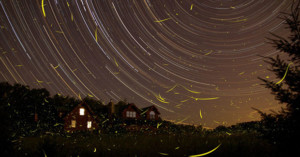
Photographer Mike Rosinski created this amazing image showing light trails from both fireflies and stars by stacking over 370 photos shot over 2 hours from his backyard in Hartland, Michigan. He used a Canon T1i and 15-85mm lens at 15mm with 20 second exposures. The stacking was done with StarStaX, a free program geared towards star trail photography. You can find more about Mike Rosinski’s work (prints, licensing fees, etc) by contacting him here.
You don’t need fancy camera gear to capture beautiful images and video of the night sky. The above video shows a timelapse created using 1262 photos captured with a Canon 20D at 30 second exposures and ISO 800. At the end there’s a star trails photo created by combining all the stills into a single image. It’s a great 1.25 minute dose of relaxation and inspiration.
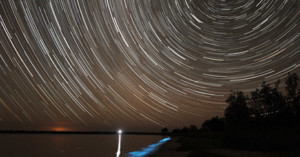
This is an amazing 1.5 hour exposure taken at the Gippsland Lakes in Australia by Phil Hart, showing both star trails and the crazy blue light given off by a bioluminescent algae called Noctiluca scintillans, commonly known as the Sea Sparkle.
The algae glows blue whenever there’s movement in the water, which there is where the waves break onto the shore. Sea Sparkles is going under Northern Lights on my list of things I’d like to see with my own eyes someday.