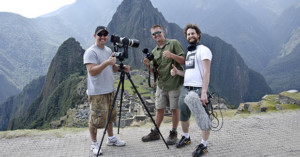
Photographer Jeff Cremer recently captured the highest-resolution photo ever shot of Machu Picchu, the most popular tourist destination in Peru and one of the New 7 Wonders of the World. Unlike other gigapixel projects that we’ve shared here in the past, this one is very well documented, offering an interesting behind-the-scenes look at how these gargantuan images are made. Read more…
By and large, as a professional of whatever description, clients hire you based on experience and expertise, grace under pressure, problem-solving skills, and your finely-tuned ability to transcend the limitations of the assignment and distill the essence of an idea into its most purely realized form.
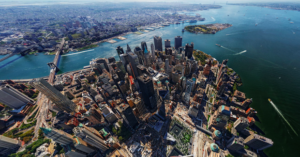
Okay so that’s what they tell you in college, but honestly it’s mostly just blather. Assignment photography is a hot-dog factory where the end results are images rather than sausages. If people saw what went into some of this stuff there’s no way they’d want anything to do with it. The sad reality is that there are all kinds of reasons you’re brought in on projects, some of them more edifying than others. Sometimes you’re exactly the right person for the job, other times you’re just a camera monkey. My favourite is the “wouldn’t-it-be-cool-if” call, where everyone gets all excited about an idea that turns out to be completely impractical. Well, this is the story of one of those ideas that actually managed to see the light of day. Read more…
You’ve probably seen gigapixel photos and timelapse videos before, but how about a fusion of the two? Researchers at Carnegie Mellon University have a project called GigaPan Time Machine that features gigapixel time-lapse videos of things ranging from plants growing to a university carnival. They also set up a wiki describing how you can create your own time-lapse using a GigaPan Pro.
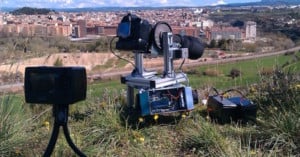
Robotic panorama devices are making the creation of gigantic photographs easier and easier. Donovan used a Gigapan EPIC Pro to create his image, along with a Canon 7D and 100-400mm f/4.5-5.6 L at 400mm. After 3.5 hours of shooting, he had 4,250 JPG images that took up 27.5 GB of his 32GB memory card. If the photograph were to be printed, it would result in a print the size of nearly 1,200 billboards.