PetaPixel

RhinoCam Turns Your Sony NEX Into a Digital Medium Format Back
RhinoCam Turns Your Sony NEX Into a Digital Medium Format Back rhinocam

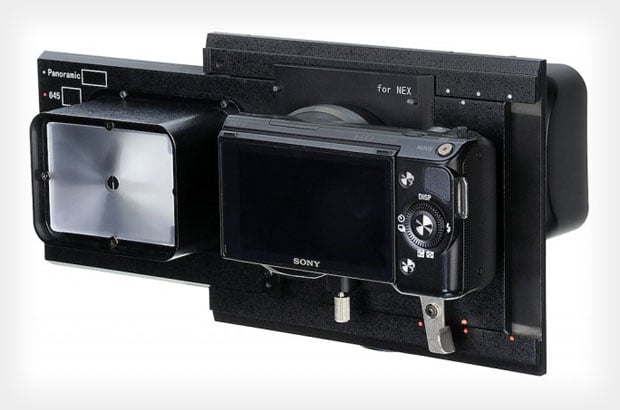
Fotodiox has announced a new mount system called the RhinoCam that turns a Sony NEX mirrorless camera into a digital back for 645 medium format photography. The kit allows NEX owners to shoot with classic medium format camera lenses to capture 140+ megapixel photos.
RhinoCam Turns Your Sony NEX Into a Digital Medium Format Back rhinocam2

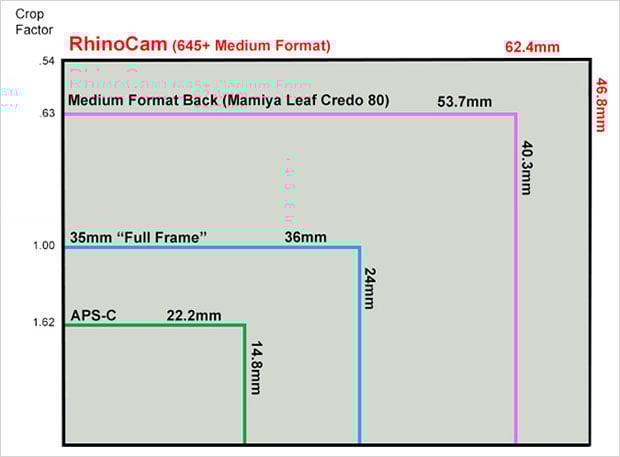
Photos resulting from the RhinoCam are equivalent to those captured with a sensor three times larger than a 35mm full frame sensor. This could be useful for photographers in certain fields (e.g. landscape, commercial, architecture) who would like ultra-high-res photos for a fraction of traditional costs.
RhinoCam Turns Your Sony NEX Into a Digital Medium Format Back rhinocam1

How RhinoCam resolution stacks up against other camera systems.

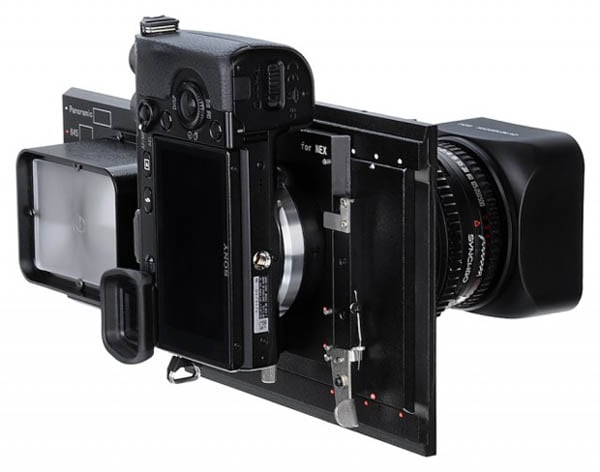
Here’s how the system works. First, it connects a NEX camera with a Pentax 645, Mamiya 645, or Hasselblad V medium format lens.

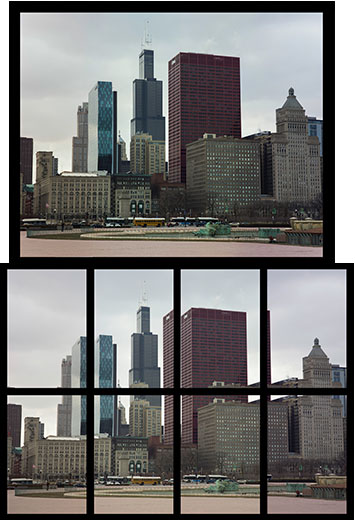
The photographer then looks through the built in Composition Screen to preview their shot. During the capture process, the camera is moved around on a moving platform while the lens remains fixed. The RhinoCam guides the NEX to a number of fixed positions for precisely positioned exposures.
RhinoCam Turns Your Sony NEX Into a Digital Medium Format Back comparison

Instead of shooting one high-res photo with one large sensor, RhinoCam lets you turn many lower-res photos shot with a smaller sensor into a high-res photo.

Once the photographs are captured, the photographer can use a number of photo stitching programs (e.g. Photoshop) to create the final ultra-high-res photo. Since the exposures were all created along a linear plane, flat-stitching can be used with minimal distortion in the final result.

The RhinoCam system is available now for $500 through the Fotodiox website.


  • pretty_ugly_1

    Why MF dynamic range is so good compared to 35 format? IF because of its size, this thing uses the same MF lens. Same image circle, same image sensor area(after stitching). If it’s the CCD thing, then why is 35mm CMOS better than 35mm CCD? Thing is CMOS tech is better than CCD in most application. And if Sony finally makes CMOS MF sensor, it will smokes CCD back big time.

    Film is a different story.

  • http://twitter.com/MediaCritiquer MediaCritiquer.com

    35 mm SLR digital back, please…

  • coca

    you would loose to much quality doing this

  • caca

    no this is not, this is made to landscape photographers or architectural
    it’s similar to a zork or mirex shift adapter

  • Joseph molina

    I too would still be interested in what camera, lens, and film you used to determine this. It can make a huge difference. No doubt, digital is way more economical. I just got a mamiya RZ 67 system for about 600$, but film cost, are definitely something i have to deal with, and even chemicals since i develop myself. That being said, the quality of some of these medium format cameras and lenses is insane when exposed through the right lens, on the right film, and developed and printed the right way. Its a touchy process forsure but in my personal opinion one thats much more exciting than digital photography. Thats just my personall opinion though. I can see why someone else may want one of these rhino cams but for me.. eh, i’ll just stick with my 67 system.

  • Teun Dilles

    That would only allow for macro-shots, as moving away from the lens decreases focusdistance.

  • Rama

    For $500 it should be motorised..

  • Sam W

    Medium Format?!?! not even close.

  • Sam W

    Exactly!