Acclaimed British Photographer Martin Parr Dies at 73
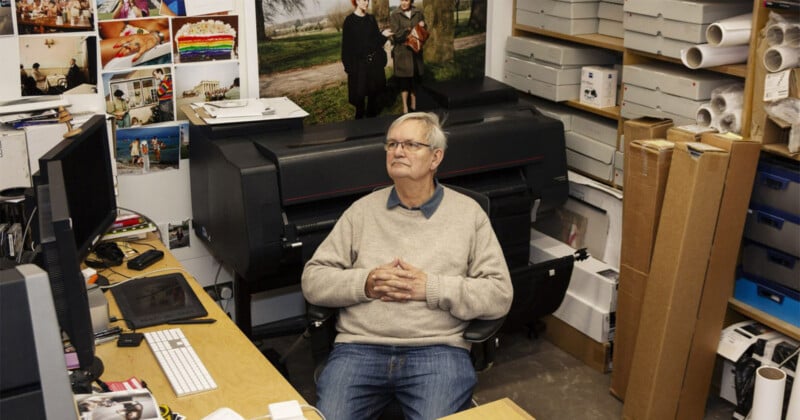
Celebrated British photographer Martin Parr, routinely listed among the best and most influential photographers in history, passed away this weekend at 73 following a multi-year battle with cancer.
The Martin Parr Foundation in Bristol, England, announced Parr’s death today, December 7.
“It is with great sadness that we announce that Martin Parr (1952-2025) died yesterday at home in Bristol,” the foundation’s statement reads. The acclaimed photographer is survived by his wife, Susie, his daughter Ellen, his sister Vivien, and his grandson, George.
In addition to requesting privacy at this difficult time, the Martin Parr Foundation says it is working with Magnum Photos to “preserve and share Martin’s legacy,” with more information to follow.
“Martin will be greatly missed,” the statement concludes.
Parr, who was frequently labeled a photojournalist alongside a documentary photographer throughout his career, told PetaPixel a few years ago that he preferred the “documentary label.”
“I don’t see myself as a photojournalist,” Parr said to PetaPixel. “I see them rushing off to, you know, wars and famines and all the other nasty things in the world that we need to know about through photography and film, but it doesn’t interest me to do that… I mean, it’s about recording the world and your relationship to it, so yeah, you could argue there are a lot of documentary pictures on Instagram. Documentary is a wide platform these days.”
Nonetheless, Parr said he was much less worried about definitions and labels than about taking pictures. And Parr captured many wonderful ones throughout his career, spanning more than five decades.
Parr’s work often focused on different socioeconomic classes and their stories in his native England, but he frequently worked abroad, too. His major projects spanned many subjects, and Parr published around 120 books during his career alongside over 600 exhibitions. He was a member of Magnum Photos since 1994.
Beyond being acclaimed for his ability to make exceptionally sharp social observations through his lens, Parr was also an extremely influential artist in the early days of color photography.
Parr remarked that back in the 1970s, photographers who wanted to be taken seriously had to shoot in black and white. Parr was acutely aware of the color photography emerging from the United States at the time, including that of Stephen Shore, William Eggleston, and Joel Meyerowitz. And then, after Sally Eauclaire traveled to the United Kingdom with her book, The New Color Photography, Parr decided the time was right to try color.
It was one of many choices the photographer made throughout his career that attracted controversy and criticism, including from Henri Cartier-Bresson.
“It’s the color that he did not like,” Parr recalled. “Cartier-Bresson said, ‘It looks like you’re from another planet.’ He was quite crossed about the show, so I wrote back to him, ‘I understand how you feel, but why shoot the messenger.'”
“I’m controversial. It still amazes me that I’m controversial. How can someone go to a supermarket and take pictures or to a beach resort and be controversial, and people who go to war and famine and photograph people dying and no one thinks that’s unethical? That’s a surprise of it all.”
Martin Parr fondly recalled to PetaPixel that his grandfather had been a “very keen amateur photographer.” When Parr would visit him as a child in the Northeast of England, his grandfather lent him his camera. The two went out and shot, processed the film, and made prints. It was then, when he was just 13 or 14, that Parr decided he would be a photographer.
And what a photographer he was.
Image credits: Martin Parr Foundation