Earlier today, the Nokia Lumia 925 that was teased yesterday became a reality. But more impressive than the phone itself, or the camera inside it, is actually the software running that camera. Announced as part of the Lumia 925, Nokia’s new Smart Camera application will soon bring some pretty cool photo features to the Lumia lineup. Read more…

A couple of weeks ago, the Magic Lantern team announced that they had discovered a RAW DNG Live View output on the 5D Mark II and Mark III. At the time, they could only get 14 frames per second for only 28 frames before the camera needed to buffer, but the team was confident that they could eventually increase the speed to 24p and pull a true RAW video feed out of the camera.
Lo and behold, that’s exactly what they’ve done. According to user lourenco in the Magic Lantern forums, he’s tested the new capability and he can pull continuous 1920×850 RAW video at 24p. Read more…
You’ve probably heard of cameras that can detect wavelengths of light that human eyes can’t, and also cameras that can detect heat in a scene, but have you ever heard of one that can capture sound? That’s right: scientists at the Korea Advanced Institute of Science and Technology have created a portable sound camera that’s sensitive to sound waves. Read more…
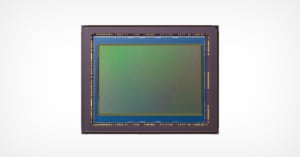
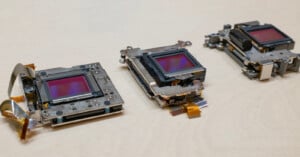
Think subject tracking in camera is impressive? Future Canon digital cameras may have image stabilization systems that can track stars. At least, that’s what a recently published Canon patent seems to suggest. The company may also be working on technology that can produce higher resolution photographs by shifting the camera sensor. Read more…
When it comes to capturing photos of your unborn child, you’re pretty much stuck to the ultrasound pics/tape that the hospital lets you take home. But what if there was a service that could take that ultrasound, and turn it into a one-of-a-kind 3D hologram? Well, that’s what Pioneer is working on with its new printing service. Read more…
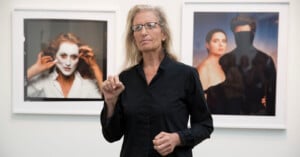
Just as RAW photo files contain all the information you need to put together a photograph, DNA contains all the information needed for a human being. Information artist and PhD student Heather Dewey-Hagborg has a fascinating portrait project that explores this idea. Read more…
Late last month, NASA launched Orbital Sciences’ Antares rocket into space, and with it a trio of satellites powered, get this, by Android Phones. Part of the NASA project “PhoneSats,” the three satellites spent a total of 5 days in space, after which they burned up in the atmosphere as planned — but not before they had a chance to beam down some sub-par smartphone snaps of Earth as seen from Orbit. Read more…
A couple of weeks ago, we shared a sneak peek of Adobe’s upcoming Shake Reduction Tool for Photoshop that has been dropping jaws ever since an advanced preview was debuted all the way back in October of 2011. The tool selects a section of the image, uses some complicated calculations to determine how the camera was moving when the photo was taken, and then remove the blur — pretty incredible stuff.
But it looks like Adobe has been beaten to this magical release by the small startup Intelligent Imaging Solutions and their newly announced Photoshop plugin Piccure. Read more…
While we’re on the subject of Google Glass, check out this interesting use case by hockey player Joseph Lallouz. He decided to wear his Glass during a hockey match in order to capture what the sport looks and feels like from a participant’s point of view. Read more…
Just like the human eye, the arthropod eye is a marvel of natural engineering. But unlike human eyes, insect eyes approach seeing very differently. Instead of a curved lens focusing an image onto a plane of rods and cones, insects have curved eyes covered by “ommatidia,” each acting as a tiny pixel.
In a paper published today in the scientific journal Nature, a team of researchers from the U.S., South Korea, Singapore and China announced that they have managed to create a camera that mimics that type of eye — and all of its advantages and pitfalls along with it. Read more…