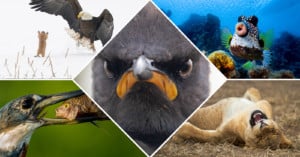
Last year we featured the work of Matthew and William Burrard-Lucas, two brothers who mounted their Canon DSLR to a remote-controlled car to shoot close-up photographs of dangerous African animals. The behind-the-scenes video above was just published yesterday, and shows the RC DSLR being driven up to different animals, all of which are clearly thinking, “what the heck is this thing”? They should offer these “BeetleCams” for sale. I want one.
While we’re on the topic of high-speed cameras (and slow motion videos), here’s a beautiful slow-motion video of an eagle owl “attacking” a camera, shot at 1,000fps with a Photron FASTCAM SA2. The new Phantom v1610 camera announced today can record footage 1000 times slower than this.
Photographer Vincent Laforet recently attached a Canon 600mm f/4 lens with a 2X converter to a $58,000 RED Epic camera using a yet-to-be-released mount, capturing some great footage of a lake at more than 3400mm (in 35mm terms).
While long lenses are nothing new in the motion picture world – this type of resolution combined with Canon’s Image Stabilization technology is utterly impressive and should be a huge hit with wildlife and sports photographers around the world.
This is once again an example of technology allowing us to pull things off we once thought impossible (or could be done with a lot of additional technology)
It’s a beautiful look at what the world looks like when you’re at a focal length powerful enough to peer closely at the moon.
Multi-tools are pretty convenient when you’re wandering around the great outdoors, but they’ve never really been a friend specifically to photographers. That changes with Gerber’s new Steady multi-tool, which turns into a mini-tripod using fold-out legs on one side and a fold-out tripod screw on the other. It also has 11 other useful tools to help you get things done. The Steady will be available starting in Spring 2012 for $65.
This is the first color photograph ever taken underwater. It’s a hogfish captured off the Florida Keys in 1926 by National Geographic photographer Charles Martin and Dr. William Longley. In addition to some special waterproof camera housing, the duo used pounds of highly explosive magnesium flash powder to illuminate the scene. Read more…
Lyrebirds are ground-dwelling Australian birds that have the remarkable ability to mimic sounds, both natural and artificial. In addition to copying the calls of other birds, they imitate whatever they hear around them, including the sound of cameras if photographers are working nearby.
This short BBC clip features a Lyrebird that makes realistic camera shutter sounds (including the motordrive sound). It only runs 3 minutes, but if you want to skip to the camera-related part it’s at around 1m50s.
If you want to make your camera stealthy for whatever reason (maybe wildlife photography?), there’s special camouflage-patterned bags or cases you can buy to put your camera in. Those can be pricey though, and an easier do-it-yourself solution is to simply tape up your camera with some camouflage duct tape. Instructables member Nano_Burger posted a series of photos showing how he did this with a cheap film camera.
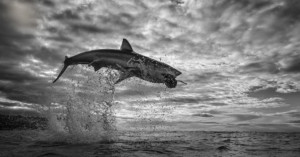
It’s always fun listening to photographers recount once-in-a-lifetime experiences that lead to once-in-a-lifetime photographs. In this short National Geographic video, photographer Brian Skerry describes what it was like to get up close and personal with a 45-foot-long whale. We only wish there was a little video to go along with his wonderful storytelling!
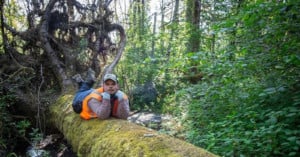
Think it’s difficult to muster up enough courage for street photography? At least strangers don’t eat you! This wildlife photographer got quite a scare while shooting a pride of lions when a lioness decides to investigate him. Luckily, he escapes without a scratch and now has a great story to tell his buddies.
Can anyone identify the camera and lens he’s clutching in his hand?
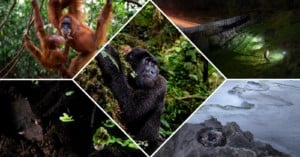
While watching a nature program on primates I was struck by their facial similarity to our own. Humans are clearly different to animals, but the great apes inhabit that grey area between man and animal. I thought it would be interesting to try to photograph gorillas, chimpanzees, bonobos and orangutans using the aesthetic of the passport photograph- its ubiquitous style inferring the idea of identity.
I decided against photographing in zoos or using ‘animal actors’ but traveled to Cameroon, Republic of Congo, Democratic Republic of Congo and Indonesia to meet orphans of the bush meat trade and live pet trade. [#]