Camera bags can get pricy, and when it comes to camera bags that travel well (i.e. on wheels) prices can really skyrocket. In fact, if you type “Rolling Camera Bag” into Amazon your first three options will run you $262.54, $171.07, and $249.00.
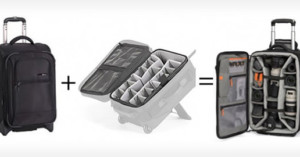
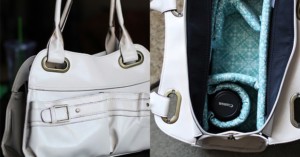
So if your idea of prepping for a vacation with your camera doesn’t include a hefty bag budget, Jerrit Pruyn over at FStoppers has a great solution: take your ordinary rolling carry-on bag, buy a matching Calumet Padded Insert for about $30, and put the two together. The result is pretty indistinguishable from some of the rolling camera bags you’ll find on the market.
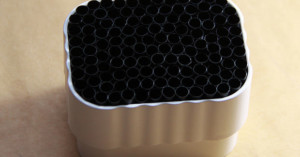
Photography enthusiast Jeff Vier made himself a cheap DIY grid spot using a $5 gutter downspout adapter he purchased from Home Depot and a $0.50 bag of drinking straws. Simply cut all the straws to the same length (the longer the straws, the more focused the light), carefully arrange them inside the adapter, and then use super glue to fix them into place. Vier found that his makeshift adapter fit perfectly over his Speedlight 580 EX II without any adjustments.
Update: We’re hearing that Walmart is no longer offering medium format film development.
Want to try your hand at shooting medium format 120 film but not sure where you’d get it developed? Stacie Grissom of Stars for Streetlights recommends WalMart as an easy and affordable option:
I have an awesome tip for you. I actually got my Holga prints developed through Walmart for about $3 per roll. That’s it. I could not believe it. Here’s what you need to do:
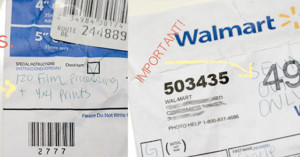
For each roll of film, take a separate film envelope and write “SEND OUT ONLY” at the top. Then fill in your info. “Send Out Only” means that Walmart will send it to a photo lab to be developed instead of developing it in the store. I don’t know how many (if any) Walmarts still develop 35mm film, but they definitely won’t do 120 film. Just send it out to a lab that knows what to do. Next, in the special instructions section, make sure you write “120 Film Processing, 4×4 prints.” And then drop them in the box! It’s seriously that simple. I was really paranoid when I sent out my film, but Walmart actually did a nice job.
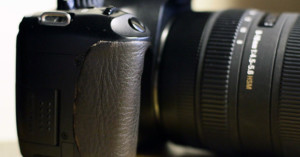
When the grip on his Canon Rebel T2i finally peeled and warped beyond repair, NYU computer science and mechanical engineering student Rob Huebner decided to go the DIY route. He found a beat up leather shoe, cut the proper shape out of it, and attached the leather graft onto his DSLR using rubber cement.
Image credit: Photograph by Rob Huebner and used with permission
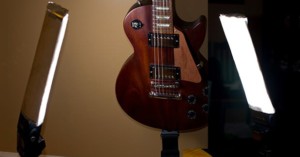
Here’s a tutorial by photographer Joe Edelman that teaches how you can build a studio lighting setup with fluorescent lights for under $200. You can find a detailed parts list over in the description of the video on YouTube. Read more…
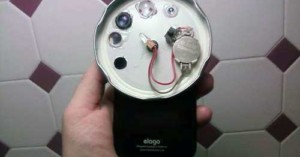
YouTube filmmaker Casey Neistat‘s DSLR recently took a tumble, breaking a piece off of the built-in lens hood of his Sigma lens. Instead of sending the lens in for repairs, Neistat decided to do a thrifty repair himself. After finding a similar-sized jar lid on some peanut butter at a local grocery store, he created a replacement hood himself by drilling a large hole and a couple small screw holes into the lid. He calls the project “The Peanut Butter Solution”.
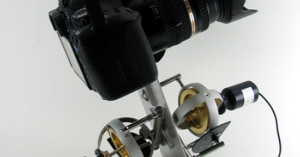
Physics guru David Prutchi recently came across a line of professional grade gyroscopic camera stabilizers by Kenyon Laboratories. They cost thousands of dollars each, but Prutchi noticed that the designs hadn’t changed much since they were first patented in the 1950s. He then set out to create his own DIY version using low-cost gyroscopes from Gyroscope.com. His finished device (shown above) actually helps stabilize his DSLR when shooting video or when photographing with non-image-stabilized lenses. Read more…
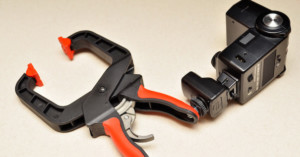
Photographer Allen Mowery has a step-by-step tutorial on how to build a useful DIY flash mounting accessory using a ratcheting hand clamp and standard 1/4-inch threaded screw. It’s a cheap DIY version of the Super Clamp or Nasty Clamp, and can help you place your flash in places that are inaccessible to light stands or traditional equipment.
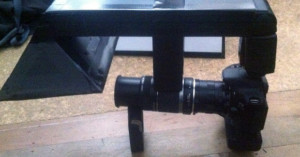
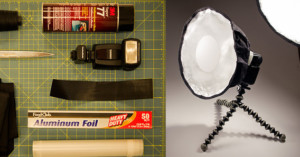
Photography enthusiast Kris Robinson used to handhold a flash above his subjects for macro photographs, but then he got tired of doing that and ran out of hands. He then came up with the brilliant idea of making a do-it-yourself contraption that attaches to his flash when it’s mounted to the hotshoe. The light travels down a tube lined with reflective aluminum tape, and is bounced downward onto the subject through a diffused lightbox. For a couple sample shots, see here and here.
P.S. Robinson also offers a tip for shooting macro photos of insects: if you place them into your freezer for a minute or two, they’ll sit nice and still for a while before warming up and scurrying away.
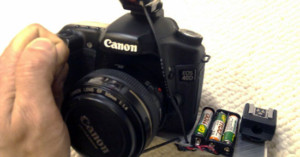
Image credit: IMG_0495 by Kris Robinson and used with permission
Want to shoot professional-looking shots of smaller objects. You can build your own tabletop studio using a collapsible clothes hamper, a white plastic sheet (e.g. a table cover), and a sheet of white posterboard. Stick the posterboard inside the hamper for your infinite white backdrop, and then use the plastic sheets on the sides to diffuse your light. Total cost? Less than 10 bucks!