Posts Tagged ‘tests’

Lumia 920 Outperforms the iPhone 5 and Competitors in Low-Light Tests

Lumia 920 Outperforms the iPhone 5 and Competitors in Low Light Tests lowlight1

Earlier this month, Nokia found itself in a public relations nightmare after it came to light that photos and videos in a video promoting the Lumia 920 smartphone had been faked. The company quickly began to do damage control by inviting the press to test out the PureView camera against competing smartphone cameras. The Verge’s test was quite promising, and now Engadget is confirming those results after doing tests of their own:

The 920 took the cake, without question, but the iPhone didn’t fare too poorly itself, snatching up nearly as much light as the Nokia device. The 808 PureView also performed quite well, but the HTC One X and Samsung Galaxy S III yielded unusable results.

It’s one thing to snag proper exposure, though — capturing sharp details with little noise and superior color balance is an entirely different beast, and the Lumia managed to do just that [...] The 920 did present some issues with exaggerated shake and other rapid movements, but it offered up excellent results overall, even in scenes that were too dark for us to make out any details with our own eyes

From the lab: Lumia 920 low-light shootout with Nokia 808, iPhone 5, HTC One X and Galaxy S III [Engadget via Cult of Mac]

Canon 24-70mm II “Way Better” Than the Original, Kicks Butt and Takes Names

Canon 24 70mm II Way Better Than the Original, Kicks Butt and Takes Names 2470mm

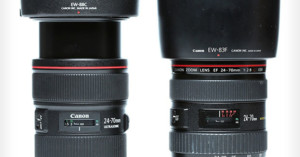
After being announced back in 2002 as a replacement to the 28-70mm, Canon’s 24-70mm f/2.8 (above right) quickly became an extremely popular and highly regarded lens due to its friendly all-around focal range and sharpness. When the Mark II version was unveiled back in February to succeed “The Brick”, as the Mark I version is called, photographers grumbled at its hefty $2,300 price tag, the fact that it uses an 82mm filter instead of 77mm, and the lack of Image Stabilization. Roger Cicala over at LensRentals tested out the new lens, and has extremely positive things to say about it:

This is short, sweet, and simple. The resolution absolutely, positively kicks butt and takes names. It is way better than the lens it replaces. It’s better at 70mm than the best Canon zoom I know of, the 70-200 f/2.8 IS II. It’s even better at 24mm than the sharpest 24mm prime we have, the Canon 24 TS-E. In the center, in the corners, it doesn’t care. We only had 5 copies to test, but they were all very similar with little copy-to-copy variation.

Resolution is not everything, of course. But it’s certainly an important thing. Unless the real lens reviewers find some dramatic problems with this lens, I’d have to lean towards worth-the-money on this one. I can’t believe I’m saying that a $2,300 standard zoom is worth the money. But then again, I can’t believe I’m seeing a zoom lens out resolve a $2,000 world-class prime, either.

Okay, okay. Time to sell a kidney.

Canon 24-70 f/2.8 II Resolution Tests [LensRentals]

Double Focusing Doesn’t Lead to Sharper Photographs

Double Focusing Doesnt Lead to Sharper Photographs focus mini

Have you ever learned that you should autofocus on the same point twice in a row to achieve optimal focusing? Apparently it’s a tip that’s often taught to beginners. Roger Cicala over at LensRentals decided to run some tests to see if this theory has any merit:

[If communication between a camera and a lens is one-way], AF may be more accurate if you ‘double focus’, meaning you push the shutter button halfway down until the AF beeps, then release and push it halfway down again. The idea is that you’re providing the camera a ‘recheck’ of the AF point and a chance to fine tune focus. I was taught to do this when I started photography but I have no idea if it really helps. So I thought we’d look at that [...]

If the two click AF method works better than one click AF, that might give us some indication that the system is open and without feedback. Maybe. If it isn’t I’m not sure it means there is a feedback loop. Maybe AF is as accurate as it gets no matter how many times you pre-focus.

After a battery of tests, Cicala came to the conclusion that “pre-focusing” a camera does absolutely nothing for the accurate focusing of photos.

Autofocus Reality Part 2: 1 versus 2, old versus new (via Gizmodo)


Image credit: Lens by 14zawa

Low Light Comparison of the Canon 5D Mark II, 5D Mark III, and Nikon D800

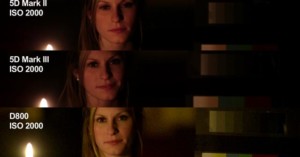
The folks over at NoFilmSchool recently did a low light comparison of the Canon 5D Mark II, Canon 5D Mark III, and Nikon D800. The cameras were used to film the same dark candlelit scene with the same settings, and the ISO was slowly pushed up to the cameras’ respective limits. It’s pretty striking how big of a difference in low light/high ISO quality there is in the cameras, especially in light of DxO Lab’s test results for the cameras’ sensors…

(via NoFilmSchool via Fstoppers)

How Carl Zeiss Lenses Are Stress Tested

Want to see how high end camera lenses are tested for durability? Here’s a video in which Carl Zeiss researcher Norbert Wittekindt shows off the various tests lenses are subjected to, ranging from temperature tests to mechanical vibrations.

(via Foto Actualidad)

Nikon D800 Resolution Compared to the Canon 5D Mark III

Nikon D800 Resolution Compared to the Canon 5D Mark III tests mini

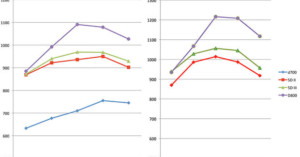
Last week camera testing service DxOMark announced that the Nikon D800 had earned the highest sensor quality score ever awarded. Roger Cicala of LensRentals wanted to see for himself how much of an advantage the D800′s 36.3MP sensor had over its competition, so he did some sensor resolution tests on the camera, comparing it to the Canon 5D Mark III, 5D Mark II, and Nikon D700. His conclusion?

[...] there’s no question the D800 can actually get those pixels to show up in the final product (assuming your final product is a big print – they’re going to be wasted posting on your Facebook page). But you’d better have some really good glass in front of it. I don’t think the 28-300 superzooms are going to cut it with this camera.

In the real world, highest possible resolution is nice to know about and talk about, but usually not of critical importance compared to other factors. You’ll be able to make superb images with any decent lens for an 8 X 10 or even 11 X 16 print. But if you’re getting the camera because of the resolution, it makes sense to know which lenses will allow all of that resolution to be utilized. Just in case you get that job that needs billboard sized prints.

Read more…

Old School Flash Powder Compared to a Modern Day Flash

Maurice Ribble of Tech Photo Blog recently found the ingredients list for flash powder, which was used for state-of-the-art photographic lighting 150 years ago. After making some of the powder, he began to test it to see how it compares to modern day flashes (more specifically, a Canon 580EX II).

One of the tests is a simple scene that was lighted with a modern flash and then flash powder so we can compare the images. Overall I was quite impressed with the amount of light that even a small amount of flash powder makes; however, there were many disadvantages to flash powder.

If you’re interested in making your own, a simple search on Google will point you in the right direction. Be careful though — the stuff is quite dangerous.

(via TPB via DIYPhotography)

Quantifying the Variation in Sharpness Between Copies of the Same Lens

Quantifying the Variation in Sharpness Between Copies of the Same Lens chartlens

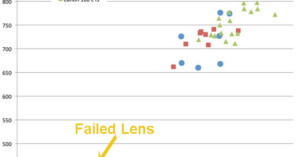
As you might know, different copies of the same lens can vary in quality, and some people go as far as to purchase multiple copies to pick the sharpest one before returning the others. Roger Cicala over at LensRentals wanted to quantify exactly how much variation actually exists between copies of the same lens, so he subjected some to Imatest quality tests:

[...] while the Canon 100mm f/2.8 IS L lens is a bit sharper than the other two on average, not every copy is. If someone was doing a careful comparative review there’s a fair chance they could get a copy that wasn’t any sharper than the other two lenses. I think this explains why two careful reviewers may have slightly different opinions on a given lens.

That’s interesting to think about. Two highly objective reviews of the same lens could come to different conclusions about relative sharpness compared to other lenses, simply because there are differences among copies of that lens. Too bad reviews are usually based on a single copy of a lens, rather than the average performance of multiple copies.

Notes on Lens and Camera Variation [LensRentals]

Nikon 1 System Sensor Performs Very Well Given Its Small Size

Nikon 1 System Sensor Performs Very Well Given Its Small Size j1test mini

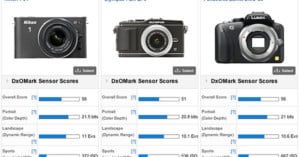
DxOMark has just published its findings on the quality of Nikon’s new mirrorless camera sensor, and the verdict is that Nikon did a pretty good job milking quality out of the small 1-inch sensor:

With regard to its size, this ranking is a big surprise, as the Nikon J1 sensor manages to score close to or even better than larger sensors (including 4/3 sensors).

[...] On the other hand, its low-light ISO score is a bit low: 372, which reflects the impact of the sensor size. Indeed, this score is naturally dependent on the sensor size: the bigger the sensor, the more light it captures. So even though the quality of the pixels provided by Nikon is very close to that of its main competitor, its sensor size physically limits the image quality.

If low-light shooting is your thing. then you might want to look into cameras with larger sensors. However, for everyday photography the new Nikon line perform surprisingly well given how much smaller its sensor is compared to its competitors.

Interchangeable Lens cameras by Nikon (via Nikon Rumors)

JPEG and RAW Samples Published for the Nikon J1

JPEG and RAW Samples Published for the Nikon J1 samples mini

The relatively small 1-inch CX-format sensor found in Nikon’s new mirrorless cameras caused quite a bit of discontent among serious shooters even before the cameras were announced, but now that it’s official we finally have the opportunity to see its image quality in real-world environments. dpreview has published a gallery of 23 JPGs shot with the Nikon J1, along with 5 RAW files shot between ISO 100 and ISO 3200. Take a look, and judge for yourself.

Nikon J1 real-world samples gallery [dpreview]