Posts Tagged ‘survey’

Canon Conducts Customer Survey Regarding Mirrorless Cameras

Canon Conducts Customer Survey Regarding Mirrorless Cameras questions mini

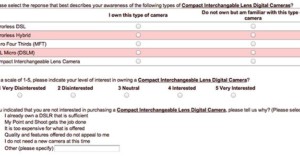
Canon sends out an email containing a customer survey once or twice a year, and yesterday’s survey included a few questions regarding mirrorless cameras. Looks like the company is looking into entering the mirrorless game. About time too — mirrorless cameras are chipping away at Canon’s market share, and Nikon is rumored to have a mirrorless camera announcement just around the corner on September 21st.

(via Canon Rumors)

Leave Digital Photo Frames Off Your Christmas Shopping List

Leave Digital Photo Frames Off Your Christmas Shopping List digiframe

Thinking of buying a love one a digital photo frame this Christmas? You might want to reconsider. A recent survey of 2,000 people by the British Video Association found that digital photo frames were the most unwelcome gifts, followed by foot spas, blenders and digital organizers.

More than a third of those surveyed said they simply didn’t have time to use the gadgets they had received, while 23 per cent didn’t see the point of some of them. The survey found that 18 per cent of those who rarely used their gadget gift simply didn’t like them, 10 per cent couldn’t be bothered to clean them, while seven per cent had not read the instructions or didn’t know how to use the device. [#]

Have you ever received a digital photo frame that you never ended up using? (I have)

(via Steve’s Digicams)


Image credit: digital photo frame – hanging by m a r c

Camera Failure Versus Price and Brand

SquareTrade is a company that provides warranties for consumer electronics. As such, it has a good deal of data on digital cameras and, more specifically, how often they fail. After a three year study of over 60,000 new digital cameras, they’ve published a report with their findings.

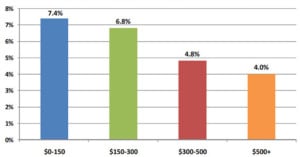
Here’s a graph comparing failure rate with camera price:

Camera Failure Versus Price and Brand malfunctionprice

Surprise! Cheaper cameras have a higher failure rate than more expensive ones.

When comparing failure rate with camera brands, the results are a little more surprising:

Camera Failure Versus Price and Brand failurebrands

The study found that Panasonic cameras are the most reliable for both value and premium point-and-shoots. Canon cameras are more reliable than Nikons for cheaper compacts, but for premium models Canon’s reliability does not improve, while Nikon’s improves drastically. Keep in mind this report is only about reliability, not performance or image quality.

Finally, why do cameras fail? The report has a nice graph for that question too:

Camera Failure Versus Price and Brand failurereasons

Both curves seem to decrease in steepness after the first year, suggesting that if you have a well built camera and aren’t clumsy or reckless, you’ll probably take care of your camera for a good amount of time.

Finally, here’s an interesting highlight from the report:

For DSLR Cameras, Nikon and Canon were equally reliable.

Whew! Glad that’s settled…

We’d be interested in seeing a graph comparing actual life span of specific camera models compared with their price. This could provide a ranking of cameras in terms of price per year (of average life).

Digital Camera Failure Rates (via Wired)

Study Finds Photography Undesirable as a Job

Study Finds Photography Undesirable as a Job careercastJob portal careercast recently released a ranking of 200 jobs from best to worst for 2010. The Wall Street Journal republished the data in a nice, sortable chart as its Best and Worst Jobs 2010 list. Since you’re reading this, you probably want to know how jobs involving photography rank on the list. The answer: pretty low.

The job “photographer” ranks 126th on the list, right below “waiter/waitress” and right above “advertising salesperson”. “Photojournalist” is near the bottom of the list, ranked #189 below “firefighter” and above “butcher”.

In terms of the methodology used, five categories are evaluated and summed up: environment, income, outlook, stress and physical demands.

I think the methodology is flawed because of the fact that they focus primarily on tangible upsides and downsides. Many photographers I’ve spoken to chose photography as a career for reasons including a passion for photography and the opportunity to see the world. These things aren’t accounted for in the study, since they don’t have categories such as “job satisfaction”.

What do you think of these rankings? If you disagree, what should photography-related jobs actually be ranked?

(via A Photo Editor)

Nikon Releases Interesting Survey Results

Nikon Releases Interesting Survey Results nikonlogo100pxNikon recently conducted a survey called “Picture Yourself”, and released some interesting findings today, a lot of which reveals things about the way people view themselves. The survey was conducted using random telephone dialing, and sampled 1000 Americans 18 and older.

If only we had thought of some of these questions for our weekly polls… Maybe we’ll use a few in the future.

Anyhow, here were some interesting findings:

  • 25% would choose to retake a family photo if they could turn back time
  • 92% of adults had at least one photograph taken of them so far this year
  • 79% believe they look better in person than in photographs (do you?)
    Nikon Releases Interesting Survey Results 98102794 39ef3eae1f
  • 26% chose weight as the feature they dislike the most in photos
  • Men have an average of 73 photos taken of them, while women have only 38

Are there any other questions you wish Nikon had included in the survey? Let us know, and we’ll conduct “research” with PetaPixel polls!

(via The Imaging Resource)


Image credit: Mirrored self-misidentification by eqqman

Survey Reveals Image Theft Widespread

Survey Reveals Image Theft Widespread polylogoA recent survey of 200 creative professionals in the UK found that 37% admit to illegally using images found on the Internet.

What’s even more shocking is the fact that most of the professionals surveyed did not know the correct definition of “royalty free” and “rights managed”. Nearly half (44%) believed that “royalty free” meant the image could be used without paying for it, when it actually means there aren’t additional royalty charges associated one the image is licensed/purchased. Similarly, only 16.5% understood what “rights managed” means.

Do you think the survey is accurate, and reflects the state of the industry as a whole? Is there this type of ignorance in your workplace?

(via Digital Photography Now)