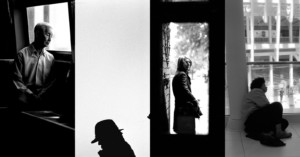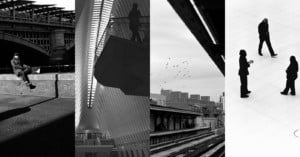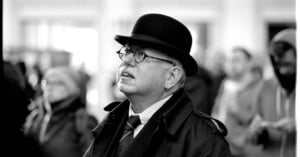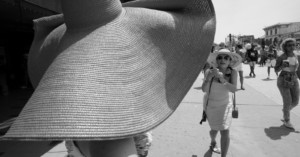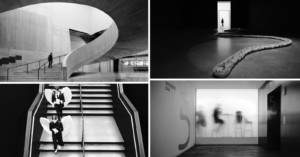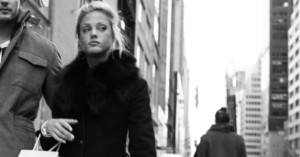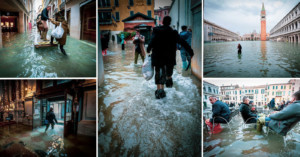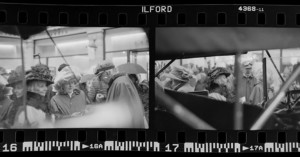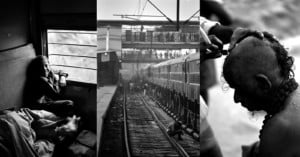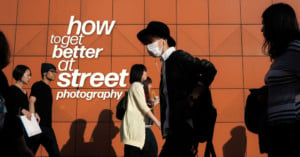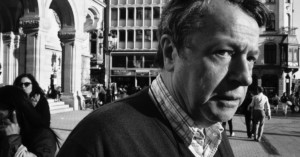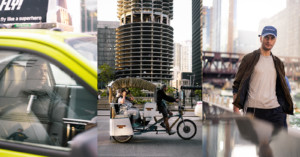
Here’s a photo essay that documents Magnum photographer Alex Webb‘s exploration of the streets of Chicago. In an interview with Leica, Webb states,
[...] I am not trying to convey messages. I take photographs to affirm reality, not explain reality and that reality often has a high level of ambiguity to it, which is subject to interpretation. So what one viewer discovers in a given image may be very different from what another viewer discovers. This particular photograph seems to suggest to you something about corporate culture, but another viewer might simply be amused by the similarity of be-suited figures and another viewer might find something else. I believe in photographs that have a level of ambiguity, images that work on suggestion, that ask questions rather than provide answers.
Street photographer Eric Kim created this video showing what it’s like to photograph passers-by on the sidewalks of Beverly Hills, CA. He attached a GoPro camera to his Leica M6 (loaded with Kodak Portra 400 film) to record his adventure, and then edited in the final photographs after getting the film developed. Kim ruffled a lot of feathers with some of his old behind-the-scenes videos due to his in-your-face style, but has since toned it down quite a bit — not using a large handheld flash certainly helps on that front.
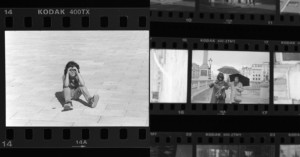
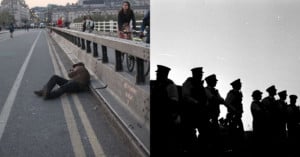
P.S. Wouldn’t it be awesome if more photographers started doing these camera POV videos to show how they work?
Reflections is a series of photographs by New York-based fine art photographer Ira Fox. Shot through the reflections seen in puddles on their ground, they show shadows of passers-by as they cross paths with Fox on a rainy day. Read more…
Here’s an interesting behind-the-scenes mini-documentary showing Scott Schuman (AKA “The Sartorialist“) shooting his street fashion photographs in Tokyo, Japan. Unlike many street photographers, Schuman first approaches his subjects and asks for permission.
We featured a different BTS video showing Schuman at work back in January.
This video was shot by a German film crew in the early 1980s, and shows American street photographer Garry Winogrand at work. Although he died of bladder cancer at age 56, his photographic output during his lifetime was enormous, even compared to other photographers:
Consider this: at his death, Winogrand left behind 2500 undeveloped rolls of 36-exposure 35mm film (mostly Tri-X), 6,500 rolls of film that had been developed but not contact-printed–not to mention 300 apparently untouched, unedited 35mm contact sheets.
Do the math. Conservatively, that’s at least 300,000 pictures – equal to at least two life’s work for anyone else–that Winogrand took but never even saw, so busy he already had been photographing the world around him. [#]
That explains why Winogrand is able to load new film into his Leica so effortlessly while talking to the camera — he could probably do it in his sleep.
Philosopher and Georgia Tech professor Ian Bogost gave this short talk recently on the photography of renowned American street photographer Garry Winogrand, specifically focused on Winogrand’s famous quote in which he says,
I photograph to see what the world looks like in photographs.
Unless you’re a philosopher, this may be the most confusing photography talk you’ve ever heard. See if you can wrap your mind around what Bogost is saying…
Here’s a video in which renowned street photographer Joel Meyerowitz shows us his method of doing street photography. His quiet, friendly, and “invisible” style is quite different from Bruce Gilden’s in-your-face technique. The New Yorker also has a great video on Meyerowitz’s photography.
If you want to do street photography, attacking people with cameras like Fabio Pires does in London probably isn’t the way you should go about doing it — unless you’re trying to give photography a bad name. Does anyone know of any good behind-the-scenes videos of good (and candid) street photography being done in a respectable way?