Posts Tagged ‘rogercicala’

Is Sony Going to be the Digital Kodak?

Is Sony Going to be the Digital Kodak? sonybuilding mini

My mind is a strange and dangerous place. I shouldn’t go in there alone after dark. But the other night I was thinking, just me and myself, about all the new camera releases this year. Which had made the biggest impact? Was it the Canon 5D III with that world-class autofocus system? The Olympus OM-D bringing mirrorless cameras up a notch in image quality and usability? Should I mention the excellent Samsung NX20, just because no one knows it’s really good? Give the Fuji X-Pro an award for best concept most poorly carried out? Consider the Sony NEX-7 for putting full-frame resolution on an APS-C sensor?
Read more…

The Rashomon Effect and My Small-Camera Choice

The Rashomon Effect and My Small Camera Choice rashoman mini

Way back in the day, when the first mirrorless cameras were released, I was on them like white on rice. I desperately wanted to love, well, any of them: the Sigma DP-1, Panasonic G1, Olympus E-P1, Leica X-1, and more all passed through my hands. Many people loved having a small camera that delivered high image quality. I loved that idea, too, but I didn’t love those first cameras because of what they couldn’t do. They couldn’t shoot high ISO. There weren’t many lenses. Autofocus times reminded me of loading pages on dial-up Internet connections. But at the time (way back in 2009) I thought this was the future of consumer imaging. I predicted that by their third generation, mirrorless cameras would eventually take over the intro-level SLR slot.
Read more…

Nikon D800 Resolution Compared to the Canon 5D Mark III

Nikon D800 Resolution Compared to the Canon 5D Mark III tests mini

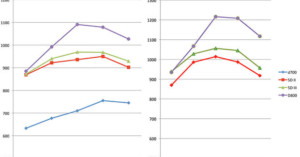
Last week camera testing service DxOMark announced that the Nikon D800 had earned the highest sensor quality score ever awarded. Roger Cicala of LensRentals wanted to see for himself how much of an advantage the D800′s 36.3MP sensor had over its competition, so he did some sensor resolution tests on the camera, comparing it to the Canon 5D Mark III, 5D Mark II, and Nikon D700. His conclusion?

[...] there’s no question the D800 can actually get those pixels to show up in the final product (assuming your final product is a big print – they’re going to be wasted posting on your Facebook page). But you’d better have some really good glass in front of it. I don’t think the 28-300 superzooms are going to cut it with this camera.

In the real world, highest possible resolution is nice to know about and talk about, but usually not of critical importance compared to other factors. You’ll be able to make superb images with any decent lens for an 8 X 10 or even 11 X 16 print. But if you’re getting the camera because of the resolution, it makes sense to know which lenses will allow all of that resolution to be utilized. Just in case you get that job that needs billboard sized prints.

Read more…

The Truth About Fractional Sensor Size Measurements

The Truth About Fractional Sensor Size Measurements vidtube mini

Ever wonder why camera manufacturers these days are describing often sensor sizes with fractions instead of millimeters? Roger Cicala of LensRentals explains:

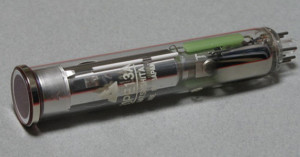
[...] then we get into all of these fractional-inch-type-measurements for the smaller sensors. That measurement system originated in ancient times (the 1950s to 1980s) when vacuum tubes were used instead of CCD or CMOS sensors in video and television cameras. The image sensor was, in those days, referred to in terms of the outside diameter of the vacuum tube that contained it.

Why do manufacturers keep using such an archaic measurement? Because it helps them lie to you, of course. If you do the math 1/2.7 equals 0.37 inches, which equals 9.39 mm. But if you look at the chart above you’ll see that a 1/2.7″ sensor actually has a diagonal of 6.7 mm. Why? Because, of course, a thick glass tube used to surround the sensors. So they calculate the sensor size as if the glass tube was still included. Makes perfect sense to a marketing person who wants to make their sensor seem larger than it is. What sounds better: 1/2.7″ or ‘less than 10% the size of a full frame sensor’?

If you have a few minutes, give his entire post on sensor sizes a read — it’s quite illuminating.

Sensor Size Matters [LensRentals Blog]


Image credits: Photograph by Sphl

You Can Increase Sharpness a Lot by Stopping Down Just a Little

You Can Increase Sharpness a Lot by Stopping Down Just a Little sharp mini

You probably know that stopping down (i.e. increasing your f-stop number) can increase the sharpness of your subject, but how much should you stop down to boost resolution without losing that nice, creamy bokeh? Roger Cicala did some research on this question and writes:

For those lenses that do benefit, stopping down just to f/2.0 provides the majority of resolution improvement. The difference between wide open and f/2.0 is generally much greater than the difference between f/2.0 and the maximum resolution.

Getting the edges and corners sharp requires stopping down to at least f/4 for most wide-aperture primes, and some really need f/5.6. Stopping down to f/2.8 may maximize center sharpness but often makes only a slight difference in the corners, at least on a full-frame camera.

None of the lenses performed any better after f/5.6 (for the center) or f/8 for the corners. Most were clearly getting softer at f/11.

If you’re using a wide-aperture lens, stopping down to just f/2.0 will reap big gains in sharpness while still keeping the depth-of-field narrow. Furthermore, for some lenses you don’t really even need to worry about stopping down for sharpness, since it hasn’t a relatively negligible effect on the outcome.

Stop It Down. Just A Bit. [LensRentals]


Image credit: Margaritas a la bokeh by ganso.org

Quantifying the Variation in Sharpness Between Copies of the Same Lens

Quantifying the Variation in Sharpness Between Copies of the Same Lens chartlens

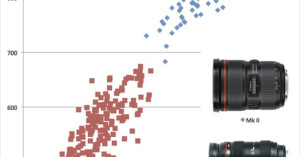
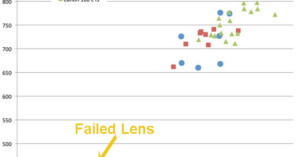
As you might know, different copies of the same lens can vary in quality, and some people go as far as to purchase multiple copies to pick the sharpest one before returning the others. Roger Cicala over at LensRentals wanted to quantify exactly how much variation actually exists between copies of the same lens, so he subjected some to Imatest quality tests:

[...] while the Canon 100mm f/2.8 IS L lens is a bit sharper than the other two on average, not every copy is. If someone was doing a careful comparative review there’s a fair chance they could get a copy that wasn’t any sharper than the other two lenses. I think this explains why two careful reviewers may have slightly different opinions on a given lens.

That’s interesting to think about. Two highly objective reviews of the same lens could come to different conclusions about relative sharpness compared to other lenses, simply because there are differences among copies of that lens. Too bad reviews are usually based on a single copy of a lens, rather than the average performance of multiple copies.

Notes on Lens and Camera Variation [LensRentals]

The Ancestors of Modern Camera Lenses

The Ancestors of Modern Camera Lenses ances

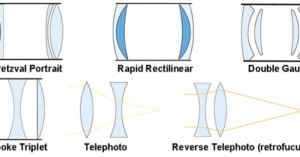
Rather than being built from scratch with new designs, new camera lenses are designed by taking existing lens designs that work well and then improving on them. As a result, virtually every lens design can be traced back to one of six basic lens designs developed in the early 1900s (shown above). Roger Cicala of LensRentals writes,

Those original lenses in their pure form each had strengths and weaknesses. Modern lenses derived from them have ‘inherited’ those same underlying tendencies. Many of the complex technologies used in a modern lens are put there to correct the underlying problems of the original design.

Head on over to his post to learn about lenses derived from the first three of these designs.

Lens Genealogy Part 1 [Lens Rentals]