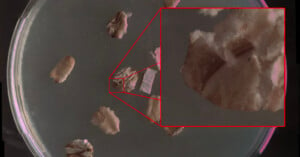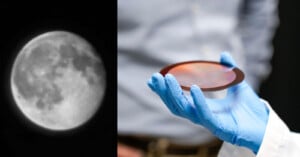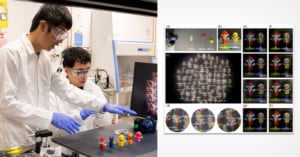
Think subject tracking in camera is impressive? Future Canon digital cameras may have image stabilization systems that can track stars. At least, that’s what a recently published Canon patent seems to suggest. The company may also be working on technology that can produce higher resolution photographs by shifting the camera sensor. Read more…
Back in 2010, Nokia created “the world’s smallest stop-motion video” using its new N8 smartphone and a tiny 9mm-tall figure of a girl. If you think 9mm is tiny, try 1/25,000,000th of a inch!
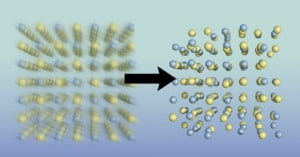
Today, IBM scientists announced that they have created the world’s smallest movie. Unlike the previous record holder, this one will be extremely difficult to beat. The stop-motion movie was made using individual atoms. Read more…


A team of researchers at Heriot-Watt University in Edinburgh have developed a new laser camera system that can take extremely precise 3D depth scan images from up to a kilometer away (0.62 miles). An impressive advancement in laser imaging, the camera uses a low power infrared laser beam to create 3D images precise to the millimeter. Read more…
Recently published patent applications filed by Nikon offer a glimpse into what the company may be working on for future DSLRs and mirrorless cameras. The three technologies spotted are: illuminated lens mounts, dual lens contacts, and a hybrid viewfinder. Read more…
New cameras are like new computers. Both of them depreciate quite quickly as new technologies and new models are churned out year after year. This presents a perpetual problem for photographers, as many constantly grapple with the question of whether to upgrade their camera to a more recent model, or whether to purchase a higher-end model so that it keeps its value longer.
Market research software company Terapeak recently did a study that looks at depreciation in Canon EOS DSLRs. The results are pretty interesting. Read more…
It doesn’t have an official name, but when used in combination with traditional techniques, the new interface could help take your stop-motion animation to the next level. Read more…
Lenses and sensors weren’t the only camera components miniaturized and dumbed down when digital photography jumped over into the world of smartphones: flashes did too. In order to fit everything into a tiny package, smartphone makers have largely opted for LED flashes in their phones rather than the bigger and bulkier xenon flashtubes found in proper digital cameras (a notable exception is the Nokia PureView 808). That may soon change.
Scientists in Singapore have developed a new capacitor that may lead to more powerful xenon flash units replacing the LED flashes found in consumer smartphones. Read more…
Talking to computers is one of the exciting new trends that’s emerging in the tech world, and in the future we may find ourselves casually talking to our gadgets as we go about our lives. One application of this that you may never have considered is photo editing: what if you could post-process your photographs simply by telling an image editor what you would like done to the images?
That’s exactly what scientists are currently working on, and the research is further along than you might think. They’re already playing around with a prototype version of an app — one called PixelTone. Read more…
At the CP+ show in Japan, Ricoh is showing off a new camera prototype its developing that can capture full 360-degree immersive photographs with a singel push of the shutter. The omnidirectional camera looks like a cross between an electric toothbrush and a hammerhead shark. Lift it up into the air, press a button, and it will capture an image that shows every direction around you. Read more…
Panasonic is claiming a major breakthrough in the world of camera sensors, saying that it has doubled the color sensitivity with a new technology called ‘Micro Color Splitters.’ Read more…