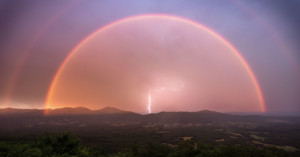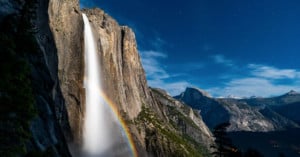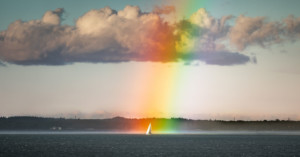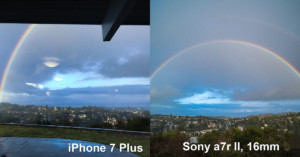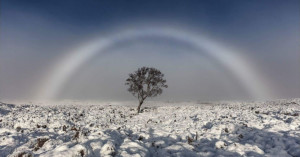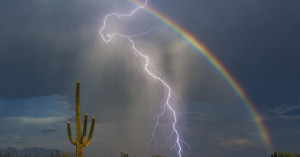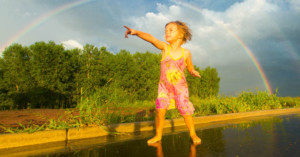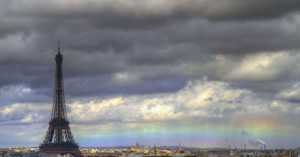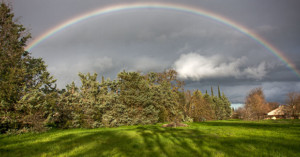
Photographer Bertrand Kulik was standing at his window in Paris last week when he noticed something peculiar about the horizon. Although his view is ordinarily quite beautiful because of the Eiffel Tower dominating the cityscape, this time it had something he was treated with a bright and colorful horizon rainbow painted across the sky in the distance.
Read more…

The colors you see in these photographs are real — they’re not simply landscapes modified using Photoshop. They’re photographs of tulip fields captured by French photographer Normann Szkop from the air.
Read more…
Programmer and photography enthusiast Roderick Lee Mann snagged quite the time-lapse video earlier this week. He had originally set up his camera to snap photos of a beautiful Hawaiian sunset, but afterward he discovered that he had captured something that you can’t really plan for: the perfectly-framed formation of an end-to-end rainbow.
Read more…

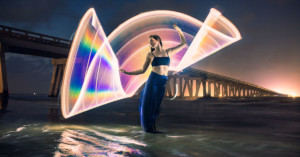
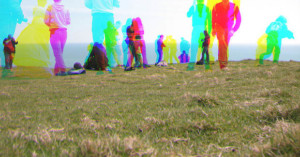
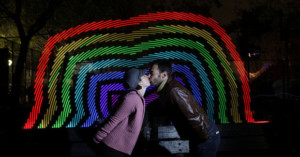
Looking for a photo project to play around with this weekend? Try exploring a technique known as the Harris Shutter. Invented in the days of film photography by Robert Harris of Kodak, it involves capturing three sequential exposures of a scene through red, green, and blue filters, and then stacking the images into a single frame. This causes all the static elements within the scene to appear as they ordinarily would in a color photo, while all the moving elements in the shot show up in one of the three RGB colors.
Read more…

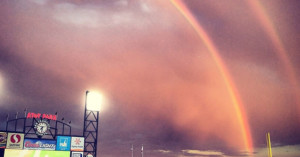
San Francisco residents were treated with a dazzling sight yesterday: a double rainbow all the way across the sky, visible from many parts of the city. The San Francisco Chronicle writes,
The mist mixed with golden light from the low-slung sun to cast a beautiful pink glaze across downtown skyscrapers. Thousands at the Giants baseball game took their eyes away from the game to gawk at a double rainbow that formed over center field, perfectly framed by the grandstands. “There was just some very light rain at the game, but it was amazing to see so many people bringing out their iPhones and taking a picture of it,” said Mike Pechner, a forecaster with Golden West Meteorology who was at the game. Dozens of motorists pulled their cars to the side of the road to gawk and take pictures of the rare double-rainbow, created when the light refracted through the moisture in the air.
Read more…

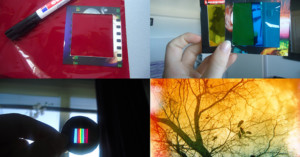
Want to add some custom tints to your photos without resorting to digital trickery? dainy over at Lomography has a tutorial on how you can create a simple color filter using some cardboard and colored transparency sheets. Combining thin strips of various colors can lead to pretty artsy effects.
Make Your Own Color Filter! [Lomography]

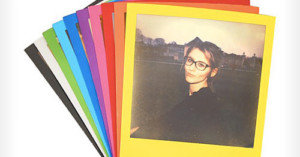
The Impossible Project has partnered up with Japanese music producer and designer Nigo for a limited edition version of its PX 70 Color Shade Film. Instead of its traditional white frames or the newer black frames, the film comes in 10 different colors: yellow, orange, red, pink, lilac, dark blue, light blue, green, black and white. Each pack comes with eight frames with randomly selected colors and costs $25 over at The Impossible Project shop.
PX 70 Color Shade by Nigo Film Edition [Impossible Project]

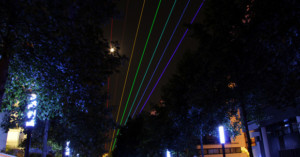
“Global Rainbow” is an outdoor art installation by Yvette Mattern that consists of seven high powered lasers projecting a bright rainbow across the night sky. The rainbow was originally displayed in New York in 2009, but has since appeared in cities across the UK. If you’re lucky enough to see the project in real life, be sure to take some photographs — it’s not every day you get to enjoy rainbows at night.
Read more…

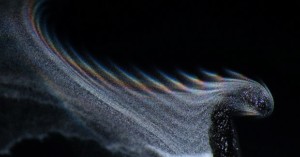
Photographer Grover Schrayer captured this amazing photograph of a rainbow in candle smoke.
I shot it with my Fuji Finepix S8100fd, with a Raynox M-250 macro lens attached. I shot at 1/1000th or higher, using the camera’s built-in flash. The built -in flash gave me head-on illumination of the smoke, and that head-on lighting allowed me to pick up the refraction through the droplets of wax. Any other angle of illumination would not produce the rainbow effect. The hardest part was getting the camera to focus on just the right part of the smoke. I focused on the wick, or the edge of the flame, had the shutter button half-pressed and ready, and blew out the candle and snapped very quickly. Most of the time the results were less than spectacular, but when the smoke and the timing cooperated, I got shots like this…
Here’s another shot using the same technique.
(via Photojojo)
Image credit: Rainbow Fringe… by Grover Schrayer and used with permission

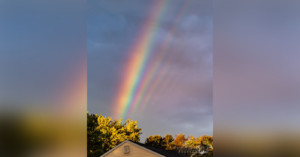
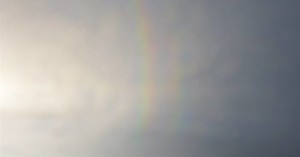
Seeing a double rainbow is a relatively rare treat, but how about three or four rainbows? Scientists have only reported seeing triple rainbows five times over the past 250 years, but German photographer Michael Theusner was recently able to capture this first ever photograph of a fourth-order rainbow. Ordinary rainbows (first and second order) appear in the area of the sky opposite the sun (and aren’t seen in his shot), but when higher order rainbows appear, they show up on the sunward side.
Last year, U.S. Naval Academy meteorologist Raymond Lee and a colleague, Philip Laven, laid out a prediction for the conditions that would produce third-order rainbows, and they challenged rainbow-chasers to go out and find one. Among the requirements: dark thunderclouds, and either a heavy downpour or a rainstorm with nearly uniform rain droplets. If the sun broke through the clouds under these conditions, it could project a dim tertiary rainbow against the dark clouds nearby, they said. [#]
Back in May, a photographer named Michael Grossman followed this advice and succeeded in capturing the first ever photo of a third-order rainbow. Lee’s challenge and Grossman’s success are what inspired Theusner to try his hand at photographing higher order rainbows. You can find more background info on Theusner’s blog and in his recently published scientific paper.
Whoa! It’s a quadruple rainbow! [MSNBC]
P.S. Capturing all four rainbows in one shot is exceedingly difficult and hasn’t been done yet. Now there’s a challenge for those of you looking for a difficult photo assignment.
Image credits: Photograph by Michael Theusner/Applied Optics