Posts Tagged ‘quality’

The Print Quality Across Various Editions of “American Photographs”

The Print Quality Across Various Editions of American Photographs printquality

Walker Evans’ famous photo book “American Photographs” was first published in 1938. Since then, the book has been released in new editions every 25 years or so. Although the photos contained within its covers have remained the same, the processes and technologies used to print the photos have evolved over time, causing each edition to be every so slightly different from the others.

Read more…

Cameras in Phones Are Now Better Than Compact Cameras from 5 Years Ago

Cameras in Phones Are Now Better Than Compact Cameras from 5 Years Ago compare

A few weeks ago, we casually remarked that the best cameraphones today can probably snap better photos than top-of-the-line compact cameras from over a decade ago. Turns out that it’s true.
Read more…

Check Out These Full-Res Sample Photos Shot Using the New iPhone 5

Check Out These Full Res Sample Photos Shot Using the New iPhone 5 photo full 1

Earlier today, Apple announced its new iPhone 5, which features a camera that’s nearly identical to the one found in the 4S. Soon after the announcement, Apple put up the official product page for the phone, which includes a gallery of sample photographs shot using the iPhone 5. Unfortunately, none of the shots show low-light environments, which would have allowed us to gawk at the power of the camera’s new and improved noise-killing processor. For now, we’ll just have to settle for these generic shots showing what the 3264×2448 images look like when they pop out of the camera.
Read more…

Leaked Sample Shots Show the High ISO Performance of the Sony A99

Leaked Sample Shots Show the High ISO Performance of the Sony A99 a99test

A user over on the Chinese forum Xitek has leaked the first sample photographs captured using the Sony A99, the company’s upcoming flagship SLT (i.e. pellicle mirror) camera. The images are 100% crops of straight-out-of-camera JPEGs, with noise reduction completely turned off.
Read more…

40MP Shootout: Nokia 808 PureView vs Pentax 645D

40MP Shootout: Nokia 808 PureView vs Pentax 645D compare mini

Nokia’s 808 PureView phone packs a hefty 41-megapixel sensor, but how do its megapixels compare to a “real” 40+ megapixel camera photo? Spanish website Quesabesde decided to find out by putting the phone head-to-head with the 40MP Pentax 645D medium format DSLR. They shot the same scenes with both cameras, and blew them up to examine the quality. The article is in Spanish, but a little Google Translate magic does the trick.

Nokia 808 and Pentax 645D PureView: 40 megapixel face to face (via TOP)

This Is Why You Shouldn’t Buy a Cheap UV Filter for Your Lens

This Is Why You Shouldnt Buy a Cheap UV Filter for Your Lens filtercompare mini

UV lens filters are a popular way to protect the front element of lenses from damage, but you should make sure you invest in a high-quality one unless you want to make a huge sacrifice in image quality. Reddit user EvilDoesIt shot the photos above comparing a cheap filter with a pricier one:

The top one is a $20 Quantaray UV filter. Bottom is a ~$70 B+W MRC UV filter. This is a more extreme example, but it shows the difference between a nice filter and a crappy cheap one. Both these shots are unedited JPEGs from my Nikon D7k with a Nikkor 17-55 ƒ/2.8 @ 1.3s ISO100.

I do realize that the top pic can be easily fixed by adjusting levels, but in my opinion, it’s always better to get the best picture you can get out of your camera before editing. [#]

His last sentence is a gem: to achieve the best images, you want to make sure you’re squeezing out the best image quality you can from each step along the way.


Image credit: Photographs by EvilDoesIt and used with permission

DxOMark: Canon 5D Mark III Sensor Best Among Canons, Falls Short of Nikon

DxOMark: Canon 5D Mark III Sensor Best Among Canons, Falls Short of Nikon canon5dmark3dxo mini

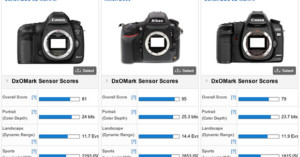
Camera rating business DxOMark has published its in-depth sensor review for the Canon 5D Mark III. For Canon fans, there’s both good and bad news: while the camera boasts the best sensor seen in a Canon DSLR so far — besting the sensor found in the 1Ds Mark III — its score of 81 is far below the Nikon D800′s 95. DxOMark does, however, point out that the two cameras focus on different strengths:

The duel between the Nikon D800 and the EOS 5D Mark III would most certainly take place except that the different sensors each one has adopted makes it difficult to do a head-to-head comparison. Both sensors offer different advantages —in principle, sensitivity for the Canon and definition for the Nikon. With its 36 megapixels, the Nikon D800 clearly has concentrated its efforts on fine detail reproduction.

For its part, the Canon EOS 5D Mark III chose to make a grand compromise: with its 22 megapixels, it offers both higher definition and in theory, higher sensitivity.

Canon 5D Mark III Review [DxOMark]

Nikon D800 Receives the Highest Sensor Score Ever Given by DxOMark

Nikon D800 Receives the Highest Sensor Score Ever Given by DxOMark d800 mini

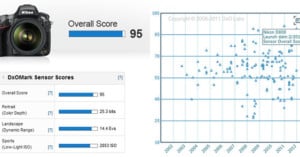
Turns out the 36.3 megapixel sensor inside the new Nikon D800 isn’t just a megapixel war marketing tactic: the sensor has been given the highest score ever awarded by camera equipment rating service DxOMark. Calling it a “complete success in every sensor-related respect”, the lab states that the D800′s sensor has become the new sensor of reference by which all other camera sensors will be measured. Furthermore, it boasts an “unmatched quality-to-price ratio” by being the cheapest (by far) among the 8 top cameras. The sensor is even comparable in quality to the best medium-format sensors out there, and even outperforms them at higher ISOs. Check out the full review for a more detailed analysis of the sensor and how the D800 stacks up against competition.

Nikon D800: The best sensor analyzed on DxOMark! [DxOMark]

Untouched Sample Shots Captured with Nokia’s New 41MP Camera Phone

Untouched Sample Shots Captured with Nokias New 41MP Camera Phone sample1 mini

Nokia has released a set of sample photographs in order to show off the camera quality of its new 41MP 808 PureView camera phone. The 33.3MB ZIP file contains just 3 untouched JPEG images — the largest of which (seen above) is a 5368×7152, 38-megapixel photograph that weighs in at 10.3MB. The quality is quite impressive, given that the images were captured with a phone.
Read more…

Exposing to the Right May Not Be as Right as Sensors Improve

Exposing to the Right May Not Be as Right as Sensors Improve exposeright mini

Exposing to the right” is a well-known rule of thumb for maximizing image quality by pushing exposure to avoid noise, but the equation is changing as the quality of image sensors continues to improve. Ctein over at The Online Photographer writes,

In theory, you can still use the dubious right-hand rule. Just be careful to never blow out any pixels.

[...] Unless you’re sure you’re dealing with a low contrast subject, pushing your exposure to the high side makes it likely you’ll blow highlights. If you’re trying to improve your odds of getting a good exposure, pulling away from the right is a much smarter thing to do. If you know your subject is really high in contrast, pull far, far away from the right. Keep those highlights under control and let the shadows go where they may.

[...] Just, whatever you do, don’t expose to the right unless you’re absolutely positive there are no highlights to get blown. It was a questionable rule to begin with; these days I call it downright dangerous.

‘Expose to the Right’ is a Bunch of Bull [The Online Photographer]


Image credit: Out and about again by c@rljones